SI
SI
discoversearch

We've detected that you're using an ad content blocking browser plug-in or feature. Ads provide a critical source of revenue to the continued operation of Silicon Investor.  We ask that you disable ad blocking while on Silicon Investor in the best interests of our community.  If you are not using an ad blocker but are still receiving this message, make sure your browser's tracking protection is set to the 'standard' level.
Politics : How Quickly Can Obama Totally Destroy the US? -- Ignore unavailable to you. Want to Upgrade?


To: Honey_Bee who wrote (1717)3/3/2013 11:41:23 PM
From: joseffy3 Recommendations  Respond to of 16547


To: Honey_Bee who wrote (1717)3/6/2013 3:02:27 PM
From: joseffy2 Recommendations  Respond to of 16547
 
Leaked email adds fuel to claims White House playing politics over impact of cuts

March 06, 2013 FoxNews.com


A leaked email from an Agriculture Department field officer adds fuel to claims President Obama's political strategy is to make the billions in recent federal budget cuts as painful as possible to win the public opinion battle against Republicans.

The email, circulated around Capitol Hill, was sent Monday by Charles Brown, a director at the agency’s Animal and Plant Health Inspection Service office in Raleigh, N.C. He appears to tell his regional team about a response to his recent question on the amount of latitude he has in making cuts.

According to the partially redacted email, the response came from the Agriculture Department’s budget office and in part states: “However you manage that reduction, you need to make sure you are not contradicting what we said the impact would be.”

The response noted that the administration had already told Congress that the APHIS would “eliminate assistance to producers in 24 states in managing wildlife damage to the aquaculture industry” without additional funds.

Arkansas Republican Rep. Tim Griffin said the administration’s response to Brown’s email shows a bid to undermine efforts to replace the cuts, known as sequester, with less onerous ones.

“This email confirms what many Americans have suspected: The Obama administration is doing everything they can to make sure their worst predictions come true and to maximize the pain of the sequester cuts for political gain,” Griffin said in a statement.

Griffin told Fox News on Wednesday that the bosses effectively said, “You can’t do anything that is inconsistent with the negative impact that we’ve told everybody these cuts are going to have.”

An Agriculture Department spokesperson told Fox on Wednesday that the email "has been completely taken out of context. The spokesperson said it references "cuts and impacts communicated to Congress as part of the FY2013 budget, not as part of a sequester plan."

Under the 2011 deal reached by Obama and Congress, the cuts are supposed to be across the board, meaning government officials have limited flexibility in moving around money.

The administration in recent weeks has made doomsday predictions about the impact of the cuts. And the White House so far has appeared unwilling to accept a Republican offer to give the president more autonomy in making the cuts, covering $85 billion this fiscal year, to help reduce the impact on some of the most essential or hardest-hit programs or agencies.

Some political strategists say the president hopes the cuts hurt enough to compel Republican lawmakers seeking re-election next year to end them by agreeing to more tax increases.

On Sunday, Gene Sperling, the White House’s top economic adviser, suggested Republicans would indeed make this decision.

“Our hope is, as more Republicans start to see this pain in their own districts, they will choose bipartisan compromise over this absolutist position,” he said.

Agriculture Secretary Tom Vilsack, during a House hearing Tuesday, was asked by South Dakota Republican Rep. Kristi Noem about the Brown email.

Vilsack said he was unaware of the email, but denied the administration has a policy of being inflexible and maximizing the cuts’ impact.

“I wouldn’t say that we’ve said no to flexibility,” Vilsack said. “But there are certain circumstances where we don’t have flexibility.”

“I’m hopeful that isn’t an agenda that has been put forward," Noem said.


Read more: foxnews.com


A leaked email from an Agriculture Department field officer adds fuel to claims President Obama's political strategy is to make the billions in recent federal budget cuts as painful as possible to win the public opinion battle against Republicans.

The email, circulated around Capitol Hill, was sent Monday by Charles Brown, a director at the agency’s Animal and Plant Health Inspection Service office in Raleigh, N.C. He appears to tell his regional team about a response to his recent question on the amount of latitude he has in making cuts.

According to the partially redacted email, the response came from the Agriculture Department’s budget office and in part states: “However you manage that reduction, you need to make sure you are not contradicting what we said the impact would be.”

The response noted that the administration had already told Congress that the APHIS would “eliminate assistance to producers in 24 states in managing wildlife damage to the aquaculture industry” without additional funds.

Arkansas Republican Rep. Tim Griffin said the administration’s response to Brown’s email shows a bid to undermine efforts to replace the cuts, known as sequester, with less onerous ones.

“This email confirms what many Americans have suspected: The Obama administration is doing everything they can to make sure their worst predictions come true and to maximize the pain of the sequester cuts for political gain,” Griffin said in a statement.

Griffin told Fox News on Wednesday that the bosses effectively said, “You can’t do anything that is inconsistent with the negative impact that we’ve told everybody these cuts are going to have.”

An Agriculture Department spokesperson told Fox on Wednesday that the email "has been completely taken out of context. The spokesperson said it references "cuts and impacts communicated to Congress as part of the FY2013 budget, not as part of a sequester plan."

Under the 2011 deal reached by Obama and Congress, the cuts are supposed to be across the board, meaning government officials have limited flexibility in moving around money.

The administration in recent weeks has made doomsday predictions about the impact of the cuts. And the White House so far has appeared unwilling to accept a Republican offer to give the president more autonomy in making the cuts, covering $85 billion this fiscal year, to help reduce the impact on some of the most essential or hardest-hit programs or agencies.

Some political strategists say the president hopes the cuts hurt enough to compel Republican lawmakers seeking re-election next year to end them by agreeing to more tax increases.

On Sunday, Gene Sperling, the White House’s top economic adviser, suggested Republicans would indeed make this decision.

“Our hope is, as more Republicans start to see this pain in their own districts, they will choose bipartisan compromise over this absolutist position,” he said.

Agriculture Secretary Tom Vilsack, during a House hearing Tuesday, was asked by South Dakota Republican Rep. Kristi Noem about the Brown email.

Vilsack said he was unaware of the email, but denied the administration has a policy of being inflexible and maximizing the cuts’ impact.

“I wouldn’t say that we’ve said no to flexibility,” Vilsack said. “But there are certain circumstances where we don’t have flexibility.”

“I’m hopeful that isn’t an agenda that has been put forward," Noem said.


Read more: foxnews.com


To: Honey_Bee who wrote (1717)3/10/2013 11:13:06 AM
From: joseffy1 Recommendation  Respond to of 16547
 
Rory Cohen: Tracking Muslim Brotherhood's 'Grand Deception'

by Rory Cohen Orange County Register December 3, 2012
investigativeproject.org

A new documentary film, " The Grand Deception, delves into the subversive culture of muslim brotherhood in the United States, bringing to light footage of radical Islamists masquerading as moderate Muslims, who call for violent jihad against the United States and its allies.

"While working at CNN as a correspondent in 1992, I had been sent to Oklahoma City, and I just happened to pass by the Oklahoma City Convention Center, where I witnessed thousands of people coming out dressed in Middle Eastern garb. I went inside and found out it was a radical Islamist conference with calls to kill the Jews and attack America," Steve Emerson, the film's producer and an award-winning journalist, said in an interview, explaining that the event prompted him to create a documentary called "Jihad in America" to research the subject. "If I looked good, it was only because others in the business were not doing their job."

In many ways, they still aren't.

Take, for instance, the invocation given by Siraj Wahhaj, one of the Brotherhood's celebrated imams. He was the first Muslim clergyman to give an invocation before Congress in the early 1990s. Yet days following that humble speech, Wahhaj, touted as a moderate, was caught on tape at a Brooklyn mosque where he said, "You know what this country is? It's a garbage can... It's filthy." He prayed that America would "crumble" and be replaced by Islam.

One would think this would be the end of his political career. Yet he made an appearance this summer at the Democratic National Convention for "Jumah" prayers.

Ironically, a Catholic cardinal's request to deliver a prayer at this same event was turned down.


Emerson's film delves not into spiritual leaders who spew anti-American ideas it also documents leaders within mainstream Muslim groups, such as the Council on American Islamic Relations, who have helped to finance terrorism.
Influence at many mainstream mosques and Muslim organizations, from the Islamic Circle of North America to the Muslim Students Association, is not necessarily a moderate one as is portrayed. These groups were described in a declassified Muslim Brotherhood as capable of helping teach Muslims "that their work in America is a kind of grand jihad in eliminating and destroying the Western civilization from within and 'sabotaging' its miserable house by their hands ... so that ... God's religion [Islam] is made victorious over all other religions."

The MSA, in particular, has gotten better at masking some elements of radicalism, but audio unearthed by the Investigative Project on Terror presents a different picture.

"Osama bin Laden I don't know this guy," Amir Mertaban, the president of MSA West, said during a 2007 speech entitled "Methods of Da'wah" and cited in the documentary. "I don't know what he did. I don't know what he said. I don't know what happened. But we defend Muslim brothers, and we defend our Muslim sisters to the end. Is that clear?"

While not part of the movie, the DVD's archive material details, perhaps the most notable and shocking case concerning an MSA member is that of Hasan Akbar, an American Muslim extremist who attended the MSA-controlled student mosque at UC Davis. After college, Akbar joined the U.S. Army and, in the early hours of March 23, 2003, he detonated a grenade amidst sleeping members of his 1st Brigade, 101st Airborne Division, stationed in Kuwait killing two soldiers and wounding 15.

One of the most troubling cases presented in the documentary is against Muslim Brotherhood figure Abdurahman Alamoudi. An FBI wiretap caught him stating that al-Qaida should have killed more Americans in the African embassy bombings in 1998. An Islamic adviser to President Bill Clinton, Alamoudi publicly denounced terrorism while he secretly raised funds for al-Qaida. "We are against all forms of terrorism," he said publicly. Years after he successfully infiltrated the government at the highest level, the FBI caught on.

The film is based on primary source materials and interviews with recognized experts, such as Lafif Lakhdar, who fought for the Islamists as an Algerian revolutionary and is now a vocal critic of the Muslim Brotherhood and Islamism.
Former FBI officials interviewed in the documentary refer to the Islamists network as insidious a "Trojan horse."

The film takes 70 minutes to demonstrate how far the Muslim Brotherhood has reached within our own political fabric in less than three decades. It is a must-see.


To: Honey_Bee who wrote (1717)3/10/2013 11:13:55 AM
From: joseffy1 Recommendation  Respond to of 16547
 
Conquest through proselytizing

A new documentary says Muslim Brotherhood networks wish to turn the US into an Islamic state.

by Yaakov Lappin February 15, 2013
investigativeproject.org
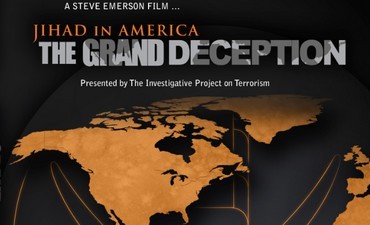

The Grand Deception Photo: Courtesy

A new documentary exposing an extensive Muslim Brotherhood network in the United States and systematic attempts by members to disguise its existence has been released.

Jihad in America: The Grand Deception shines a spotlight on an area that traditional media outlets have been fearful of exploring, filmmaker Steve Emerson, an investigative journalist and terrorism expert, told The Jerusalem Post this week.

The focus of the film is the shadowy world of Muslim Brotherhood front groups that market themselves as religious civil liberty organizations but are guided by a covert agenda of gradually converting the US into an Islamic country.

The movie features secret recordings of closed-door speeches by a number of Islamist figures in the US. The recordings include shocking messages expressing the speakers' desire to Islamize the US and change its constitution to Shari'a (Islamic law).

It also contains plethora of declassified FBI documents from investigations targeting Muslim Brotherhood and Hamas members.

"Conquest through da'wa [propagating Islamist ideology], proselytizing, that's what we hope for. We will conquer Europe. We will conquer America. Not through sword, but through da'wa," leading Qatar-based Muslim Brotherhood cleric Sheikh Yussuf Qaradawi is recorded as saying during a speech in Ohio.

"It's a stealth jihad. They're using our values in a manner that's very legal," Emerson says of the groups he investigated. "Their real agenda is stated behind closed doors: To transform the US into a part of the caliphate and to make this a Muslim country."

Emerson stresses that the movie "is not about Islam the faith. We're talking about political Islamism, the Muslim Brotherhood.
That's not to be conflated with Islam in general or all Muslims."

Emerson adds that Muslim Brotherhood leaders based in America "know how to use our systems of laws for their purpose. They openly talk about twisting the system because we're such a tolerant country."
The film documents the start of the Muslim Brotherhood in 1920s Egypt, its clash with the Egyptian state, its move to Saudi Arabia and subsequent spread around the world, with a focus on the US.
It features several well-informed and captivating sources on the movement, such as Nathan Garrett, a former FBI agent and federal prosecutor who investigated the Muslim Brotherhood over several years.
"The Muslim Brotherhood is an international movement, the goal of which is to create an Islamic state universally, all over the world.

The Muslim Brotherhood operates in various countries around the world and, as we learned in the course of our investigation and our work, the United States was one of those," Garrett says on camera.
Kamal Helbawy, a Western Muslim Brotherhood leader, is the only member of the movement who agreed to be interviewed.

"I give him credit for appearing," Emerson says. "He tried to believe no one ever had tapes from behind closed doors. Again, that's the major shock in watching this film the juxtaposition of what these groups say in public and in private."

The Muslim Brotherhood's US infrastructure has links to its counterpart in Egypt,
Emerson says. "They have a joint agenda, and that increases their leverage on the White House," he adds.

Egyptian scholar and Muslim Brotherhood expert Mamoun Fandy, who appears in the movie, tells viewers, "The Muslim Brotherhood had twin strategies.
The first strategy is its public face, which is a political organization, with charitable organizations… But the core of the organization and the master plan of the organization is a sense of world domination. Their ambition is limitless."

Emerson says it is not the job of law enforcement to tackle the challenge, but rather that of the media and non-governmental organizations.
"The FBI's role is not to serve as a lie-detector test. It's to stop criminal plots, or solve them. You don't go to jail for lying to the American public.

It's up to the media and nonprofits, just as they outed David Duke and the KKK and delegitimized them. But unfortunately, the [Muslim Brotherhood] groups have been able to co-opt the media or engage them as ideological collaborators by pretending to serve as religious civil rights groups when they are, in fact, anything but," says Emerson.

Islamist groups use the threat of labeling those who challenge them as Islamophobic with devastating efficiency, he adds.
They have also been able to deceive law enforcement, local and federal government and even Hollywood directors, Emerson argues. His film backs up these charges with hard evidence.
Asked how he was able to penetrate the groups he investigated, Emerson says, "I've been very fortunate to achieve this capability of acquiring information. I can't get into specifics I can't endanger them [the inside sources]. They're more likely to come to me if they're ideologically predisposed than to the FBI, because they know I will not force them to testify."

Ex-Islamist militant Abdur-Rahman Muhammad says in the film, "There's some good people in these organizations. And a lot of them, themselves, don't even know the inner workings of the Brotherhood. But you have to know the personalities who founded these things. You have to look at what they were calling themselves before they changed the name. You have to follow the paper trail."

The film includes a 90-second clip featuring a 2010 House Judiciary Committee in which US Attorney-General Eric Holder refused to name radical Islam as the common factor behind the previous 20 attacks on the United States.

Emerson says it is a "stunning piece of video," adding, "In the same way, you have the Department of Homeland Security appointing members of the Muslim Brotherhood and issuing alerts that there's no common denominator behind the attacks."

Asked why none of the groups featured in the film responded to the movie, Emerson says that after realizing that their speeches had been recorded, "They knew they couldn't win."

