This is from the NASA website. I think I would believe them
Would that be Jim Hansen's NASA, or Gavin Schmidt's NASA, or a different one?
Piecing together the temperature puzzle Each year, scientists at NASA'S Goddard Institute for Space Studies analyze global temperature data. The past year, 2009, tied as the second warmest year since global instrumental temperature records began 130 years ago. Worldwide, the mean temperature was 0.57°C (1.03°F) warmer than the 1951-1980 base period. And January 2000 to December 2009 came out as the warmest decade on record.
Take a look below at NASA's collection of videos, articles and imagery designed to help tell the story of our warming world.
Download captioned version Download HD version Other video formats http://climate.nasa.gov/warming_world/
-
Global warming on Mars, ice caps melting
Link to this page
The skeptic argument...
Mars is warming
"Some people think that our planet is suffering from a fever. Now scientists are telling us that Mars is experiencing its own planetary warming: Martian warming. It seems scientists have noticed recently that quite a few planets in our solar system seem to be heating up a bit, including Pluto.
NASA says the Martian South Pole’s “ice cap” has been shrinking for three summers in a row. Maybe Mars got its fever from earth. If so, I guess Jupiter’s caught the same cold, because it’s warming up too, like Pluto." ( Fred Thompson).
What the science says... | Select a level... |  Basic Basic | |  Intermediate Intermediate | | | | Martian climate is primarily driven by dust and albedo and there is little empirical evidence that Mars is showing long term warming. | The primary empirical evidence for long term, global warming on Mars comes from Fenton 2007. Fenton compared a composite snapshot of Mars from 1977 taken by the Viking spacecraft to a 1999 image compiled by the Mars Global Surveyor (referencing work from Geissler 2005). The 1977 snapshot showed a brighter planet. In 1999, the planet had a lower albedo, with prominent darker regions in the southern mid and high latitudes. Using the albedo changes in a general circulation model, Fenton calculated a 22 year global warming trend of 0.65°C.

Figure 1: Snapshots of Mars 1977 (top) and 1999 (bottom). Image courtesy of Geissler 2005.
Fenton attributed the warming to surface dust causing a change in the planet's albedo. Martian dust plays a major role in the planet's climate ( Kahn 1992). Solar variations are not the main driver of Martian climate. Nevertheless, an important question remains: is the interpretation of long term global warming on Mars correct?
A broader view of Martian climate change To put these results in proper perspective, an understanding of what drives Martian climate is required. Global dust storms increase the surface albedo by settling brighter dust on dark surfaces. Within a year after a dust storm, various wind systems remove the dust and Mars returns to a normal, lower albedo.
The 1977 snapshot was taken after a global dust storm had deposited dust over the southern latitudes, lightening the planet surface. Before the storm, the planet had albedo comparable to recent measurements ( Szwast 2006).
Fenton drew conclusions about long term climate by comparing two end points. This led to the classic error of mistaking weather for climate (similar to the recent global cooling argument). When you look at the broader data, there is no discernable long term trend in albedo:
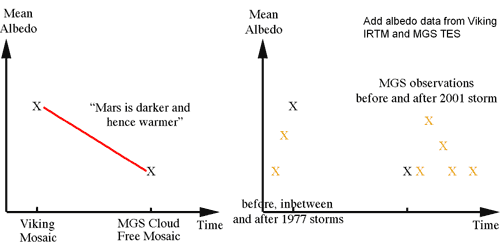
Figure 2: Comparison of data sampling by Fenton 2007 (left, comparing 2 end points) and the full sample of data (courtesy Mark Richardson).
The apparent long-term warming between the 1970's and 1990's is largely a consequence of the timing of the two snapshots used. The "brighter" 1977 snapshot was immediately after a global dust storm when the planet was temporarily lighter. The "darker" 1999 snapshot was of the planet in it's usual state. There is little evidence that Mars is undergoing decadal-scale, long term global warming. In fact, following the 2001 global dust storm, the southern hemisphere was brighter than in 1977 ( Szwast 2006).
Conclusion The empirical evidence isn't conclusive on whether global warming is happening on Mars. However, to answer the question on whether the sun is causing Earth's global warming, there is plentiful data on solar activity and Earth's climate. Many papers have examined this data, concluding the correlation between sun and climate ended in the 70's when the modern global warming trend began.
So the argument that Martian warming disproves anthropogenic global warming fails on two points - there is little empirical evidence that Mars is warming and Mars' climate is primarily driven by dust and albedo, not solar variations.
Last updated on 20 August 2010 by John Cook.
Printable Version | Offline PDF Version | Link to this page
Planet wide dust storm
A good example of how dust affects Mars climate: over 2007, Mars suffered a titanic dust storm that engulfed the entire planet. The dust storm contributed to a temporary warming effect around Mars, raising the temperature of the atmosphere by around 20-30°C. Interestingly, whereas the atmosphere of the planet heats up, the surface of the planet cools down because it receives much less solar heat.
skepticalscience.com
Here's where the warming is coming from

Figure 1: Net human and natural percent contributions to the observed global surface warming over the past 50-65 years according to Tett et al. 2000 (T00, dark blue), Meehl et al. 2004 (M04, red), Stone et al. 2007 (S07, green), Lean and Rind 2008 (LR08, purple), Huber and Knutti 2011 (HK11, light blue), and Gillett et al. 2012 (G12, orange). This has been added to the SkS Climate Graphics Page.
and here's where it's going

Land, atmosphere, and ice heating (red), 0-700 meter OHC increase (light blue), 700-2,000 meter OHC increase (dark blue). From Nuccitelli et al. (2012).
.
==
|



