There are no transitional fossils? There are many.
Now you don't even have to go to a museum, just google, and they range from fish to reptile from ape to modern man
en.wikipedia.org
List of transitional fossils
From Wikipedia, the free encyclopedia
Jump to: navigation, search
This is an incomplete list, which may never be able to satisfy particular standards for completeness. You can help by expanding it with reliably sourced entries.


Possibly the best known of all transitional fossils, the Berlin specimen of Archaeopteryx lithographica
This is a tentative list of transitional fossils (fossil remains of a creature that exhibits primitive traits in comparison with more derived organisms to which it is related). The fossils are listed in series, showing the transition from one group to another, representing significant steps in the evolution of major features in various lines. These changes often represent major changes in anatomy, related to mode of life, like the acquisition of feathered wings for an aerial lifestyle in birds, or legs in the fish/ tetrapod transition. As noted already by Darwin, the fossil record is incomplete. [1]
Ideally, this list would only recursively include 'true' transitionals, fossils representing ancestral species from which later groups evolved, but most if not all, of the fossils shown here represent extinct side branches, more or less closely related to the true ancestor. [2] They will all include details unique to their own line as well. Fossils having relatively few such traits are termed "transitional", while those with a host of traits found neither in the ancestral or derived group are called "intermediate". Since all species will always be subject to natural selection, the very term "transitional fossil" is essentially a misconception. It is however a commonly used term and a useful concept in evolutionary biology. The fossils listed represent significant steps in the evolution of major features in various lines and therefore fit the common usage of the phrase.
Nautiloids to ammonoids [ edit] The Nautiloids ? Ammonoids Evolutionary Series Appearance Taxa Relationships Status Description Image | >500 Ma | Subclass:
| | | |  | | 390 Ma | Order:
| - Member of the Nautiloids.
- Direct ancestor of the ammonoids.
| | | | | 370 Ma | Subclass:
| - Direct descendants of Bactirida.
| | |  | Cephalopods [ edit] The Cephalopod Evolutionary Series Appearance Taxa Relationships Status Description Image | 296 Ma | Genus
| | | The earliest described octopod. | | | 164 Ma | Genus:
| | | A primitive octopod. |  | | 165–164 Ma | Genus:
| | | An early Vampyromorphida. | 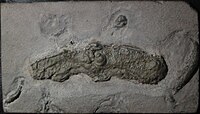 | | 89 - 71 Ma | Genus:
| | | A primitive octopod. |  | Evolution of insects [ edit] The Insect Evolutionary Series Appearance Taxa Relationships Status Description Image | 400 Ma | Genus:
| | | The world’s oldest known insect.
| | | 400 Ma | Genus:
| | | Early springtail.
| | | 300 Ma | Genus:
| | | Ancestral to cockroaches, mantids and termites.
| | | 316.5 Ma | Genus:
| | | A primitive cockroach.
| | | 140 Ma | Genus:
| | | The earliest known Lepidopteran.
| | | 92 Ma | Genus:
| | | The oldest known species of bee.
| | | 80 Ma | Genus:
| | | The earliest known species of ant.
| | | 56 - 34 Ma | Genus:
| | | First leaf insect from the fossil record. | | Evolution of spiders [ edit] The Spider Evolutionary Series Appearance Taxa Relationships Status Description Image | 390 Ma | Genus:
| | | Previously thought to be the world's oldest spider. | | | 165 Ma | Genus
| | | The oldest known haplogyne spider. | | Invertebrates to fish [ edit]
This list is incomplete; you can help by expanding it.
Chondrichthyes [ edit]
This list is incomplete; you can help by expanding it.
The Chondrichthyes Evolutionary Series Appearance Taxa Relationships Status Description Image | 370 Ma | Genus:
| | | An early primitive shark. |  | | 70 - 65 Ma | Genus:
| | | An early sawfish | | | 99 – 65 Ma | Genus:
| | | An early stingray-like skate. |  | Bony fish [ edit]
This list is incomplete; you can help by expanding it.
The Bony Fish Evolutionary Series Appearance Taxa Relationships Status Description Image | 420 Ma | Genus:
| | | The earliest-known Actinopterygiian.
| | | ??? Ma | Genus:
| | | An early relative of the flatfishes, one eye had already migrated towards the body midline. |  | | 48 – 37 Ma | Genus:
| | | The earliest known true flatfish | | | 183.7–125.0 Ma | Genus:
| | | One of the first teleosts. |  | | 99 – 93 Ma | Genus:
| | | The oldest known eel. | | | 13 Ma | Genus:
| | | One of the oldest known seahorses. |  | | 13 Ma | Genus:
| | | One of the oldest known seahorses. |  | | 83 - 70 Ma | Genus:
| | | The oldest known lamprid fish |  | | 56 - 34 Ma | Genus:
| | | A primitive sunfish | | | 58 - 55 Ma | Genus:
| | | The oldest known member of the catfish family Callichthyidae. |  | | 56 - 34 Ma | Genus:
| | | A primitive rabbitfish. | | | 48 - 37 Ma | Genus:
| | | A primitive perch |  | | 58 - 55 Ma | Genus:
| | | A primitive pomfret |  | | 48 - 40 Ma | Genus:
| | | An early handfish | | | 48 - 40 Ma | Genus:
| | | The oldest known ostraciid boxfish |  | | 48 - 40 Ma | Genus:
| | | The oldest known aracanid boxfish |  | | 48 - 40 Ma | Genus:
| | | A basal surgeonfish | | | 48 - 40 Ma | Genus:
| | | A primitive monodactylid moonyfish |  | | 48 - 40 Ma | Genus:
| | | A primitive monodactylid moonyfish |  | | 48 - 40 Ma | Genus:
| | | A short-snouted ancestor of the modern Moorish Idol. | | | 83 - 65 Ma | Genus:
| | | A primitive member of the Tetraodontidae | | | 83 - 65 Ma | Genus:
| | | A primitive Perciforme | | | 58 - 55 Ma | Genus:
| | | A primitive member of the Zeidae | | | 58 - 55 Ma | Genus:
| | | A primitive member of the Zeidae | | | ??? Ma | Genus:
| | | A primitive member of the Ichthyodectidae |  | | 65 Ma | Genus:
| | | A primitive tetraodontid | | Fish to tetrapods [ edit] The Fish ? Tetrapods Evolutionary Series Appearance Taxa Relationships Status Description Image | 416-359 Ma | Genus:
| An early member of the Tetrapodomorpha, the piscine line leading to tetrapods, Osteolepis is generalised enough to give a fair approximation of the common ancestor of tetrapods and lungfish. [6] | Fish | A small to medium sized sarcopterygian fish with internal nostrils and pectoral fins stiffened by bony components broadly homologous to the humerus and radius/ ulna found in tetrapods. [6] |  | | 385 Ma | Genus:
| Belonging to the family Tristichopteridae, a family that form a sister group to Panderichthys and the tetrapods. [6] | Though not on the evolutionary path to tetrapods, Eusthenopteron is of fairly general build and is very well known, serving as an iconic model organism in tetrapod evolution. [7] | A medium sized, mainly pelagic fish, Eusthenopteron mainly use the pectoral and pelvic fins for navigation, and the tail for propulsion. [7] The fin was of diphycercal, foreshadowing the straightening of the spine and the evolution of a contiguous fin in fish like Panderichthys |  | | 380 Ma | Genus:
| Very close to the origin of tetrapods, a "fishapod" elpistostegalian. [6] | Fish | A large, predatory shallow water fish. As common in shallow water fish, the pectoral and pelvic fins were flexible and paddle-like for propulsion. [8] The dorsal and anal fins are lost, the tail fin contiguous. [9] The spiracles were short and wide, indication large amount of oxygen were taken up by the lungs rather than through the gills. [10] |  | | 375 Ma | Genus:
| A " fishapod" more tetrapod-like than Panderichthys. [6] | A fish, transitional between fish and the early, fish-like labyrinthodonts. [11] [12] | "Fish" with stout, fleshy pectoral fins with a joint between the innermost and the two next bony elements, corresponding to the elbow in higher tetrapods. The cleithrum bone was free of the skull, functioning as anchoring for the pectoral fins, and at the same time allowing for movement of the neck. [12] [13] | 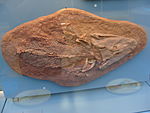 | | 368 Ma | Genus:
| Analysis of the cranial material shows it was more advanced than Tiktaalik, and together with Obruchevichthys form a sister group to the higher tetrapods. [14] | A fairly fragmentary find, Elginerpeton straddles the fish/tetrapod divide with a mosaic of features resembling ' Panderichthys, Ichthyostega and Hynerpeton. [14] Probably one of the " fishapods". [15] | Though fragmentary, the find includes a shoulder blade (Cleitrum bone) as well as elements of the limbs, which shows it had comparable limbs Ichthyostega and Hynerpeton, indicating feet rather than fins. |  | | 365 Ma | Genus:
| Known only from fragmentary remains, mostly a lower jaw, Ventastega is morphologically midway between Tiktaalik and Acanthostega/ Ichthyostega. [16] | Possibly oldest animal to have feet rather than fins. [16] | A large, dorso-ventrally flattened predatory fish with a well armoured labyrinthodont-like skull. While the fins themselves has not been found, the shoulder girdle is essentially similar to that of Acanthostega, indicating it too had feet rather than fins. [16] |  | | 365 Ma | Genus:
| | Together with Ichthyostega the sole early labyrinthodont known from fairly complete skeletons. It is the oldest animal known to have feet rather than fins, thus making it a true tetrapod and the oldest known unquestionable ichthyostegalian. [17] | First known animal with toes rather than fins. The feet were broad and paddle-like, adapted for movement in water. [18] It retained functional gills in adulthood, behind a fleshy operculum. |  | | 365 Ma | Genus:
| Fairly closely related to Acanthostega. It possibly represent an early (and ultimately unsuccessful) line adapted to moving on land by inchworm-like movements. | Together with Acanthostega the sole early labyrinthodont known from fairly complete skeletons. | Early labyrinthodont with polydactylous, paddle-like feet and reinforced vertebrae and neural spines. It probably spent time on land, yet retained gills and a tail with fin rayes. |  | | 360 Ma | Genus:
| While known only from fragmentary remains, it is more advanced than Ichthyostega. | Early labyrinthodont amphibian | A large, basically salamander-like creature. The shoulder girdle was powerful, indicating it was a competent walker. [19] |  | | ??? Ma | Genus:
| | An advanced ichthyostegalian, it straddle the divide between the fish-like Devonian forms and the more advanced Carboniferous amphibians. It has been suggested it is an early reptil-like amphibian. [20] | A large animal with paddle-like six-toed feet. It did however not have gills in adulthood, and is thus the oldest labyrinthodont known to depend entirely on breathing with its lungs. [21] | 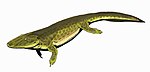 | | 359 - 345 Ma | Genus:
| Hailing from the fossil-poor Romer's Gap, Pederpes may be ancestral to the higher labyrinthodonts. | Intermediate between the earlier Ichthyostegalian and the later, more advanced labyrinthodonts. | Despite an extra toe on the forelimbs, Pederpes had limbs that terminated in feet adapted primarely for walking rather than paddles for combined swimming and walking like the earlier groups. [22] |  | | 295 Ma | Genus:
| The Temnospondyli are derived paleozoic amphibians, possibly ancestral to modern amphibians | A "classical" temnospondyl, an advanced labyrinthodont group. | One of the best known labyrinthodonts, Eryops combines the large, flat skull and short limbs typical of the group. |  | The Labyrinthodontia ? Lissamphibia Evolutionary Series Appearance Taxa Relationships Status Description Image | 290 Ma | Genus:
| Colloquially referred to as a "frogamander" due to this taxon being both chronologically and morphologically basal to both anurans and salamanders | One of the first transitional fossils towards modern amphibians ( Lissamphibia). [23] | Primitive traits - Backbone with intermediate characteristics
- Retains a fully developed tail
Derived traits
- Bears a large space for a tympanic ear
- Ankle bones are fused together like in salamanders
- Lightly built wide skull as in frogs [23]
| 
| | 250 Ma | Genus:
| Intermediate between generalized amphibians and derived frogs | Early "almost frog" transitional amphibian | Primitive traits - Possessed short limbs and therefore was unable to hop, unlike all extant anurans
- Retains fourteen vertebra unlike modern frogs who have four to nine vertebra
- Tibia and fibula are not fused into a tibiofibula
Derived traits
- Skull resembles that of modern anuran skull with a latticework of thin bones in skull
| 
| | 190 Ma | Genus:
| Another transitional form which could be properly classified as a frog | An intermediate form which may replace Triadobatrachus as the "ultimate" ancestor of anurans | Primitive traits - Still possess relatively short limbs
Derived traits
- Tail is greatly reduced
- Does not have greatly enlarged legs, but shows some adaptations for hopping, such as a three-pronged pelvis
|  | | 213-188 Ma | Genus:
| A derived fossil frog completing the series of transitional fossils between early amphibians and modern anurans | The oldest "true" frog [24] | Primitive traits - Retains ten presacral vertebra
Derived traits
- Hind legs are adapted for hopping
| 
| | 210 Ma | Genus:
| Intermediate between basal amphibians and caecilians | An early caecilian | Primitive traits - Bears three-toed vestigial limbs
- The size of the orbits indicates well developed eyes and suggest a non-subterranean lifestyle
Derived traits
- The body has been adapted to a sort of serpentine shape
| 
| Amphibians to amniotes (early reptiles) [ edit] The Amphibians ? Reptiles Evolutionary Series Appearance Taxa Relationships Status Description Image | 326 - 318 Ma | Genus:
| One of the early reptile-like amphibians | Amphibian | A large, somewhat lizard-like labyrinthodont with a deep skull, laterally placed eyes and five digits to each foot. |  | | ??? Ma | Genus:
| The order Diadectomorpha is the sister group of the amniotes. | The Limnoscelis was originally described as a " cotylosaur" (early reptiles) together with the other diadectomorphans. Today the large-bodied diadectomorphs are thought to have had a larval stage, falling close to, but just outside the amphibian/reptile divide. | A large, predatory reptile-like amphibian. The limbs are extremely heavily built, indicating it fed on slow moving prey. |  | | ??? Ma | Genus:
| Uncertain phylogeny, possibly a Seymouriamorph or Diadectomorph [25] [26] | Amphibian | A medium sized, probably herbivorious animal |  | | 350 Ma | Genus:
| Uncertain phylogenetic position. Westlothiana may be a small-bodied diadectopmorph, falling just outside the amphibian/reptile divide | Originally described as the first reptile, it is now considered an advanced reptile-like amphibian. | Small, probably insectovorious animal. The body and tail was long, the limbs small, somewhat like a modern skink. |  | | 320-305 Ma | Genus:
| Possibly allied to the Diadectomorpha, or belinging to a sister group to Diadectomorpha and Amniota [27] | Likely an amphibian [27] | Smallish, likely carnivorious. [28] |  | | 340 Ma | Genus:
| The fragmentary nature of the fossil (it lacks a cranium) makes an exact phylogenetic position hard to establish. | Possibly the first animal with an amniote egg, and thus the first reptile. | Small lizard-like animal, the first known tetrapod to possess claws, indicating it has reptilian type skin with scutes. [29] |  | | 315 Ma | Genus:
| One of several small, basal reptile genera | Reptile | An early anapsid reptile, considered to be ancestral to both the synapsid and sauropsid lines, and thus the oldest representative of the crown group amniotes. |  | | 312 - 304 Ma | Genus:
| One of several small, basal reptile genera | Reptile (most likely a sauropsid) | An early anapsid reptile. In phylogenetic analysis it falls on the sauropsid side, it is thus likely a progenitor of the diapsids |  | Turtles [ edit] The Turtle Evolutionary Series Appearance Taxa Relationships Status Description Image | 220 Ma | Genus:
| | | The oldest known turtle.
| 
| | 210 Ma | Genus:
| | | |  | | 164 Ma | Genus:
| | | An evolutionary bridge between early land turtles and sea turtles.
| | From lizards to snakes [ edit] The Lizard ? Snake Evolutionary Series Appearance Taxa Relationships Status Description Image | 92 Ma | Genus:
| | | A transitional form between Cretaceous lizards and limbless snakes retaining distinct, if non-functional, legs. [30] |  | | 90 Ma | Genus:
| | | A basal snake with two hind-limbs. | | Lizards [ edit]
This list is incomplete; you can help by expanding it.
Pterosaurs [ edit] Archosaurs to dinosaurs [ edit]

| This documentation needs attention from an expert in Dinosaurs. Please add a reason or a talk parameter to this template to explain the issue with the documentation. WikiProject Dinosaurs (or its Portal) may be able to help recruit an expert. (April 2010) |
This list is incomplete; you can help by expanding it.
The Archosauria ? Dinosauria Series Appearance Taxa Relationships Status Description Image | ??? Ma | Genus:
| | | The oldest known archosaur, Proterosuchus was one of the largest land reptile during the Early Triassic, about the size of to today's Komodo dragons. It looked somewhat crocodile-like, with sprawling legs, long jaws, powerful neck muscles and a long tail. A distinct proterosuchid trait is the peculiar hook-shaped mouth. | 
| | ??? Ma | Genus:
| | | |  | | ??? Ma | Genus:
| | The oldest known animal on the dinosaur/ pterosaur side of the archosaurian tree (the Ornithodira), dating to about 245 million years ago. [33] | A small, lightly built animal. It had a fairly long neck (contrary to the short necked relatives of crocodiles), but ran on all four legs. |  | | ??? Ma | Genus:
| | Known from a somewhat fragmentary find, Spondylosoma was possibly an early dinosaur, or near dinosaur. [34] It has however also been classified as a rauisuchian. [35] | | | | 228 Ma | Genus:
| | A very early representative of the sauropod stem line or perhaps even the Saurischia as a whole. [36] [37] [38] | A small (1 meter, ~ 10 kg) bipedal carnivore with numerous sharp teeth. It was a swift digigrade runner. The forelimbs were half the length of the hindlimbs and the hands had five fingers |  | Dinosauria [ edit]
| This documentation needs attention from an expert in Dinosaurs. Please add a reason or a talk parameter to this template to explain the issue with the documentation. WikiProject Dinosaurs (or its Portal) may be able to help recruit an expert. (June 2010) |
This list is incomplete; you can help by expanding it.
Dinosaurs to birds [ edit]
Further information: Origin of birds
Further information: Evolution of birds
The Dinosaurs ? birds Evolutionary Series Appearance Taxa Relationships Status Description Image | 152-151 Ma | Genus:
| | | Primitive traits - Undifferentiated hind digits displaying no specialties for climbing
- Spine attaches to the back end of the skull rather than the base
- Moderately long, bony tail
Derived traits
- Basic proto-feathers cover parts of the body for insulation
| 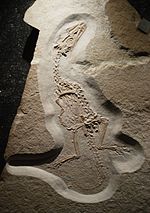 | | 168-152 Ma | Genus:
| | | The find is represented only by a hind leg, but one that is very bird-like. It belonged to a small maniraptoran dinosaur with long, pennaceous feathers on its hind legs and (in all likelihood) arms. | | | 161-151 Ma | Genus:
| Basal troodontid | Although once classified as a bird, Anchiornis is now considered a basal troodontid which bears pennaceous, symmetrical feathers on all four limbs. | Primitive traits - Wings symmetrical and rounded, probably not used for flight but instead insulation, mating displays, and gliding
- Long legs overall morphology similar to that of other troodontids
- Spine attaches to the back end of the skull rather than the base
- Moderately long, bony tail
Derived traits
- Flexible wrists which are more similar to aves than other theropods
- Like birds and unlike troodontids, Anchiornis had arms nearly the same length as the hind legs
- Bore primary and secondary pennaceous symmetrical wings on both arms, legs, toes, and wrist
|  | | 150–145 Ma | Genus:
| Known for its mosaic of avian and theropod characteristics Archaeopteryx is both the first primitive bird in the fossil record and one of the first transitional fossils discovered. | Traditionally seen as the first proper bird, though it is not directly ancestral to modern birds. [39] An excellent intermediate form between dinosaurs and birds. Capable of gliding, but lacking alula and keel, it could likely not sustain powered flight. | Primitive traits - Slower dinosaur-like growth rate
- No keel
- Spine attaches to the back end of the skull rather than the base
- Forelimbs have three unfused, clawed fingers, no alula
- Maxilla and premaxilla bore unserrated teeth
- Moderately long, bony tail
Derived traits
- Fully developed asymmetrical flight feathers
- Fused furcula from two joined clavicles
- Backward and elongated pubis similar to maniraptors, but not found in more primitive theropods
|  | | 120 Ma | Genus:
| Found in the famous Liaoning province Confuciusornis is the first primitive bird with a pygostyle. | With its short tail and toothless beak, Confuciusornis is very modern looking compared to Archaeopteryx. The toothless beak is however a case of convergent evolution, as more advanced birds retained teeth, illustration the sometimes confusing mosaic evolution of the dinosaur-bird transition. | Primitive traits - Retained unfused clawed digits, no alula
- Sideways-facing glenoid joint
Derived traits
- Short tail with fused vertebrae at the end ( pygostyle)
- Larger sternum with a low primitive keel
- Unlike other early birds Confuciusornis had a toothless beak
|  | | 115 Ma | Genus:
| Primitive bird and possibly a descendant of "urvogels" like Archaeopteryx. First bird to possess an alula. | | Plesiomophic traits - Two unfused, functional digits remain on second and third digit
Derived traits
- First digit bearing an alula rather than claw
| | | 93.5-75 Ma | Genus:
| Considered a close relative to the ancestor to modern birds | A flying bird found in several epochs in the late Cretaceous which still bore teeth, but in most respects very similar to Neornithes. | Primitive traits - Numerous sharp teeth in much of the beak
Derived traits
- Fused bones ( metacarpals) II & III of the hand
- Rigid ribcage with a well developed carina
- No functional claws on the hand
- Short childhood with distinct adult stage. [40]
|  | Bird evolution [ edit]
| This documentation needs attention from an expert in Birds. Please add a reason or a talk parameter to this template to explain the issue with the documentation. WikiProject Birds (or its Portal) may be able to help recruit an expert. (May 2010) |
This list is incomplete; you can help by expanding it.
The Bird Evolutionary Series Appearance Taxa Relationships Status Description Image | 60-58 Ma | Genus:
| | | The earliest-known Penguin.
|  | | ??? Ma | Genus:
| | | An early flamingo. | | | ??? Ma | Genus:
| | | An early gaviiform. | | | 55-48 Ma | Genus:
| | | An early psittacine. | | | ??? Ma | Genus:
| | | A basal falconiform. | | | 50 Ma | Genus:
| | | An early apodiform. | | Synapsid ("mammal-like reptiles") to mammals [ edit] The Synapsids ? Mammals Evolutionary Series Appearance Taxa Relationships Status Description Image | ??? Ma | Genus:
| | Known from very fragmentary finds, Protoclepsydrops may be the earlies synapsid (mammal-like reptile) | A low-slung, lizard-like animal of moderate size. | | | 306 Ma | Genus:
| | The oldest undisputed synapsid (mammal-like reptile) | Primitive traits - A relatively flat, reptile-like skull
- Typically reptilian sprawling gait
- Generally lizard-like proportions with a dorso-ventrally flattened body
Derived traits
|  | | 297 Ma | Genus: | A primitive member of the Sphenacodontidae, or possibly just outside the group. [41] [42] | A pelycosaur-grade synapsid | Derived traits - Two or three moderately large canine-like teeth about a third down the maxilla. [43]
- Dentary bone the largest element of the lower jaw [42]
- The skull deeper than in Archaeothyris
|  | | 265 Ma | Genus:
| An advanced member of the family Sphenacodontidae, from which the therapsids (advanced synapsids) evolved | A pelycosaur-grade synapsid. At up to 4 meters, Dimetrodon was one of the largest animals of its time. The distinct sail of the back makes it the most recognized synapsid known | Primitive traits
- Cold blooded metabolism dependent of external heat source (hence the "sail") [44]
- Sprawling gait
- No secondary palate
- No enlarged side teeth in the lower jaw
Derived traits
- Distinctly elongated 2nd and 3rd tooth on the maxilla, corresponding to the canine in mammals. The first canine generally longer than the second. [45]
- Skull deep and narrow
- Body overall deeper than in earlier forms
|  | | 267 Ma | Genus:
| | A primitive therapsid. About the size of a large dog, Biarmosuchus was a lightly built and likely fairly agile animal for its size. [46] | Primitive traits
Derived traits
- A single canine as the first tooth on the maxilla, all other maxillary teeth small
- Tendency for an enlarged caninelike tooth on the dentary
- Internal nostrils covered by a partial fleshy palate [48]
- Enlarged temporal opening giving more powerful bite
|  | | 248-245 Ma | Genus:
| | | |  | | 205 Ma | Genus:
| | | |  | | 125 Ma | Genus:
| | An early crown group mammal. | |  | Evolution of mammals [ edit] The Mammal Evolutionary Series Appearance Taxa Relationships Status Description Image | 100–104 Ma | Genus:
| | | The earliest known monotreme.
| | | 125 Ma | Genus:
| | | The oldest metatherian known.
|  | | ?? Ma | Genus:
| | | The earliest-known marsupial.
|  | | 164-165 Ma | Genus:
| | | The oldest known eutherian [49]
|  | | 63-50 Ma | Genus:
| | | The earliest known proboscidean.
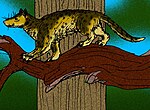
| | | 60-55 Ma | Genus:
| | | The possible ancestor of the modern order Carnivora.
|  | | 15.97–11.61 Ma | Genus:
| | | The earliest known cervid.
|  | | 20-18 Ma | Genus:
| | | The earliest known bovid.
|  | | 45-40 Ma | Genus:
| | | The oldest camel known, it was also the smallest.
| | | ??? Ma | Genus:
| | | Suspected to be the ancestor of modern tapirs and rhinoceroses.
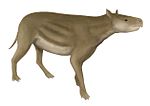
|  | | 55.4—48.6 Ma | Genus:
| | | Suspected to be the ancestor of modern tapirs.
|  | | 38—33.9 Ma | Genus:
| | | The earliest known canid.
|  | | ??? Ma | Genus:
| | | The earliest known lagomorph.
| | | 52.5 Ma | Genus:
| | | One of the two oldest known monospecific genera of bat.
| | | 2 Ma | Species:
| | | The earliest known member of the giant panda clade.
| | | 63 - 61.7Ma | Genus:
| | | Believed to be the earliest example of a primate or a proto-primate, a primatomorph precursor to the Plesiadapiformes. |  | | 12.5-8.5 Ma | Genus:
| | | This genus may have been the ancestor to the modern orangutans.
|  | | 16 - 8 Ma | Genus:
| | | An possible ancestor of living hippopotamids. | | | ?? Ma | Genus:
| | | The earliest known true (and scaled) pangolin. |  | Early artiodactylans to whales ( evolution of whales) [ edit] The whale Evolutionary Series Appearance Taxa Relationships Status Description Image | 55.8 ± 0.2 - 33.9 ± 0.1 Ma | Genus:
| | | |  | | 50 Ma | Genus:
| | | |  | | 46 Ma | Genus:
| | | |  | | 47 Ma | Genus:
| | | | | | 41-33 Ma | Genus:
| | | |  | | 25 Ma | Genus:
| | | |  | | 40-34 Ma | Genus:
| | | |  | | 8-15 Ma | Genus:
| | | |  | | 26 Ma | Genus:
| | | | | Evolution of sirenians [ edit] The Sirenia Evolutionary Series Appearance Taxa Relationships Status Description Image | 50 Ma | Genus:
| | | A primitive sirenian.
|  | | 40 Ma | Genus:
| | | | 
| | ??? Ma | Genus:
| | | | | | 48.6–33.9 Ma | Genus:
| | | An evolutionary bridge between primitive land-dwelling sirenians to aquatic sirenians
|  | | ??? Ma | Genus:
| | | | 
| Evolution of the pinnipeds [ edit] The Pinniped Evolutionary Series Appearance Taxa Relationships Status Description Image | 21 to 24 Ma | Genus:
| | | The oldest known pinniped.
| 
| | ??? Ma | Genus:
| | | A very basal pinniped. |  | | 24-22 Ma | Genus:
| | | An early seal, but with more primitive skull and feet. | 
| Evolution of the horse [ edit] The Hyracotherium ? Equus Evolutionary Series Appearance Taxa Relationships Status Description Image | 60-45 Ma | Genus:
| | | |  | | 40-30 Ma | Genus:
| | | |  | | 20 Ma | Genus:
| | | |  | | 17-11 Ma | Genus:
| | | |  | | 12 Ma | Genus:
| | | | 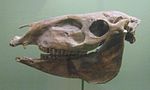 | | 1.8-0 Ma | Genus:
| | | |  | Human evolution [ edit]
Further information: Timeline of human evolution
The Human Evolutionary Series Appearance Taxa Relationships Status Description Image | 36-32 Ma | Genus
| The oldest primitive monkey known in the fossil record, dating back before the split between Old and New world monkeys. | Basal to both Old and New world monkeys. | Primitive traits - Smaller canines than later monkeys such as Parapithecus
- Retains some post-cranial characters seen in prosimians
Derived traits
- Fused mandibular symphysis
- Scapula similar to modern squirrel monkeys
- Low rounded molar cusps rather than high cusps as is seen in tarsiers and strepsirrhine
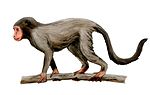
| | | 33 Ma | Genus
| A Miocene monkey which bridges the gap between the Eocene ancestors of Old world monkeys and Miocene ancestor of Hominoidea. | Tentatively positioned transitional form prior to the Old world monkey/ape split. | Primitive traits - Retained auditory features similar to Old world monkeys
- Incapable of true brachiation unlike extant apes
- Reduced capitular tail, but was proportionally smaller than Apidium
Derived traits
- Ape-like teeth including broad, flat incisors and sexually dimorphic canines
- A low sagittal keel and strong temporalis muscles
- Increased size in the visual cortex
|  | | 27-14 Ma | Genus
| This primate exhibits very ape-like features like its teeth, but much of its post-cranial remains are more similar to monkeys. | Universally accepted to be intermediate between 'ape-like monkeys' such as Aegyptopithecus and later apes including hominids. | Primitive traits - Monkey-like wrist
- Narrow, monkey-like illium
Derived traits
- Completely lacked a fully formed tail
- 5-Y pattern on lower molar cusps as also seen in hominoids
|  | | 13 Ma | Genus:
| A European ape which is considered to be the predecessor of the great apes. | Some objections have been raised to this fossils status due to its location in Spain, but Pierolapithecus is likely a transitional taxon between generalized apes and the lineage which led to great apes. | Pleisomorphic traits - Relatively short fingers and walked in a similar quadrupedal fashion like baboons
- Lacks adaptations for both gibbon-style brachaition as well as derived knuckle-walking like in chimpanzee's and gorilla's
Derived traits
- Flat, wider rib cage like great apes for tree-climbing
- The clavicle is large and similar to modern chimps suggesting a dorsally positioned scapula
| | | 4.4 Ma | Genus:
| A woodland hominid adapted to quadruped arboreal locamotion, but also for bipedalism. | Intermediate between the last common ancestor of chimps and humans, and the australopithecines. | Primitive traits - Brains smaller than later hominids ranging from about 300-350 cc
- Foot thumb is not retracted into the foot as a 'big toe'
- Phalanges are more heavily curved than in Australopithecus
Derived traits
- Reduced size in canines, however still retained dimorphic characters
- Hind leg dominant, bipedal locomotion while walking, however were quadrupedal while climbing trees
|  | | 4.4-2.0 Ma | Genus:
| First known genus of fully bipedal apes which are probably ancestral to robust australopiths and the genus Homo. | Intermediate between extinct quadrupedal and bipedal apes. While the relationship between some species are being revised, Australopithecus afarensis is considered to be, by most experts, the ancestor to all later hominids. | Primitive traits - Some species retain a sagittal crest
- Curved phalanges, indicating semi-arboreal lifestyle
- Semisectorial premolar is present
- Prognathic face to varying degrees
Derived traits
- Fully bipedal as indicated by many features including the knee joint, hips, lumbar curve in the spine, position of the foramen magnum, and feet
- Increase in brain size ranging from about 375-500 cc
- Development of a parabolic jaw
|  | | 2.5-1.5 Ma | Species:
| An early human which is the morphological link between australopithecines and later human species. | Perfect intermediate between early hominids and later humans, possibly ancestral to modern humans. | Primitive traits - Pronounced brow ridge
- Foramen magnum is not positioned as anteriorly like in modern humans, giving a slightly semi-erect appearance
- Although reduced in size the teeth are still fairly large
Derived traits
- Increase brain size ranging from 510-800 cc
- Face is slightly prognathic, but at a much steeper angle
- Bulge in the Broca area, possibly the first hominid to use rudimentary speech
- Associated with the first use of stone tools
|  | | 2.0-1.0 Ma | Species:
| Very successful hominid, which was probably ancestral to both modern humans and neanderthals. Probably the first hominid to leave and successfully colonize territories outside of Africa. | Ancestral to modern humans and neanderthals. | Primitive traits - Still retains a heavy brow ridge and nuchal torus
- Lacked the complexity of modern human language, but does show increase in the Broca area
- Thicker bones and larger teeth than modern humans
Derived traits
- Rounder and larger brain (about 900-1100 cc) than H. habilis
- Face is orthognathic compared to H. habilis
- Probably lived in bands and was an active group hunter
- Associated with advanced stone tools and possibly the first hominid to use and produce fire
|  | | 500 Ka-recent | Species
| Homo rhodesiensis was the immediate ancestor of modern humans which evidently displaced the neanderthals in Europe and the island 'hobbits' of southeast Asia. H. rhodesiensis evolved from Homo erectus about half a million years ago but still retains some primitive characteristics such as relatively thick bones and molars larger than modern humans. | Ancestral to modern humans. | Primitive traits - Large teeth
- Heavy brow ridge
- Extremely robust build in most groups
Derived traits
- Rounder, less broad based cranium
- Larger brain size, approaching (and sometimes exceeding) modern values
|  | | See also [ edit]
References [ edit]
^ Darwin, C (1859) On the Origin of Species. Chapter 10: On the Imperfection of the Geological Record. ^ Weishampel D.B. (1996). "Fossils, Phylogeny, and Discovery: A Cladistic Study of the History of Tree Topologies and Ghost Lineage Durations". Journal of Vertebrate Paleontology 16 (2): 191–197. doi: 10.1080/02724634.1996.10011307. JSTOR 4523710. ^ Shu, D. G.; Morris, S. C.; Han, J.; Zhang, Z. F.; Yasui, K.; Janvier, P.; Chen, L.; Zhang, X. L. et al. (Jan 2003), "Head and backbone of the Early Cambrian vertebrate Haikouichthys", Nature 421 (6922): 526–529, Bibcode: 2003Natur.421..526S, doi: 10.1038/nature01264, ISSN 0028-0836, PMID 12556891 |displayauthors= suggested ( help) edit ^ Ahlberg, Per Erik (2001). Major events in early vertebrate evolution: palaeontology, phylogeny, genetics, and development. Washington, DC: Taylor & Francis. p. 188. ISBN 978-0-415-23370-5. ^ Zhu, M.; Zhao, W.; Jia, L.; Lu, J.; Qiao, T.; Qu, Q. (2009). "The oldest articulated osteichthyan reveals mosaic gnathostome characters". Nature 458: 469–474. ^ a b c d e Ahlberg, P. E.; and Johanson, Z. (1998). "Osteolepiforms and the ancestry of tetrapods". Nature 395 (6704): 792–794. Bibcode: 1998Natur.395..792A. doi: 10.1038/27421. ^ a b R. Cloutier (1996). "Taxonomic review of Eusthenopteron foordi.". Devonian Fishes and Plants of Miguasha, Quebec, Canada. Dr. Friedrich Pfeil, München. pp. 487–502. ^ Nature: The pelvic fin and girdle of Panderichthys and the origin of tetrapod locomotion ^ Carroll, R. (1995). "Between fish and amphibians". Nature 373: 389–390. ^ Brazeau, M.D.; Ahlberg, P.E. (2006). "Tetrapod-like middle ear architecture in a Devonian fish". Nature 439 (7074): 318–321. doi: 10.1038/nature04196. PMID 16421569. ^ John Noble Wilford, The New York Times, Scientists Call Fish Fossil the Missing Link, Apr. 5, 2006. ^ a b Shubin, Neil (2008). Your Inner Fish. Pantheon. ISBN 978-0-375-42447-2. ^ "Meet Your ancestor, the Fish that crawled". New Scientist Magazine. Retrieved 2007-02-07. ^ a b Ahlberg, Per E. (1995). "Elginerpeton pancheni and the earliest tetrapod clade". Nature 373 (6513): 420–425. Bibcode: 1995Natur.373..420A. doi: 10.1038/373420a0. ^ Elginerpeton pacheni at Devonian Times Archived 18 January 2010 at WebCite ^ a b c Ahlberg, Per. E.; Jennifer A. Clack, Ervins Luksevics, Henning Blom and Ivars Zupins (26 June 2008). "Ventastega curonica and the origin of tetrapod morphology". Nature 453 (7199): 1199–1204. Bibcode: 2008Natur.453.1199A. doi: 10.1038/nature06991. PMID 18580942. article ^ Clack, J. (2005-11-21). Getting a leg up on land. Scientific American. Archived from the original on 2006-11-04. ^ " Acanthostega gunneri," Devonian Times. Archived 17 January 2010 at WebCite ^ Shubin, Neil (2009). Your Inner Fish: A Journey Into the 3.5-Billion-Year History of the Human Body. New York: Vintage. p. 13. ISBN 978-0-307-27745-9. ^ Lebedev, O.A. (1984). "The first find of a Devonian tetrapod vertebrate in the USSR". Doklady Akademii Nauk SSSR. Palaeontology (in Russian) 278: 1470–1473. ^ Gordon, M.S.; Long, J.A. (2004). "The Greatest Step In Vertebrate History: A Paleobiological Review of the Fish-Tetrapod Transition" (PDF). Physiological and Biochemical Zoology 77 (5): 700–719. ^ Clack, J. A. (2002). "An early tetrapod from 'Romer's Gap'". Nature 418 (6893): 72–76. doi: 10.1038/nature00824. PMID 12097908. ^ a b Anderson, J. S., Reisz, R. R., Scott, D., Fröbisch, N. B., Sumida, S. S. (2008). "A stem batrachian from the Early Permian of Texas and the origin of frogs and salamanders". Nature 453: 515–518. doi: 10.1038/nature06865. PMID 18497824. ^ Estes, R., and O. A. Reig. (1973): The early fossil record of frogs: a review of the evidence. Pp. 11-63 In J. L. Vial (Ed.), Evolutionary Biology of the Anurans: Contemporary Research on Major Problems. University of Missouri Press, Columbia. ^ Moss J.L. (1972). "The Morphology and phylogenetic relationship of the Lower Permian tetrapod Tseajaia campi Vaughn (Amphibia: Seymouriamorpha)". University of California Publications in Geological Sciences 98: 1–72. ^ Berman, D.S.; Sumida, S.S.; Lombard, R.E. (1992). "Reinterpretation of the temporal and occipital regions in Diadectes and the relationship of diadectomorphs". Journal of Paleontology 66: 481–499. ^ a b Gauthier J., Kluge, A.G., & Rowe, T. (1988) The early evolution of the Amniota. In: M. J. Benton (ed.) The phylogeny and classification of the tetrapods, Volume 1: amphibians, reptiles, birds (1): pp 103-155. Oxford: Clarendon Press. ^ Solenodonsaurus on the TOL-web ^ R. L. Paton, T. R. Smithson and J. A. Clack, "An amniote-like skeleton from the Early Carboniferous of Scotland", (abstract), Nature 398, 508-513 (8 April 1999) ^ "Fossilized Snake With Two Legs Found - Science - redOrbit". Retrieved 2008-04-16. ^ Blogspot.com ^ Wordpress.com ^ Nesbitt, S.J.; Sidor, C.A.; Irmis, R.B.; Angielczyk, K.D.; Smith, R.M.H.; and Tsuji, L.M.A. (2010). "Ecologically distinct dinosaurian sister group shows early diversification of Ornithodira". Nature 464 (7285): 95–98. Bibcode: 2010Natur.464...95N. doi: 10.1038/nature08718. PMID 20203608. ^ Langer, M.C. (2004). Basal Saurischia. In: Weishampel, D.B., Dodson, P., and Osmólska, H. (eds.). The Dinosauria (second edition). University of California Press:Berkeley, 25-46. ISBN 0-520-24209-2 ^ Galton, P.M. (2000). "Are Spondylosoma and Staurikosaurus (Santa Maria Formation, Middle-Upper Triassic, Brasil) the oldest saurischian dinosaurs?". Palaontologische Zeitschrift 74 (3): 393–423. ^ R.N. Martinez et al. A basal dinosaur from the dawn of the dinosaur era in southwestern Pangaea. Science, Vol. 331, January 14, 2011, p. 206. ^ Kaplan M, "Move over Eoraptor", http://www.nature.com/news, 13-1-2011. ^ Apaldetti, C; Martinez, RN; Alcober, OA; Pol, D (2011). "A New Basal Sauropodomorph (Dinosauria: Saurischia) from Quebrada del Barro Formation (Marayes-El Carrizal Basin), Northwestern Argentina". PLoS ONE 6 (11): e26964. doi: 10.1371/journal.pone. ^ Padian, K. & Chiappe, L.M. (1997): Bird Origins. In: Encyclopedia of Dinosaurs (red. Currie, P.J & Padian, K., Academic Press, San Diego, pp 41–96, ISBN 978-0-12-226810-6 ^ Chinsamy A., Martin L.D., Dobson P. (1998). "Bone microstructure of the diving Hesperornis and the volant Ichthyornis from the Niobrara Chalk of western Kansas". Cretaceous Research 19 (2): 225–235. doi: 10.1006/cres.1997.0102. ^ Jörg Fröbisch, Rainer R. Schoch, Johannes Müller, Thomas Schindler and Dieter Schweiss (2011). "A new basal sphenacodontid synapsid from the Late Carboniferous of the Saar-Nahe Basin, Germany". Acta Palaeontologica Polonica 56 (1): 113–120. doi: 10.4202/app.2010.0039. ^ a b Michel Laurin (1994). "Re-evaluation of Cutleria wilmarthi, an Early Permian synapsid from Colorado". Journal of Vertebrate Paleontology 14 (1): 134–138. ^ Romer, A.S.; Price, L.L. (1940). "Review of the Pelycosauria". Special Papers of the Geological Siciety of America 28: 1–538. ^ GA Floridesa, Kalogiroua SA, SA, Wrobelb, L Tassoub (2001). "Natural environment and thermal behavior of Dimetrodon limbatus".". Journal of Thermal Biology 26 (1): 15–20. ^ Kenneth D. Angielczyk, Dimetrodon Is Not a Dinosaur: Using Tree Thinking to Understand the Ancient Relatives of Mammals and their Evolution Evolution: Education and Outreach, Volume 2, Number 2, 257-271, doi: 10.1007/s12052-009-0117-4 ^ a b White, T. & Kazlev, M. A. (2009): Therapsida: Biarmosuchia: Biarmosuchidae / Eotitanosuchidae, from Palaeos website. ^ Ruben, J.A.; Hillenius, W.J., Kemp, T.S. and Quick, D.E. (2011). "The Evolution of Mammalian Endothermy". In Chinsamy-Turan, A. (ed.). Forerunners of Mammals. Bloomington: Indiana University Press. pp. 272–286. ISBN 0-253-35697-0. ^ Maier, W.; Heever, J., Durand, F. (27 April 2009). "New therapsid specimens and the origin of the secondary hard and soft palate of mammals". Journal of Zoological Systematics and Evolutionary Research 34 (1): 9–19. doi: 10.1111/j.1439-0469.1996.tb00805.x. ^ Zhe-Xi Luo, Chong-Xi Yuan, Qing-Jin Meng and Qiang Ji (25 August 2011). "A Jurassic eutherian mammal and divergence of marsupials and placentals". Nature 476 (7361): 442–445. Bibcode: 2011Natur.476..442L. doi: 10.1038/nature10291. Electronic supplementary material
|



