No justification for Syria Intervention
By Donald Sensing
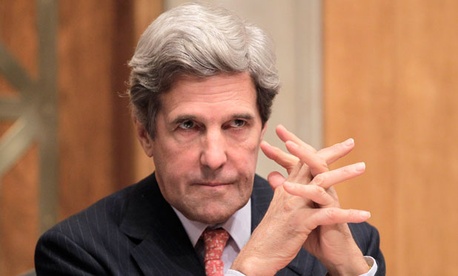 | Secretary of State John Kerry leads the war faction in the Obama administration,
insisting that American warplanes should begin bombing Syria right away. |
Don't try to blame this on the military somehow forcing Obama to intervene.
In the past few days, the White house announced that it will begin sending military materiel to Syrian rebels. This decision comes in the wake of the administration's determination that Syria's ruling Assad regime had used chemical weapons, including the nerve agent sarin, on the insurgents. This use constituted Assad crossing one of the Obama administration's "red lines," so named because crossing them would be seen as an intolerable act that could not be passively encountered by the United States.
International agencies estimate that the chemical attacks killed 100-150 people. As IBD puts it, "That's in addition to the more than 90,000 Syrians killed by conventional weapons that didn't seem to prompt any action."
Government Executive reports that Secretary of State John Kerry pushed hard for the United States to bomb key Syrian targets after the chemical use was confirmed.
On Thursday, President Obama confirmed what reports had been speculating for a few weeks: Syrian President Bashar al-Assad had used chemical weapons, notably sarin gas, on his own people, and tripping the president's "red line" that would rouse the United States to greater action. The response includes arming and training the rebels. It turns out that Secretary of State John Kerry also wanted the response to include an air strike on Syrian airfields, according to Jeffery Goldberg at Bloomberg View. According to Goldberg, Kerry's "vociferous" thoughts on the matter were not received well by Chairman of the Joint Chiefs of Staff Martin Dempsey during a meeting in the situation room last Wednesday.(My own experience of working in the Pentagon from 1990-1993 is that the state department is considerably quicker to reach for the sword than the defense department.) The reason Kerry's push did not prevail is that Joint Chiefs Chairman Gen. Martin Dempsey made it clear that a few runs on target would do no good, that if the bombing was not be be merely symbolic, it would require a sustained, large effort of no short duration.
Secretary Kerry lost the debate that day, but the desire is out in the open: there is a powerful faction within the Obama administration that wants direct military action by the United States against the Assad regime.
My position is that no just rationale can be proffered for American intervention in the civil war, whether by supply, air campaign or boots on the ground. Such action fails to meet the standards of the two major influences that have shaped American military action since the country's founding: Just War theory and Realpolitik, or foreign-affairs Realism.
Realpolitik and the national interests
Realpolitik is the easier of the two to deal with, so I'll start with it. Realpolitik "refers to politics or diplomacy based primarily on power and on practical and material factors and considerations, rather than ideological notions or moralistic or ethical premises." The United States has (let us be thankful) not been skilled in its practice - both the Bay of Pigs and Vietnam War come to mind as two prominent, recent examples.
In Syria, however, even if the Obama administration was inclined toward Realpolitik it would find there is no upside for American power interests in intervention. Simply put, the outcome of the civil war there is wholly immaterial to the national-security interests of the United States. The fight is not a fight between repressed Jeffersonian democrats and their cruel oppressors. It is a fight between what we may understand as a Stalinist regime in power and a fascist movement that wants to replace it.
There are no good guys in this war. It is not a war about repression vs. liberty. It is a war about who will do the repressing. As Atlantic Council managing editor James Joyner puts it, " Syrian Rebels Today, Syrian Taliban Tomorrow."
Radical Islamists now dominate the Syrian opposition. And you’re arming them.
Reuters (“Syria’s Islamists seize control as moderates dither“):
During a 10-day journey through rebel-held territory in Syria, Reuters journalists found that radical Islamist units are sidelining more moderate groups that do not share the Islamists’ goal of establishing a supreme religious leadership in the country. The moderates, often underfunded, fragmented and chaotic, appear no match for Islamist units, which include fighters from organizations designated “terrorist” by the United States.
The Syrian resistance, such as it is, is dominated by foreign al Qaeda elements. If the resistance loses, Assad's Syria will become even more of an Iranian client than it already is. If the resistance wins, Syria will be a a Muslim Brotherhood client with a strong share of Saudi Salfism thrown in for good measure.
So what is the Syrian civil war really about? It is another round in the centuries-old conflict between Sunni and Shia Muslims (in which Assad is ironically neither). Understand, the conflict between Sunnis and Shias is not a religious conflict, it is political. The Islamic-theological differences are actually rather minor. They dispute who should be authoritative in setting doctrinal standards for Muslims, but this springs from a centuries-old schism over Mohammed's successors as leaders of Islam. Islam itself is basically identical for both.
The center of Shia Islam is Iran, which named the United States the Great Satan in 1979 (Israel, by contrast, was only named the Little Satan). Al Qaeda began as a Sunni movement arising from the local jihad against the Soviet army declared by a Palestinian Sunni cleric living in Saudi Arabia. The occasion was the USSR's invasion of Afghanistan in December 1979. Out of the Islamic resistance to the USSR, led by Saudi Arabia and Pakistan, was born the organization that Osama bin Laden would use to form al Qaeda, whose hatred of all things American need not be explained further.
This history helps illuminate why both sides in Syria can each hate the United States as much (or more) as they hate one another. Whether the rebels prevail or Assad, neither outcome is inherently more desirable for the United States than the other. So simply from a Realpolitik point of view, there is no upside for the United States to intervene in any fashion.
There is, however, considerable downside, not least would be the expenditure of American blood and treasure to achieve goals that are unclear, mostly undefined, in a campaign of of indefinite duration, for no possible outcome that benefits the security of the country.
....
senseofevents.blogspot.com |



