What strikes me as very odd, since you are a Christian, you don't seem ton know the very strategic passages referencing the Persian king Cyrus the Great. Many Jews considered him to be the first messiah , seems clear to me Cyrus was head & shoulders above them all and the Jews obviously borrowed their major religious ideas from this encounter right before they build their first temple. Now the question remains , who taught who?
Cyrus the Great in the Bible
en.wikipedia.org
Cyrus the Great figures in the Hebrew Bible (Old Testament) as the patron and deliverer of the Jews. He is mentioned 23 times by name and alluded to several times more. [1] From these statements it appears that Cyrus the Great, king of Persia, was the monarch under whom the captivity of the Jews ended, for in the first year of his reign he was prompted by God to make a decree that the Temple in Jerusalem should be rebuilt and that such Jews as cared to might return to their land for this purpose. Moreover, he showed his interest in the project by sending back with them the sacred vessels which had been taken from the First Temple and a considerable sum of money with which to buy building materials


Depiction of Cyrus the Great by Jean Fouquet, 1470.
Cyrus the Great figures in the Hebrew Bible (Old Testament) as the patron and deliverer of the Jews. He is mentioned 23 times by name and alluded to several times more. [1] From these statements it appears that Cyrus the Great, king of Persia, was the monarch under whom the captivity of the Jews ended, for in the first year of his reign he was prompted by God to make a decree that the Temple in Jerusalem should be rebuilt and that such Jews as cared to might return to their land for this purpose. Moreover, he showed his interest in the project by sending back with them the sacred vessels which had been taken from the First Temple and a considerable sum of money with which to buy building materials.
Cyrus in Babylon and the Jewish connection [ edit]The personage of Cyrus the Great is unconditionally praised in the Jewish sources. It is likely that, after the Persian conquest of Babylon, Cyrus had commenced his relationship with the Jewish leaders in exile, [2] and that he later was considered as a messiah sent by God. [3] Daniel was in the favor of Cyrus, and it was in the third year of Cyrus that he had the vision recorded in his tenth chapter.
The Hebrew Bible states that Cyrus issued the decree of liberation to the Jews, [4] concerning which Daniel had prayed and prophesied. [5] The edict of Cyrus for the rebuilding of the Temple in Jerusalem marked a great epoch in the history of the Jewish people. According to Ezra 4:1-6 "the enemies of Judah and Benjamin" asked to help build the temple, and when this was denied hired counselors to frustrate the people of Judah from completing the rebuilding throughout the reign of Cyrus, Xerxes ('Ahasuerus'), and Artaxerxes, until the reign of Darius. The work recommenced under the exhortations of the prophets, and when the authorities asked the Jews what right they had to build a temple, they referred to the decree of Cyrus. Darius, who was then reigning, caused a search for this alleged decree to be made, and it was found in the archives at Ecbatana, [6] whereupon Darius reaffirmed the decree and the work proceeded to its triumphant close.
A chronicle drawn up just after the conquest of Babylonia by Cyrus, gives the history of the reign of Nabonidus ('Nabuna'id'), the last king of Babylon, and of the fall of the Babylonian empire. In 538 BC, there was a revolt in Southern Babylonia, while the army of Cyrus entered the country from the north. In June the Babylonian army was completely defeated at Opis, and immediately afterwards Sippara opened its gates to the conqueror. Gobryas (Ugbaru), the governor of Media, was then sent to Babylon, which surrendered "without fighting," and the daily services in the temples continued without a break. In October, Cyrus himself arrived, and proclaimed a general amnesty, which was communicated by Gobryas to "all the province of Babylon," of which he had been made governor. Meanwhile, Nabonidus, who had concealed himself, was captured, but treated honourably; and when his wife died, Cambyses II, the son of Cyrus, conducted the funeral. Cyrus now assumed the title of "king of Babylon," claimed to be the descendant of the ancient kings, and made rich offerings to the temples. At the same time he allowed the foreign populations who had been deported to Babylonia to return to their old homes, carrying with them the images of their gods. Among these populations were the Jews, who, as they had no images, took with them the sacred vessels of the temple.
Speculation abounds to the reasoning for Cyrus' release of the Jews from Babylon. One argument being that Cyrus was a follower of Zoroaster, the monotheistic prophet: Zoroastrianism played a dominant religious role in Persia throughout its history until the Islamic conquest. As such, he would feel a kindred spirit with the monotheistic Jews. Another possibility is the magnanimous respect he is ascribed to have shown to the diverse beliefs and customs of the peoples within his extended kingdom.
As one example, upon the conquest of Babylon itself, it's recorded that he paid homage at the temple of the Babylonian god Marduk - thereby gaining the support of the Babylonian people and minimizing further bloodshed. While Jewish tradition, as described previously in Ezra1:1-8, indicates "the Lord inspired King Cyrus of Persia to issue this proclamation", in the Cyrus Cylinder he pays homage to Marduk. This Babylonian document has been interpreted as referring to the return to their homelands of several displaced cultural groups, one of which could have been the Jews:
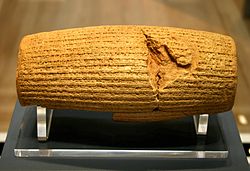
The Cyrus cylinder, which confirms that Cyrus allowed captives in Babylon to return to their native lands, earning him an honored place in Judaism.
From [Babylon] to Aššur and (from) Susa, Agade, Ešnunna, Zamban, Me-Turnu, Der, as far as the region of Gutium, the sacred centers on the other side of the Tigris, whose sanctuaries had been abandoned for a long time, I returned the images of the gods, who had resided there [i.e., in Babylon], to their places and I let them dwell in eternal abodes. I gathered all their inhabitants and returned to them their dwellings. In addition, at the command of Marduk, the great lord, I settled in their habitations, in pleasing abodes, the gods of Sumer and Akkad, whom Nabonidus, to the anger of the lord of the gods, had brought into Babylon. (lines 30-33) [7] |



