Some of you need to learn how to at least use google before spouting nonsense.
++++
United States[ edit]In the United States, Philadelphia carpenters went on strike in 1791 for the ten-hour day. By the 1830s, this had become a general demand. In 1835, workers in Philadelphia organized a general strike, led by Irish coal heavers. Their banners read, From 6 to 6, ten hours work and two hours for meals. Labor movement publications called for an eight-hour day as early as 1836. Boston ship carpenters, although not unionized, achieved an eight-hour day in 1842.
In 1864, the eight-hour day quickly became a central demand of the Chicago labor movement. The Illinois legislature passed a law in early 1867 granting an eight-hour day but had so many loopholes that it was largely ineffective. A city-wide strike that began on May 1, 1867 shut down the city's economy for a week before collapsing. On June 25, 1868, Congress passed an eight-hour law for federal employees [7] which was also of limited effectiveness. (On May 19, 1869, Grant signed a National Eight Hour Law Proclamation. [8])
In August 1866, the National Labor Union at Baltimore passed a resolution that said, "The first and great necessity of the present to free labour of this country from capitalist slavery, is the passing of a law by which eight hours shall be the normal working day in all States of the American Union. We are resolved to put forth all our strength until this glorious result is achieved."
During the 1870s, eight hours became a central demand, especially among labor organizers, with a network of Eight-Hour Leagues which held rallies and parades. A hundred thousand workers in New York City struck and won the eight-hour day in 1872, mostly for building trades workers. In Chicago, Albert Parsons became recording secretary of the Chicago Eight-Hour League in 1878, and was appointed a member of a national eight-hour committee in 1880.
At its convention in Chicago in 1884, the Federation of Organized Trades and Labor Unions resolved that "eight hours shall constitute a legal day's labour from and after May 1, 1886, and that we recommend to labour organizations throughout this jurisdiction that they so direct their laws as to conform to this resolution by the time named."
The leadership of the Knights of Labor, under Terence V. Powderly, rejected appeals to join the movement as a whole, but many local Knights assemblies joined the strike call including Chicago, Cincinnati and Milwaukee. On May 1, 1886, Albert Parsons, head of the Chicago Knights of Labor, with his wife Lucy Parsons and two children, led 80,000 people down Michigan Avenue, Chicago, in what is regarded as the first modern May Day Parade, in support of the eight-hour day. In the next few days they were joined nationwide by 350,000 workers who went on strike at 1,200 factories, including 70,000 in Chicago, 45,000 in New York, 32,000 in Cincinnati, and additional thousands in other cities. Some workers gained shorter hours (eight or nine) with no reduction in pay; others accepted pay cuts with the reduction in hours.
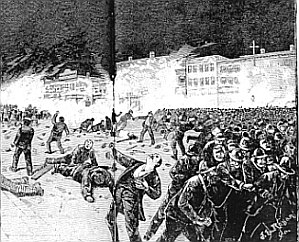

Artist impression of the bomb explosion in Haymarket Square
On May 3, 1886, August Spies, editor of the Arbeiter-Zeitung (Workers Newspaper), spoke at a meeting of 6,000 workers, and afterwards many of them moved down the street to harass strikebreakers at the McCormick plant in Chicago. The police arrived, opened fire, and killed four people, wounding many more. At a subsequent rally on May 4 to protest this violence, a bomb exploded at the Haymarket Square. Hundreds of labour activists were rounded up and the prominent labour leaders arrested, tried, convicted, and executed giving the movement its first martyrs. On June 26, 1893 Illinois Governor John Peter Altgeld set the remaining leader free, and granted full pardons to all those tried claiming they were innocent of the crime for which they had been tried and the hanged men had been the victims of "hysteria, packed juries and a biased judge".
The American Federation of Labor, meeting in St Louis in December 1888, set May 1, 1890 as the day that American workers should work no more than eight hours. The International Workingmen's Association ( Second International), meeting in Paris in 1889, endorsed the date for international demonstrations, thus starting the international tradition of May Day.
The United Mine Workers won an eight-hour day in 1898.
The Building Trades Council (BTC) of San Francisco, under the leadership of P.H. McCarthy, won the eight-hour day in 1900 when the BTC unilaterally declared that its members would work only eight hours a day for $3 a day. When the mill resisted, the BTC began organizing mill workers; the employers responded by locking out 8,000 employees throughout the Bay Area. The BTC, in return, established a union planing mill from which construction employers could obtain supplies — or face boycotts and sympathy strikes if they did not. The mill owners went to arbitration, where the union won the eight-hour day, a closed shop for all skilled workers, and an arbitration panel to resolve future disputes. In return, the union agreed to refuse to work with material produced by non-union planing mills or those that paid less than the Bay Area employers.
By 1905, the eight-hour day was widely installed in the printing trades – see International Typographical Union (section) – but the vast majority of Americans worked 12-14 hour days.
On January 5, 1914, the Ford Motor Company took the radical step of doubling pay to $5 a day and cut shifts from nine hours to eight, moves that were not popular with rival companies, although seeing the increase in Ford's productivity, and a significant increase in profit margin (from $30 million to $60 million in two years), most soon followed suit. [9] [10] [11] [12]
In the summer of 1915, amid increased labor demand for World War I, a series of strikes demanding the eight-hour day began in Bridgeport, Connecticut. They were so successful that they spread throughout the Northeast. [13]
The United States Adamson Act in 1916 established an eight-hour day, with additional pay for overtime, for railroad workers. This was the first federal law that regulated the hours of workers in private companies. The United States Supreme Court upheld the constitutionality of the Act in Wilson v. New, 243 U.S. 332 (1917).
The eight-hour day might have been realized for many working people in the U.S. in 1937, when what became the Fair Labor Standards Act ( 29 U.S. Code Chapter 8) was first proposed under the New Deal. As enacted, the act applied to industries whose combined employment represented about twenty percent of the U.S. labor force. In those industries, it set the maximum workweek at 40 hours, [14] but provided that employees working beyond 40 hours a week would receive additional overtime bonus salaries. [15] |



