SI
SI
discoversearch

We've detected that you're using an ad content blocking browser plug-in or feature. Ads provide a critical source of revenue to the continued operation of Silicon Investor.  We ask that you disable ad blocking while on Silicon Investor in the best interests of our community.  If you are not using an ad blocker but are still receiving this message, make sure your browser's tracking protection is set to the 'standard' level.
Politics : Mainstream Politics and Economics -- Ignore unavailable to you. Want to Upgrade?


To: koan who wrote (50416)8/7/2013 10:16:38 PM
From: Bearcatbob1 Recommendation

Recommended By
Little Joe

  Respond to of 85487
 
Koan, Let me help you understand why Reich is playing the loony left for fools.

Lie #1: U.S. corporate tax rates are higher than the tax rates of other big economies. Wrong. After deductions and tax credits, the average corporate tax rate in the U.S. is lower. According to the Congressional Research Service, the United States has an effective corporate tax rate of 27.1%, compared to an average of 27.7% in the other large economies of the world.

It is incremental $ tax rate that counts.

Lie #2: U.S. corporations need lower taxes in order to make investments in new jobs. Wrong again. Corporations are sitting on almost $2 trillion of cash they don't know what to do with. The 1000 largest U.S. corporations alone are hoarding almost $1 trillion.

Rather than investing in expansion, they're buying back their own stocks or raising dividends. They have no economic incentive to expand unless or until consumers want to buy more, but consumer spending is pinched because the middle class keeps shrinking and the median wage, adjusted for inflation, keeps dropping.

Much of that is stuck overseas where it will be used for jobs somewhere else. Congrats to the loony lefties who purport so loudly to care and then implement economic ruin in policy,

Lie #3: U.S. corporations need a tax break in order to be globally competitive. Baloney. The "competitiveness" of American corporations is becoming a meaningless term because most big U.S. corporations are no longer American companies at all. The biggest have been creating way more jobs abroad than in the U.S.

The issue is where the money flows to after it is earned.

Obama talks about caring for the middle class. Oh how loudly he purports to care and oh readily the lefty loons believe him.

The biggest victims of the idiocy of Obama are the lower classes - the ones who vote for him without thinking - and hence doom themselves to poverty - all the while believing the purporting of the liar in chief. What Obama cares about are wacko greens with money.

Bob


To: koan who wrote (50416)8/10/2013 12:52:50 PM
From: TimF  Respond to of 85487
 
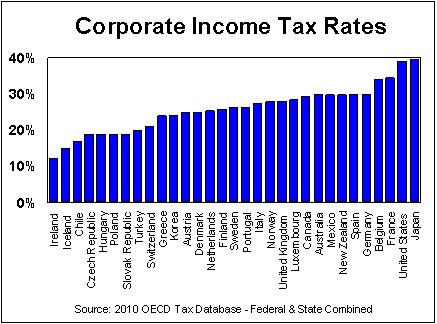
U.S. corporate tax rates are higher than the tax rates of other big economies.

Not a lie. Its true.

1 - Even if after deductions US companies paid less it still wouldn't be a lie, the rate is actually higher. And the marginal rate has an impact, and still would even if the average percentage paid was less.

2 - After deductions the American rate is still higher than the rate is most other countries and in most other rich countries.

------
After all the deductions are accounted for, Japanese companies face the highest effective tax rate worldwide. The U.S. multinationals come in second. Multinationals headquartered in tax havens like Bermuda face the lowest taxes.

forbes.com
----

Corporate income tax reform is receiving serious
consideration in Washington. The Obama administration
has suggested reducing the federal corporate tax rate from
35 percent to 28 percent while broadening the tax base.
Presidential candidate Mitt Romney has said that he would
cut the corporate tax rate to 25 percent if elected.
The urgency of tax reform increased when Japan
recently enacted a reduction to its corporate tax rate. That
left the United States in the uncompetitive position of
having the highest statutory tax rate in the world, with a
combined federal-state rate of about 40 percent.
This bulletin presents new estimates of marginal
effective tax rates (METRs) on corporate investment for
90 countries. These tax rates take into account statutory
rates plus tax-base items that affect taxes paid on new
investment, such as deductions for capital depreciation,
inventory costs, and interest expenses. We ignore
temporary incentives because they do not support
sustained capital investment, but instead shift investment
from the future to the present year.
We find that the U.S. effective tax rate on new
corporate investment is 35.6 percent in 2012, which is
almost twice the average rate
for the 90 countries studied,
and it is also the highest rate among the major industrial
nations. These results underscore the need for U.S.
policymakers to tackle corporate tax reform.
cato.org

According to Tax Foundation president Scott Hodge, statutory rates make for better comparisons. Effective rates are unpredictable and vary across different industries, but the statutory rates are fixed, Hodge told us.

"(The effective tax rate) will differ from industry to industry and business to business, whereas the list price is what it is and everyone starts at that point," Hodge said.

But Joseph Rosenberg, a research associate at the nonpartisan Tax Policy Center, argued that "effective tax rates provide the best measure of comparison for overall tax burdens." Aparna Mathur, an economist with the conservative American Enterprise Institute, added in an e-mail that "both are equally valid measures of looking at the burden of the corporate income tax."

Our ruling

In a radio interview, Kyrillos claimed, "We've got the highest corporate tax rate in the world."

It’s accurate that, at 39.2 percent, the United States has the highest statutory corporate tax rate among industrialized nations. But with various tax breaks, U.S. effective corporate tax rates range anywhere from 23 percent to 34.9 percent, studies show.

Those effective tax rates may not land in first place, but they’re still among the highest in the world.

politifact.com

The 2011 foundation report summarized 13 studies of effective corporate tax rates across the world, which used different methodologies and were not limited to the OECD roster. The smallest study compared 10 countries; the largest, 183.

Those studies found the U.S. effective tax rate ranging from 23 percent to 34.9 percent, which often placed it in the top five, but never No. 1.

But the U.S. hit the top spot in a more recent report. Morrison told us the latest such comparison was made in September 2012 for the libertarian Cato Institute. That report calculated the U.S. effective rate at 35.6 percent and ranked it highest among OECD nations but fourth among all 90 nations it examined.

How did U.S. rates get to be among the highest? Actually, other countries dropped theirs, we learned by phone from Jonathan Masters, author of the Council on Foreign Relations piece.

We found succinct descriptions of the history in Time magazine and The Hill, a Washington, D.C. newspaper. An April 2, 2012, Time blog post says that while the U.S. rate stayed steady for two decades, "the trend internationally has been towards lower corporate tax rates." The Hill’s Aug. 27, 2012 blog post says that in 1986, the OECD nations’ average corporate tax was 50 percent, but "today, it’s 25 percent for those countries -- it has fallen in half. Meanwhile, the U.S. rate, which fell from 46 percent to 34 percent as a result of tax reform in 1986, is now stuck at 35 percent."
politifact.com

Also corporate tax rates have declined below those levels in several countries, and in the UK they are scheduled to go down to 21% in 2014.

3 - Many states also have corporate taxes, which add to the rate some companies pay by as much as 12%.


To: koan who wrote (50416)8/10/2013 1:02:13 PM
From: TimF1 Recommendation

Recommended By
i-node

  Read Replies (1) | Respond to of 85487
 
U.S. corporations need lower taxes in order to make investments in new jobs.

Investments will happen even with high tax rates, but the higher the rate the lower after tax return on those investments. With lower after tax returns the marginal investment will not be made and total investment will be lower. It will also, at the margin, move to investment based off of avoiding the tax, rather than more efficient investment in terms of overall wealth creation.

Corporations are sitting on almost $2 trillion of cash they don't know what to do with.

A lot of the cash is kept overseas because the feds will take around a third of it if its brought back to the US.

Also it doesn't matter how large of cash holding a company has. It could be $20 trillion rather than 2, and it still wouldn't be a refutation of the idea that higher tax rates discourage investment. Its not an issue of ability, but of incentive. Companies invest when they think it will be worth it in terms of risk adjusted profit, not simply because they have money. If the investment isn't worth it, it won't be made no matter how much money the company has. Higher tax rates make fewer investments worthwhile.

U.S. corporations need a tax break in order to be globally competitive. Baloney.

Its not a matter of competitive or not competitive, but rather more or less competitive. Lower tax rates are not a switch that will move all or most American companies from competitive to not-competitive, but they will work at the margin to make many companies more competitive.

The "competitiveness" of American corporations is becoming a meaningless term because most big U.S. corporations are no longer American companies at all.

That doesn't logically follow. Many less big companies and some of the bigger companies are heavily focused in the US. Even for those that are not, there US operations will be more competitive with lower American tax rates, and they will have more of an incentive to make the US operations a larger part of their total operations (or at least to avoid cutting back in the US), if the US has lower tax rates.

Their investors are global. They do their R&D all over the world. And they park their profits wherever taxes are lowest

All the more reason to lower US tax rates.

