Squaring improbabilities
By Donald Sensing
I've had the link below for awhile now, waiting for a "hook" to hang it on to post, but what the hey, here it is by itself.
I only took bonehead biology, so I am not academically qualified to speak to the topic. Nonetheless, it occurs to me that as severely improbable as the uncaused appearance of life is in the primeval earth, how much more unlikely would it be that a single cell organism would both:
(a) randomly become organized from non-living compounds into a living organism, and
(b) also be capable of mitosis, or reproduction. That is an incredibly complex process and the first cell had to get it right the first time.
That self-replicating life just spontaneously popped into being is to square improbabilities to the point of incredulity. No wonder that MIT mathematician Murray Eden is quoted in the article that the chance emergence of life from non-life is impossible.
apologetics-notes.comereason.org
See also, " A Chemist Tells the Truth."
How do you get DNA without a cell membrane? And how do you get a cell membrane without a DNA? And how does all this come together from this piece of jelly? We have no idea, we have no idea. Also:
BONDING: You need 99 peptide bonds between the 100 amino acids. The odds of getting a peptide bond is 50%. The probability of building a chain of one hundred amino acids in which all linkages involve peptide bonds is roughly (1/2)^99 or 1 chance in 10^30.CHIRALITY: You need 100 left-handed amino acids. The odds of getting a left-handed amino acid is 50%. The probability of attaining at random only L–amino acids in a hypothetical peptide chain one hundred amino acids long is (1/2)^100 or again roughly 1 chance in 10^30.SEQUENCE: You need to choose the correct amino acid for each of the 100 links. The odds of getting the right one are 1 in 20. Even if you allow for some variation, the odds of getting a functional sequence is (1/20)^100 or 1 in 10^65.The final probability of getting a functional protein composed of 100 amino acids is 1 in 10^125. Even if you fill the universe with pre-biotic soup, and react amino acids at Planck time (very fast!) for 14 billion years, you are probably not going to get even 1 such protein. And you need at least 100 of them for minimal life functions, plus DNA and RNA.http://senseofevents.blogspot.com/2013/12/squaring-improbabilities.html
Life itself shows the fingerprints of Intelligence
Last year, I debated atheist Richard Carrier on the question "Does God Exist?" I'd like to review some of the arguments I made during that debate and Carrier's responses. If you'd like to see the entire debate, you can do so on the Come Reason YouTube channel. You can also receive a DVD of the debate, along with a bunch of bonus features by making a donation to the ministry here.
One of the points I offered for God's existence is the fact that life itself shows the fingerprints of intelligence. In the debate, I argued:
In all of human existence, it has been readily understood that life comes from life, since at no time have humans ever observed anything else. And now, science has amassed even more evidence for the absolute uniqueness of living systems as non-random, information-bearing systems.
Human beings have consistently recognized that highly specified information—from cave drawings to computer systems—are always the result of an intelligent mind. The identifying features of intelligence are:
They are COMPLEX SYSTEMSThey are SPECIFICALLY ARRANGED to perform a functionThey are HIGHLY CONTINGENT. In other words, there is nothing that forces the patterns to emerge as they do.Code-breakers in World War II and scientists who search for signs of extra-terrestrial life both use these criteria in separating what is natural and what is the sign of a mind a work.
Now, when we look inside living cells, we see that they exhibit the same marks of intelligence. For example some of the simplest bacteria have a DNA molecule which is about 4,000,000 nucleotides long. These nucleotides need to be in just the right order or the bacteria could not live. In fact, Gustaf Arrhenius states that there are more possible nucleotide sequences than there are atoms in the universe. Yet, these are ordered perfectly in living systems to build the proteins necessary for life.
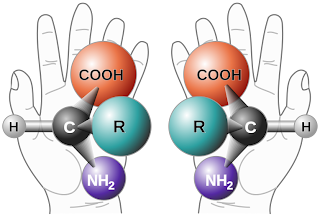
Secondly, amino acids, the workhorses that build proteins, are selected perfectly, too. Amino acids are what are known as "handed," that is they occur in two shapes that mirror each other like a left and right hand. Each of these types is equally distributed in nature: the odds of each are 50% and they will bond to the RNA molecule equally well. But ALL biological proteins must use ONLY left handed amino acids for life to exist. So, how can you have an RNA molecule form randomly but only select the left-handed acids? Given that bacteria are, for e.g., 4 million nucleotides long, how can they assemble by chance to use only left-handed acids?
These and other reasons are why MIT mathematician Murray Eden has stated that the chance emergence of life from non-life is impossible. Francis Crick, the co-discoverer of DNA, also famously stated "the origin of life appears at the moment to be almost a miracle." DNA and molecular systems required for life are specific and complex enough to rule out chance. And since complex systems that are specific are also a sign of an intelligent mind, it is reasonable to hold that "intelligence" is responsible for life.Tomorrow, I will discuss Carrier's response to this line of argumentation.
apologetics-notes.comereason.org
A chemist tells the truth
By Donald Sensing
A world-famous chemist tells the truth: there’s no scientist alive today who understands macroevolution
Professor James M. Tour is one of the ten most cited chemists in the world. He is famous for his work on nanocars, nanoelectronics, graphene nanostructures, carbon nanovectors in medicine, and green carbon research for enhanced oil recovery and environmentally friendly oil and gas extraction. He is currently a Professor of Chemistry, Professor of Computer Science, and Professor of Mechanical Engineering and Materials Science at Rice University. He has authored or co-authored 489 scientific publications and his name is on 36 patents.Here is a video of a lecture Prof. Tour gave at Georgia Tech on Nov. 1 of last year. It's 99 minutes long, so a key excerpt pasted from the linked site, above, is below the video frame.
[iframe width="560" height="315" src="http://www.youtube.com/embed/PZrxTH-UUdI" frameborder="0" allowfullscreen=""][/iframe]
… I will tell you as a scientist and a synthetic chemist: if anybody should be able to understand evolution, it is me, because I make molecules for a living, and I don’t just buy a kit, and mix this and mix this, and get that. I mean, ab initio, I make molecules. I understand how hard it is to make molecules. I understand that if I take Nature’s tool kit, it could be much easier, because all the tools are already there, and I just mix it in the proportions, and I do it under these conditions, but ab initio is very, very hard.
I don’t understand evolution, and I will confess that to you. Is that OK, for me to say, “I don’t understand this”? Is that all right? I know that there’s a lot of people out there that don’t understand anything about organic synthesis, but they understand evolution. I understand a lot about making molecules; I don’t understand evolution. And you would just say that, wow, I must be really unusual.
Let me tell you what goes on in the back rooms of science – with National Academy members, with Nobel Prize winners. I have sat with them, and when I get them alone, not in public – because it’s a scary thing, if you say what I just said – I say, “Do you understand all of this, where all of this came from, and how this happens?” Every time that I have sat with people who are synthetic chemists, who understand this, they go “Uh-uh. Nope.” These people are just so far off, on how to believe this stuff came together. I’ve sat with National Academy members, with Nobel Prize winners. Sometimes I will say, “Do you understand this?”And if they’re afraid to say “Yes,” they say nothing. They just stare at me, because they can’t sincerely do it.
I was once brought in by the Dean of the Department, many years ago, and he was a chemist. He was kind of concerned about some things. I said, “Let me ask you something. You’re a chemist. Do you understand this? How do you get DNA without a cell membrane? And how do you get a cell membrane without a DNA? And how does all this come together from this piece of jelly?” We have no idea, we have no idea. I said, “Isn’t it interesting that you, the Dean of science, and I, the chemistry professor, can talk about this quietly in your office, but we can’t go out there and talk about this?”
senseofevents.blogspot.com |



