The Gundestrup Cauldron - Mythology and Cosmology 1rst century? (Denmark peatbog offering)
native-science.net 
What is The Gundestrup Cauldron
visual-arts-cork.com
The famous late Iron Age vessel known as the Gundestrup Cauldron is one of the great pagan silver masterpieces of La Tene metalwork, dating from the 1st or 2nd century BCE. (La Tene was a style of Celtic art that superceded the earlier Hallstatt culture.) Discovered in a bog in Denmark, its sides and circular base are decorated in relief with numerous mythological and ritual scenes, featuring figures of real and imaginary animals. The vessel's decorative features along with its high quality craftsmanship makes it an outstanding work of Celtic art, but debate continues as to its origins. Some archeologists place its manufacture in the western European zone of Celtic culture, probably Gaul, while others believe that it originated on the Middle Danube in Thrace (modern day Bulgaria), which was inhabited by Celts who were especially skilled in goldsmithing and silversmithery. The artifact is currently on display at the National Museum of Denmark, in Copenhagen. meme
|
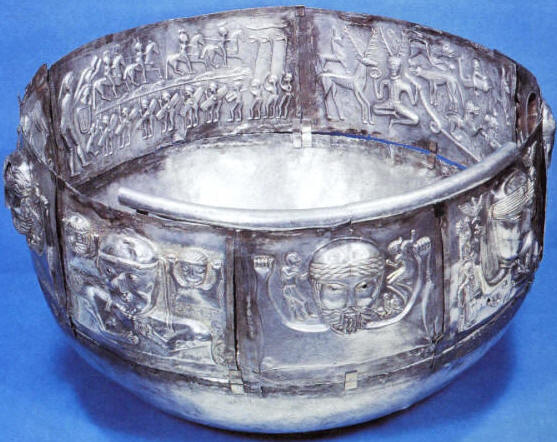
Gundestrup Cauldron Peat bog, Gundestrup (Denmark) First century B.C.E. Silver partially gilded. Diameter 69cm., Height 42cm.Copenhagen, Nationalmuseet.
The Gundestrup Cauldron is a religious vessel found in Himmerland, Denmark, 1891. It was deposited in a dry section of a peat bog, dismantled with its five long rectangular plates, seven short ones and one round plate. Each plate is made of 97.0% pure silver and filled with various motifs of animals, plants and pagan deities. Sophius Müller(1892) reconstructed these plates into the present form of the cauldron: five rectangular plates are placed in the inside of the cauldron leaving 2cm of space between each, and the seven (originally eight) plates form the outside of the cauldron. The round plate is assumed as the base of the cauldron. The reconstructed cauldron with its spherical base and cylindrical side is 69cm. in diameter and 42cm. high; both the inner and outer plates are almost of the same height ( about 21cm) forming the cylindrical side of the cauldron.
As the largest surviving piece of Europian Iron Age silver work, the Gundestrup Cauldron has been given a special interest by many scholars. Especially, its high quality workmanship and iconographic variety have generated an incessant inquiry into the origin of the cauldron. Though the date of the cauldron is generally attributed to the 2nd or 1st century BCE (La Tène III), there still remains much room for controversy concerning the place of its manufacture. The main problem comes from the fact that its style and workmanship is Thracian rather than Celtic despite its decorative motifs manifestly Celtic. So far, scholastic opinions have been largely divided into two groups: those who argue for the Gaulish origin and those who argue for the Thracian origin. The former locate the manufacture of the cauldron in the Celtic west while the latter opt for the Lower Danube in southeastern Europe.
The Vessel
The whole vessel represents the Whole World as known from the ancient 3 World division and dimension of Earth, the nearest Celestial World and the farthest celestial world of the Milky Way.
- Maybe the Vessel also once have had a lid in order to show some details regarding "the top" of these 3 Worlds? In that case the imagery would have shown some mythological "world axis" imagery.
Interpretation
In Norse Mythology these 3 worlds is mentioned: Midgaard for the humans; Asgaard for the nearest celestial world where the Sun, the Moon, the (5) Planets and for the Star Constellations and Udgaard (Out-Yard) for the farthest world representing the Milky Way galaxy where the Giants (Jaetter) live.
The interactive Mytho-Cosmological plays between these 3 worlds must be incorporated in the telling of vessel imagery. That is: We are dealing with the cosmological creative and interactive forces in these 3 worlds and we are also dealing with the Mytho-Cosmological geographical and celestial locations of these 3 worlds.
- Some knowledge would be of an obvious physical character as for instants day and night observations and the Seasons, and even the immediate knowledge of the "Udgaard", the Giant Milky Way contours. But the fully knowledge beyond the Milky Way, could only have been collected by spiritual means i.e. by Shaman travelling gathering intuitive, non verbal knowledge. It is the intuitive travelling knowledge "beyond" the Milky Way, that is incorporated in the Worlds Creation Myths.
The Plates
- The Base: A Bull in the center. A Woman with a Sword, Bull and 2 Dogs
- 5 inner plates.
- 7 outer.
- The plates on the outside show 4 male and 3 female busts.
- (Maybe there once also was a Lid?)
The Base
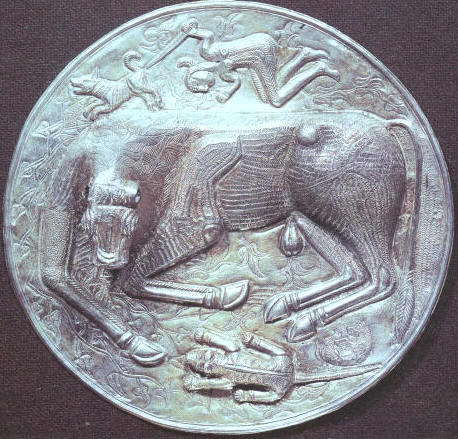
In the Norse Mythology Creation Story, http://www.native-science.net/Creation.Myth.Norse.htm the Giant Audhumbla Cow/Bull, located in the southwards warmer and lighter Muspelheim, "licked forward" the Milky Way Giant of Ymir, the northern hemisphere Milky Way figure.
The logical choice of a Bull/Cow comes from combining the Bull's roar with the thundering sound of creation in the Milky Way galaxy center. And of course when also choosing a Cow and the Utter milky symbols, this gives the natural associations to nourishing and to the white river of the Milky Way and thereby building op the the telling of how all life once began in the center of our galaxy.
On this base plate, the Bull/Cow is centered southwards as in the Milky Way center in the Star Constellation of Sagittarius, and Ymir is hovering above as the northern Milky Way contours on the Northern Earth night hemisphere. (A physical observable symbol) http://www.native-science.net/MilkyWay.GreatestGod.htm
Inner Plate A
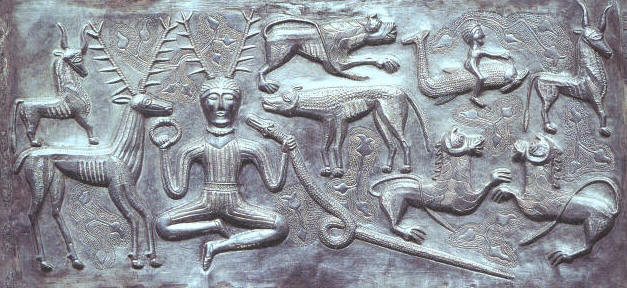
This plate shows a variety of animals around the horned figure in the center. The horned figure is presented with his legs folded and wears a torque around his neck. he holds another torque in his right hand and a horned serpent in his left hand. This torque-wearing god with stag antlers is generally identified as the Celtic god, Cernunnos. Cernunnnos is the Lord of the animals and the torques he wears are the symbols of wealth and prosperity. Cernunnos was first recognized by the inscription of the Paris monument which, along with the inscription, shows a horned deity wearing torques on his antlers. Because of this antlered deity, this plate has often been cited by those who argue for the Gaulish origin. However, this general identification of the central figure with Cernunnos has been challenged by some scholars. As early as 1971, Powell noted that there is no ground for believing that every Celtic horned god should be called "Cernunnos depending solely upon the defective inscription in Paris. In agreement with Powell, Olmsted(1979) suggests that the figure be classified as "Dieu Accroupi." According to him, all of the "accroupi" figures with antlers, torques and serpent come from north central Gaul, while only a quarter of the "accroupi" figures with one or two attributes come from outside the region.
Apart from the identity of the horned deity, it is recognized, however, that the posture and dress of the figure are not necessarily Celtic. His folded legs seen from above hint at the possible link with Buddhism in the East and his costume - tight-fitting breeches and coat fastened by a belt at the waist - is often matched by the costumes of horse-riding races from southeastern Europe. More recently, Anders Bergquist found that the shoes of the deity with zig-zag bindings are exactly the same type as those found in Thracian silver repoussé from Sãlistea and Durentsi. His discovery seems to confirm the eastern influence on the Gundestrup Cauldron for no such examples have been found in the Celtic West. |



