Jeremy Scahill: Obama Presidency Marred by Legacy of Drone Program
Throughout his term in office, President Obama has presided over misguided counterterrorism efforts.—By Jeremy Scahill
| Tue Oct. 29, 2013 11:45 AM GMT
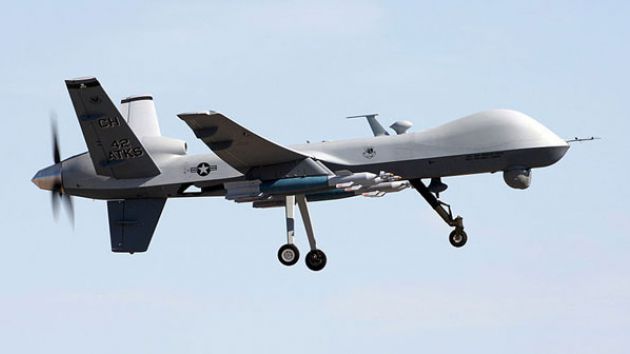 US Air Force Photo by Paul Ridgeway/Wikipedia US Air Force Photo by Paul Ridgeway/Wikipedia
This story first appeared on the TomDispatch website.
On January 21, 2013, Barack Obama was inaugurated for his second term as president of the United States. Just as he had promised when he began his first campaign for president six years earlier, he pledged again to turn the page on history and take US foreign policy in a different direction. "A decade of war is now ending," Obama declared. "We, the people, still believe that enduring security and lasting peace do not require perpetual war."
Much of the media focus that day was on the new hairstyle of First Lady Michelle Obama, who appeared on the dais sporting freshly trimmed bangs, and on the celebrities in attendance, including hip-hop mogul Jay-Z and his wife, Beyoncé, who performed the national anthem. But the day Obama was sworn in, a US drone strike hit Yemen. It was the third such attack in that country in as many days. Despite the rhetoric from the president on the Capitol steps, there was abundant evidence that he would continue to preside over a country that is in a state of perpetual war.
In the year leading up to the inauguration, more people had been killed in US drone strikes across the globe than were imprisoned at Guantánamo. As Obama was sworn in for his second term, his counterterrorism team was finishing up the task of systematizing the kill list, including developing rules for when US citizens could be targeted. Admiral William McRaven had been promoted to the commander of the United States Special Operations Command (SOCOM), and his Special Ops forces were operating in more than 100 countries across the globe.
After General David Petraeus's career was brought to a halt as a result of an extramarital affair, President Obama tapped John Brennan to replace him as director of the CIA, thus ensuring that the Agency would be headed by a seminal figure in the expansion and running of the kill program. After four years as Obama's senior counterterrorism adviser, Brennan had become known in some circles as the "assassination czar" for his role in US drone strikes and other targeted killing operations.
When Obama had tried to put Brennan at the helm of the Agency at the beginning of his first term, the nomination was scuttled by controversy over Brennan's role in the Bush-era detainee program. By the time President Obama began his second term in office, Brennan had created a "playbook" for crossing names off the kill list. "Targeted killing is now so routine that the Obama administration has spent much of the past year codifying and streamlining the processes that sustain it," noted theWashington Post.
Brennan played a key role in the evolution of targeted killing by "seeking to codify the administration's approach to generating capture/kill lists, part of a broader effort to guide future administrations through the counterterrorism processes that Obama has embraced," the paper added. "The system functions like a funnel, starting with input from half a dozen agencies and narrowing through layers of review until proposed revisions are laid on Brennan's desk, and subsequently presented to the president."
Obama's counterterrorism team had developed what was referred to as the "Disposition Matrix," a database full of information on suspected terrorists and militants that would provide options for killing or capturing targets. Senior administration officials predicted that the targeted killing program would persist for "at least another decade." During his first term in office, the Washington Postconcluded, "Obama has institutionalized the highly classified practice of targeted killing, transforming ad-hoc elements into a counterterrorism infrastructure capable of sustaining a seemingly permanent war."
Redefining "Imminent Threat"
In early 2013, a Department of Justice "white paper" surfaced that laid out the "Lawfulness of a Lethal Operation Directed Against a US Citizen." The government lawyers who wrote the 16-page document asserted that the government need not possess specific intelligence indicating that an American citizen is actively engaged in a particular or active terror plot in order to be cleared for targeted killing. Instead, the paper argued that a determination from a "well-informed high level administration official" that a target represents an "imminent threat" to the United States is a sufficient basis to order the killing of an American citizen. But the Justice Department's lawyers sought to alter the definition of "imminent," advocating what they called a "broader concept of imminence."
They wrote, "The condition that an operational leader present an 'imminent' threat of violent attack against the United States does not require the United States to have clear evidence that a specific attack on US persons will take place in the immediate future." The government lawyers argued that waiting for a targeted killing of a suspect "until preparations for an attack are concluded, would not allow the United States sufficient time to defend itself." They asserted that such an operation constitutes "a lawful killing in self-defense" and is "not an assassination."
Jameel Jaffer of the ACLU called the white paper a "chilling document," saying that "it argues that the government has the right to carry out the extrajudicial killing of an American citizen." Jaffer added, "This power is going to be available to the next administration and the one after that, and it's going to be available in every future conflict, not just the conflict against al-Qaeda. And according to the [Obama] administration, the power is available all over the world, not just on geographically cabined battlefields. So it really is a sweeping proposition."
In October 2002, as the Bush administration prepared to invade Iraq, Barack Obama gave the first major speech of his national political career. The then-state senator came out forcefully against going to war in Iraq, but he began his speech with a clarification. "Although this has been billed as an anti-war rally, I stand before you as someone who is not opposed to war in all circumstances… I don't oppose all wars." Obama declared, "What I am opposed to is a dumb war. What I am opposed to is a rash war." During his first campaign for president, Obama had blasted the Bush administration for fighting the wrong war—Iraq—and repeatedly criticized his opponent, Senator John McCain, for not articulating how he would take the fight to Osama bin Laden and al-Qaeda.
As his first term in office wound down, the overwhelming majority of US military forces had been withdrawn from Iraq and plans for a similar drawdown in Afghanistan in 2014 were being openly discussed. The administration had succeeded in convincing the American public that Obama was waging a smarter war than his predecessor. As he ran for reelection, Obama was asked about charges from his Republican opponents that his foreign policy was based on appeasement. "Ask Osama bin Laden and the 22 out of 30 top al-Qaeda leaders who have been taken off the field whether I engage in appeasement," Obama replied. "Or whoever is left out there, ask them about that."
As the war on terror entered a second decade, the fantasy of a clean war took hold. It was a myth fostered by the Obama administration, and it found a ready audience. All polls indicated that Americans were tired of large military deployments in Iraq and Afghanistan and the mounting US troop casualties that came with them. A 2012 poll found that 83% of Americans supported Obama's drone program, with 77% of self-identified liberal Democrats supporting such strikes. The Washington Post–ABC News poll determined that support for drone strikes declined "only somewhat" in cases where a US citizen was the target.
President Obama and his advisers seldom mentioned the drone program publicly. In fact, the first known confirmation of the use of armed drones by the president came several years into Obama's first term. It was not in the form of a legal brief or a press conference, but rather on a Google+ "Hangout" as the president took questions from the public. Obama was asked about his use of drones. "I want to make sure that people understand actually drones have not caused a huge number of civilian casualties," Obama said. "For the most part, they have been very precise, precision strikes against al-Qaeda and their affiliates. And we are very careful in terms of how it's been applied."
He rejected what he called the "perception" that "we're just sending in a whole bunch of strikes willy-nilly" and asserted that "this is a targeted, focused effort at people who are on a list of active terrorists, who are trying to go in and harm Americans, hit American facilities, American bases, and so on." Obama added: "It is important for everybody to understand that this thing is kept on a very tight leash. It's not a bunch of folks in a room somewhere just making decisions. And it is also part and parcel of our overall authority when it comes to battling al-Qaeda. It is not something that's being used beyond that."
Michael Boyle, a former adviser in the Obama campaign's counterterrorism experts group and a professor at LaSalle University, said that one of the reasons the administration was "so successful in spinning the number of civilian casualties" was the use of signature strikes and other systems for categorizing military-aged males as legitimate targets, even if their specific identities were unknown. "The result of the 'guilt by association' approach has been a gradual loosening of the standards by which the US selects targets for drone strikes," Boyle charged. "The consequences can be seen in the targeting of mosques or funeral processions that kill non-combatants and tear at the social fabric of the regions where they occur." No one, he added, "really knows the number of deaths caused by drones in these distant, sometimes ungoverned, lands."
Using drones, cruise missiles, and Special Ops raids, the United States has embarked on a mission to kill its way to victory. The war on terror, launched under a Republican administration, was ultimately legitimized and expanded by a popular Democratic president. Although Barack Obama's ascent to the most powerful office on Earth was the result of myriad factors, it was largely due to the desire of millions of Americans to shift course from the excesses of the Bush era.
Had John McCain won the election, it is difficult to imagine such widespread support, particularly among liberal Democrats, for some of the very counterterrorism policies that Obama implemented. As individuals, we must all ask whether we would support the same policies—the expansion of drone strikes, the empowerment of Joint Special Operations Command (JSOC), the use of the State Secrets Privilege, the use of indefinite detention, the denial of habeas corpus rights, the targeting of US citizens without charge or trial—if the commander in chief was not our candidate of choice.
But beyond the partisan lens, the policies implemented by the Obama administration will have far-reaching consequences. Future US presidents—Republican or Democratic—will inherit a streamlined process for assassinating enemies of America, perceived or real. They will inherit an executive branch with sweeping powers, rationalized under the banner of national security.
Assassinating Enemies
In 2012, a former constitutional law professor was asked about the US drone and targeted killing program. "It's very important for the president and the entire culture of our national security team to continually ask tough questions about 'Are we doing the right thing? Are we abiding by the rule of law? Are we abiding by due process?'" he responded, warning that it was important for the United States to "avoid any kind of slippery slope into a place where we're not being true to who we are."
That former law professor was Barack Obama.
The creation of the kill list and the expansion of drone strikes "represents a betrayal of President Obama's promise to make counterterrorism policies consistent with the US constitution," charged Boyle. Obama, he added, "has routinized and normalized extrajudicial killing from the Oval Office, taking advantage of America's temporary advantage in drone technology to wage a series of shadow wars in Afghanistan, Pakistan, Yemen, and Somalia. Without the scrutiny of the legislature and the courts, and outside the public eye, Obama is authorizing murder on a weekly basis, with a discussion of the guilt or innocence of candidates for the 'kill list' being resolved in secret." Boyle warned:
"Once Obama leaves office, there is nothing stopping the next president from launching his own drone strikes, perhaps against a different and more controversial array of targets. The infrastructure and processes of vetting the 'kill list' will remain in place for the next president, who may be less mindful of moral and legal implications of this action than Obama supposedly is."
In late 2012, the ACLU and the New York Times sought information on the legal rationale for the kill program, specifically the strikes that had killed three US citizens—among them 16-year-old Abdulrahman Awlaki. In January 2013, a federal judge ruled on the request. In her decision, Judge Colleen McMahon appeared frustrated with the White House's lack of transparency, writing that the Freedom of Information Act (FOIA) requests raised "serious issues about the limits on the power of the Executive Branch under the Constitution and laws of the United States, and about whether we are indeed a nation of laws, not of men."
She charged that the Obama administration "has engaged in public discussion of the legality of targeted killing, even of citizens, but in cryptic and imprecise ways, generally without citing to any statute or court decision that justifies its conclusions." She added, "More fulsome disclosure of the legal reasoning on which the administration relies to justify the targeted killing of individuals, including United States citizens, far from any recognizable 'hot' field of battle, would allow for intelligent discussion and assessment of a tactic that (like torture before it) remains hotly debated. It might also help the public understand the scope of the ill-defined yet vast and seemingly ever-growing exercise."
Ultimately, Judge McMahon blocked the release of the documents. Citing her legal concerns about the state of transparency with regard to the kill program, she wrote:
"This Court is constrained by law, and under the law, I can only conclude that the Government has not violated FOIA by refusing to turn over the documents sought in the FOIA requests, and so cannot be compelled by this court of law to explain in detail the reasons why its actions do not violate the Constitution and laws of the United States. The Alice-in-Wonderland nature of this pronouncement is not lost on me; but after careful and extensive consideration, I find myself stuck in a paradoxical situation in which I cannot solve a problem because of contradictory constraints and rules—a veritable Catch-22. I can find no way around the thicket of laws and precedents that effectively allow the Executive Branch of our Government to proclaim as perfectly lawful certain actions that seem on their face incompatible with our Constitution and laws, while keeping the reasons for their conclusion a secret."
How to Make Enemies and Not Influence People
It is not just the precedents set during the Obama era that will reverberate into the future, but also the lethal operations themselves. No one can scientifically predict the future consequences of drone strikes, cruise missile attacks, and night raids. But from my experience in several undeclared war zones across the globe, it seems clear that the United States is helping to breed a new generation of enemies in Somalia, Yemen, Pakistan, Afghanistan, and throughout the Muslim world.
Those whose loved ones were killed in drone strikes or cruise missile attacks or night raids will have a legitimate score to settle. In an October 2003 memo, written less than a year into the US occupation of Iraq, Donald Rumsfeld framed the issue of whether the United States was "winning or losing the global war on terror" through one question: "Are we capturing, killing, or deterring and dissuading more terrorists every day than the madrassas and the radical clerics are recruiting, training, and deploying against us?"
More than a decade after 9/11, that question should be updated. At the end of the day, US policymakers and the general public must all confront a more uncomfortable question: Are our own actions, carried out in the name of national security, making us less safe or more safe? Are they eliminating more enemies than they are inspiring? Boyle put it mildly when he observed that the kill program's "adverse strategic effects… have not been properly weighed against the tactical gains associated with killing terrorists."
In November 2012, President Obama remarked that "there's no country on Earth that would tolerate missiles raining down on its citizens from outside its borders." He made the statement in defense of Israel's attack on Gaza, which was launched in the name of protecting itself from Hamas missile attacks. "We are fully supportive of Israel's right to defend itself from missiles landing on people's homes and workplaces and potentially killing civilians," Obama continued. "And we will continue to support Israel's right to defend itself." How would people living in areas of Yemen, Somalia, or Pakistan that have been regularly targeted by US drones or missile strikes view that statement?
Toward the end of President Obama's first term in office, the Pentagon's general counsel, Jeh Johnson, gave a major lecture at the Oxford Union in England. "If I had to summarize my job in one sentence: it is to ensure that everything our military and our Defense Department do is consistent with US and international law," Johnson said. "This includes the prior legal review of every military operation that the Secretary of Defense and the President must approve."
As Johnson spoke, the British government was facing serious questions about its involvement in US drone strikes. A legal case brought in the United Kingdom by the British son of a tribal leader killed in Pakistan alleged that British officials had served as "secondary parties to murder" by providing intelligence to the United States that allegedly led to the 2011 strike. A U.N. commission was preparing to launch an investigation into the expanding kill program, and new legal challenges were making their way through the US court system. In his speech, Johnson presented the US defense of its controversial counterterror policies:
"Some legal scholars and commentators in our country brand the detention by the military of members of al-Qaeda as 'indefinite detention without charges.' Some refer to targeted lethal force against known, identified individual members of al-Qaeda as 'extrajudicial killing.'
"Viewed within the context of law enforcement or criminal justice, where no person is sentenced to death or prison without an indictment, an arraignment, and a trial before an impartial judge or jury, these characterizations might be understandable.
"Viewed within the context of conventional armed conflict—as they should be—capture, detention, and lethal force are traditional practices as old as armies."
The Era of the Dirty War on Terror
In the end, the Obama administration's defense of its expanding global wars boiled down to the assertion that it was in fact at war; that the authorities granted by the Congress to the Bush administration after 9/11 to pursue those responsible for the attacks justified the Obama administration's ongoing strikes against "suspected militants" across the globe—some of whom were toddlers when the Twin Towers crumbled to the ground—more than a decade later.
The end result of the policies initiated under President Bush and continued and expanded under his Democratic successor was to bring the world to the dawn of a new age, the era of the Dirty War on Terror. As Boyle, the former Obama campaign counterterrorism adviser, asserted in early 2013, the US drone program was "encouraging a new arms race for drones that will empower current and future rivals and lay the foundations for an international system that is increasingly violent."
Today, decisions on who should live or die in the name of protecting America's national security are made in secret, laws are interpreted by the president and his advisers behind closed doors, and no target is off-limits, including US citizens. But the decisions made in Washington have implications far beyond their impact on the democratic system of checks and balances in the United States.
In January 2013, Ben Emmerson, the U.N. special rapporteur on counterterrorism and human rights, announced his investigation into drone strikes and targeted killing by the United States. In a statement launching the probe, he characterized the US defense of its use of drones and targeted killings in other countries as "Western democracies… engaged in a global [war] against a stateless enemy, without geographical boundaries to the theatre of conflict, and without limit of time." This position, he concluded, "is heavily disputed by most States, and by the majority of international lawyers outside the United States of America."
At his inauguration in January 2013, Obama employed the rhetoric of internationalism. "We will defend our people and uphold our values through strength of arms and rule of law. We will show the courage to try and resolve our differences with other nations peacefully—not because we are naive about the dangers we face, but because engagement can more durably lift suspicion and fear," the president declared. "America will remain the anchor of strong alliances in every corner of the globe; and we will renew those institutions that extend our capacity to manage crisis abroad, for no one has a greater stake in a peaceful world than its most powerful nation."
Yet, as Obama embarked on his second term in office, the United States was once again at odds with the rest of the world on one of the central components of its foreign policy. The drone strike in Yemen the day Obama was sworn in served as a potent symbol of a reality that had been clearly established during his first four years in office: US unilateralism and exceptionalism were not only bipartisan principles in Washington, but a permanent American institution. As large-scale military deployments wound down, the United States had simultaneously escalated its use of drones, cruise missiles, and Special Ops raids in an unprecedented number of countries. The war on terror had become a self-fulfilling prophecy.
The question all Americans must ask themselves lingers painfully: How does a war like this ever end?
Jeremy Scahill is national security correspondent for the Nation magazine and author of the New York Times bestsellers Blackwater: The Rise of the World's Most Powerful Mercenary Army and most recently Dirty Wars: The World Is a Battlefield(both published by Nation Books). He is also the subject, producer, and writer of the film Dirty Wars, an official selection of the 2013 Sundance Film Festival, where it won the US documentary cinematography prize, now available on DVD. This essay is the epilogue to his book Dirty Wars.
Follow TomDispatch on Twitter and join us on Facebook or Tumblr. Check out the newest Dispatch book, Nick Turse's The Changing Face of Empire: Special Ops, Drones, Proxy Fighters, Secret Bases, and Cyberwarfare.
PreviousPage 2 of 2 |



