More Evidence That Antibiotic Resistance Existed LONG BEFORE Antibiotics Were Developed
Posted by jlwile on March 3, 2014
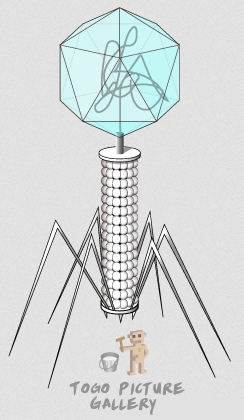 This is a drawing of a bacteriophage, a virus that attacks bacteria. (click for credit) This is a drawing of a bacteriophage, a virus that attacks bacteria. (click for credit)
Many people know that bacteria have developed resistance to popular antibiotics. Indeed, it is a big problem in medicine, and it has caused many health-care providers to call for doctors to prescribe antibiotics only when they are necessary. The Centers for Disease Control calls this “antibiotic stewardship” and thinks it will improve medical care throughout the country.1 I have written about antibiotic resistance before (see here and here), because some evolutionists try to cite it in support of the idea that novel, useful genes can be produced by evolutionary processes. Of course, the more we have studied the phenomenon, the more we have seen that this is just not the case.
There are essentially two ways that a bacterium develops resistance to an antibiotic. One way is to have a mutation that confers the resistance. For example, a bacterium can become resistant to streptomycin if a mutation causes a defect in the bacterium’s protein-making factory, which is called the ribosome. That defect keeps streptomycin from binding to the ribosome, which makes streptomycin ineffective against the bacterium. However, it also makes the ribosome significantly less efficient at its job.2 So in the end, rather than producing something novel (like a new gene that fights the antibiotic), the mutation just deteriorates a gene that already existed. While this is good for a bacterium in streptomycin, it doesn’t provide any evidence that novel, useful genes can be produced by evolutionary processes.
There is, however, a second way that a bacterium can develop resistance to an antibiotic: It can get genes that fight the antibiotic from another bacterium. Bacteria hold many genes on tiny, circular portions of their DNA called plasmids. Two bacteria can come together in a process called conjugation and exchange those plasmids, which allows bacteria to “swap” DNA. If a bacterium has a gene (or a set of genes) that allows it to resist an antibiotic, it can pass those genes to others in the population, ensuring their survival.
Of course, the natural question one must ask is, “Where did those antibiotic-resistance genes come from in the first place?” Many evolutionists want you to believe that evolution produced those genes in response to the development of antibiotics. After all, antibiotics didn’t exist until 1941, when penicillin was tested in animals and then people. Why would antibiotic-resistance genes exist before the antibiotics?
Well, it turns out that they did exist long before the development of antibiotics. As I wrote previously, some antibiotic-resistance genes were found in soil alongside mammoths! The mammoths died out quite some time before antibiotics existed, so it is very clear that these genes were not produced in response to antibiotics. A new study brings this fact closer to home.
In Namur, Belgium, a construction project uncovered latrines from the Middle Ages. Christelle Desnues and her colleagues studied the fossilized feces (some people are really committed to their science!), which is called coprolite to make it sound a little less disgusting. They drilled into the center of the coprolite and examined a sample under an electron microscope. They found several structures that were clearly viruses, so they sequenced the viral DNA that they could extract from the sample.3
They found two very interesting things. First, the viruses had all sorts of antibiotic-resistance genes in them. It turns out that bacteriophages are another means by which DNA gets transferred among bacteria. So the fact that these viruses had antibiotic-resistance genes indicates that the bacteria they were infecting back in the Middle Ages had those genes as well! While this doesn’t show that antibiotic-resistance genes have been around since the time of the mammoths, it does show that bacteria which are associated with people had them several hundred years before antibiotics were invented. Indeed, the authors state:
Here, we demonstrate that bacteriophages are an ancient reservoir of resistance genes associated with human samples that date back as far as the Middle Ages.
Since this isn’t news (except to students who have been taught incorrectly), it’s not the most interesting finding of the study. The most interesting finding is that the antibiotic-resistance genes in the viruses from the Middle Ages were more diverse than the antibiotic-resistance genes we see in modern-day viruses. In other words, based on this study, it seems that bacteria from the Middle Ages had more antibiotic-resistance genes than modern bacteria do! So far from producing such genes, it seems that evolution might have destroyed some of them over the past 700 years! This, of course, is consistent with Dr. John C. Sanford’s view that genomes deteriorate over time, despite the work of natural selection.
REFERENCES1. “Antibiotic Resistance Threats in the United States, 2013,” U.S. Department of Health and Human Services publication, p. 41 ( available online).
Return to Text
2. Gartner, T. and Orias, E., “Effects of mutations to streptomycin resistance on the rate of translation of mutant genetic information,” Journal of Bacteriology 91:1021–1028, 1966.
Return to Text
3. Sandra Appelt, Laura Fancello, Matthieu Le Bailly, Didier Raoult, Michel Drancourt, and Christelle Desnues, “Viruses in a 14th-century coprolite,” Applied and Environmental Microbiology, 2014, doi:10.1128/AEM.03242-13
Return to Text
http://blog.drwile.com/?p=12224 |



