SI
SI
discoversearch

We've detected that you're using an ad content blocking browser plug-in or feature. Ads provide a critical source of revenue to the continued operation of Silicon Investor.  We ask that you disable ad blocking while on Silicon Investor in the best interests of our community.  If you are not using an ad blocker but are still receiving this message, make sure your browser's tracking protection is set to the 'standard' level.
Politics : Formerly About Apple, Inc. Unmoderated -- Ignore unavailable to you. Want to Upgrade?


To: MGV who wrote (3640)5/4/2014 7:04:36 PM
From: Road Walker4 Recommendations

Recommended By
dhellman
HerbVic
pyslent
sylvester80

  Read Replies (2) | Respond to of 11191
 
stay out of my way

Sorry man, you've got my interest. You're too bizarre are to ignore. Seriously, just be yourself and I'll try not to get in your way.


To: MGV who wrote (3640)5/6/2014 8:33:50 AM
From: sylvester80  Respond to of 11191
 
Lenovo launches a pair of new affordable Chromebooks starting at $279
May 6th 2014 by Quentyn Kennemer
phandroid.com
Lenovo might not have a strong global presence when it comes to mobile, but they’re continuing their successful PC strategy by adding another pair of Chromebook devices to their arsenal.


Lenovo has announced the N20 and N20p, two devices which won’t change your computing life but could be decent snags for their affordable price tags. Here’s the quick rundown on the two devices’ common specs:

  • 11.6-inch 1366 x 768 display
  • Intel Celeron Haswell processor
  • 2GB of RAM (models with up to 4GB will be available)
  • Up to 16GB of internal storage (100GB of Drive storage included)
  • Up to 8 hours of battery life
  • Bluetooth 4.0 and WiFi
  • Front-facing webcam
  • Less than 1.4kg heavy and less than 17.9mm thin
  • The difference between the two? The N20 is just your regular ol’ laptop, while the N20p can swivel backwards 300 degrees to create a “tent” stance, of sorts, allowing you to prop your device up to watch videos at a comfortable viewing angle. It also features a 10-point multitouch screen.

    The when and the how much are already known, with Lenovo saying to expect the the N20 in July for $270, while the N20p model will be coming in August starting at $330. We’ll have to wait a while yet for pricing and availability details on upgraded models, but this is a good baseline for you to decide whether or not you want one once they arrive this summer.


    To: MGV who wrote (3640)5/6/2014 8:34:29 AM
    From: sylvester80  Respond to of 11191
     
    Samsung Chromebook 2 official, brings decent specs for decent price
    Mar 3rd 2014 by Quentyn Kennemer
    phandroid.com

    Ready for a new Chromebook option? The latest comes from Samsung, who has launched their second generation Chromebook for those looking for something a bit different (and cheaper) than typical notebook experiences. The Samsung Chromebook 2 will come in two sizes: one will stretch 11 inches at 1366 x 768, while the other is increased to about 13 inches and also comes with a 1920 x 1080 resolution.


    The only other difference is only in price, with the smallest option slated for a $320 price point, and the bigger one coming in at just $80 more. So what are you getting for all those bucks?

  • Octacore Exyno processor, the same one found in certain variants of the Samsung Galaxy S5 (1.9GHz for 11-inch, 2.1GHz for 13-inch
  • 4GB of RAM and 16GB of internal storage
  • Bluetooth 4.0, 1x HDMI, 1x USB3.0, 1x USB 2.0, microSD multi-reader slot
  • 8.5 hours of battery life and a 720p HD webcam
  • Also obvious is the new design language — they’ve gone with the same stitched fake-leather backing that we saw on the Samsung Galaxy Note 3. It looks quite nice from where we’re sitting, though we’ll have to get our dirty paws on it to see how we like it in person.


    Samsung’s also touting over $100 in premium services, including a year’s worth of premium membership to AirDroid for managing your Android device over-the-air, Wunderlist Pro for organizing your tasks, and LittleBridge.com for learning English.

    While beautiful, powerful devices like the Chromebook Pixel are great for showcasing the sheer power of Chrome OS, it’s these more affordable options by the likes of Samsung that have helped push Chromebooks to the bit of growth it’s already seeing. The platform soared to the tune of owning 21% of notebook market share in 2013, which is no small feat.

    Let’s hope even more of that growth is in-store for 2014, with other manufacturers hopefully jumping into the fold.It’s all headed our way this April, though Samsung didn’t have any solid date to offer just yet.

    [ Samsung via ChromeSpot]


    To: MGV who wrote (3640)5/6/2014 9:26:53 PM
    From: sylvester80  Respond to of 11191
     
    BREAKING.. The death of Apple in education sales is one step closer; Chrome OS comes of age
    By Joe Wilcox
    Published 9 hours ago
    betanews.com


    Today's Google-Intel event is a turning point for Chrome OS. The matchup is more magnanimous than Apple shipping the first x86 Macs eight years ago. Intel is after all the other half of Wintel, and the company's coming out for Chrome OS endorses the browser-based operating system as mainstream -- as do a rash of new Chromebooks announced or released over the past month by Acer, Dell, Lenovo, and Samsung.

    Chrome OS has huge momentum in the education market, for example. There are news stories about school conversions nearly every week. Those are sales taken away from Apple or Microsoft platforms. Success is shocking, because every new operating system directly competing with Windows has failed since release of version 3.1 two decades ago. The Microsoft monopoly is insurmountable, or was until Google's entrance.

    Without Precedant

    Chrome OS success defies historical precedent. The old axiom is this: no one launches a new desktop PC operating system and succeeds, because:

    There aren’t enough applicationsSwitching costs are too high, particularly for businessesThe new thing doesn’t fit in with what people already haveThe first is typically the most difficult. Rival Windows operating systems, like BeOS, failed if for no other reason than the chicken-egg scenario. Which comes first? Platforms need
    applications to succeed, but developers have little financial incentive to create them when adoption is low. If there are no apps, people don't adopt the platform.

    Google has apps -- lots of them -- and Chrome OS benefits from more than two decades of browser development.

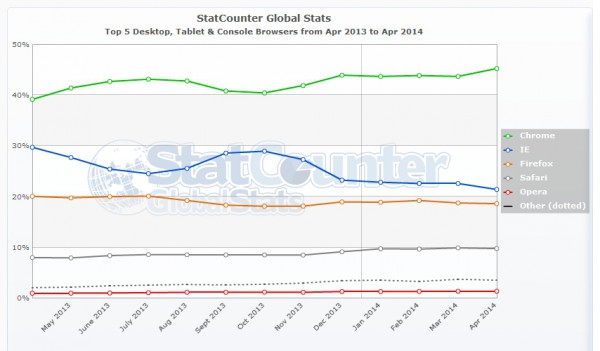
    Chrome is itself a remarkable success story. The browser launched in December 2008. Half-decade later, StatCounter puts Chrome’s global browser usage share at 45.22 percent, up from essentially nothing five years earlier. By comparison, Microsoft Internet Explorer is 21.43 percent (April 2014).

    Chrome and Chrome OS rise like specters to haunt Microsoft and Windows. They reincarnate Netscape Communications’ vision of the browser as a platform for delivering applications. Founded in 1994, Netscape Communications developed the first commercial web browser and set in motion Wall Street’s obsession with Silicon Valley startup IPOs.

    But earlier, even while distracted developing Windows 95, Microsoft cofounder Bill Gates looked to dangers ahead. In his May 1995 " Internet Tidal Wave" memo, Gates wrote that "browsing the web, you find almost no Microsoft file formats". He observed not seeing a single Microsoft file format "after 10 hours of browsing", but plenty of Apple QuickTime videos and Adobe PDF documents. Microsoft’s visionary founder predicted: "The Internet is the most important single development to come along since the IBM PC was introduced in 1981. It is even more important than the arrival of the graphical user interface".

    Gates saw in Netscape a platform threat to Windows, and the startup sought developers to create applications for the browser instead of traditional operating systems. Responding, Microsoft engaged in what the U.S. Justice Department later characterized as the "browser wars", leveraging the Windows monopoly to crush market-leading Netscape.

    Whether by measure of browser or operating system, Google has created the rival platform Netscape product managers envisioned in the late 1990s.

    Specter Rises

    Within six months of Chrome’s release, Google revealed intentions much larger than just Internet browsing -- Chrome OS in mid 2009. The search giant repositioned the browser as a rival development platform, but one still requiring a third-party operating system -- mainly OS X or Windows. Chrome OS pushed forward a more radical vision, with Google as primary platform developer.

    In June 2007, I wrote "Why Google Succeeds" for Microsoft Watch; the content remains hugely relevant seven years later (but, sigh, the site no longer exists). "Unchecked, Google is on course to be the next hugely successful computing platform", I predicted. Microsoft mis-identified the competitive problem in the late 1990s -- not Netscape but the web itself. Already, by mid last decade, many developers had made the web priority over Windows; hence, cloud computing. "Developer interest in the web platform -- and the promise of information access anytime, anywhere, and on anything -- shifts standards away from Microsoft’s dominant platforms", I explained in 2007. Google rode the web platform’s coattails, pushing adopted or open standards along the way.


    Google had the foresight to launch the Chrome Web Store in 2010. Web apps run in the browser or Google OS. So anyone using Chrome can carry them to the operating system. The search and information giant also provides a tightly-integrated suite of cloud services, such as Docs and Gmail, that cover categories businesses already use; switching is as easy as logging into Google Account on a new PC; Chrome OS fits because the browser is the most familiar motif people use every day.

    Feels Familiar

    That segues back to the other two reasons why platforms fail, switching costs fall for consumers or businesses that already have adopted Google cloud products and services. If your company uses Google Docs, for example, training and other costs related to moving from Office are already actualized. Finally, leveraged from search, many Google products or platforms -- and third-party developers supporting them -- are familiar. They fit with users’ digital lifestyles.

    With Chrome, Google presents a vividly familiar user interface. For years, Microsoft has pitched the value of Office and the extension of its motif to educational and business IT purchasers. Rationale: The number of people who work in Office make the UI natural. Perhaps, but the Internet population using browsers is larger. The browser has greater value as the most natural user interface -- not necessarily for being better but for being ubiquitous. Google makes the familiar browser the gateway to all things Chromebook.

    Chrome OS isn’t pretty, but the browser motif is remarkably functional. Chrome fills the screen and contains most task-related actions to a single, horizontal quadrant that also is more eye level. You look away from the working screen area less often, as the eye shifts from browser tab to tab. Tabs are tidy. Anyone could mimic such behavior by running the Chrome browser full screen on Mac or Windows PC and using only cloud services and web apps. Try this for a week and see if you find the tabbed browser a less-distracting, less-time-wasting way of working.

    Microsoft is in no immediate danger of losing its two desktop monopolies, but Chrome OS and supporting web apps erode them bit by bit, which is success no other modern operating system can claim. Apple's platform predates Windows 3.1, and, yes, new architecture debuted 13 years ago. Linux's traction is mostly confined to servers. There is little desktop adoption. Until now, since Chrome OS is essentially a browser running on top of a Linux core.

    Google-Intel -- Googtel, if you prefer -- marks Chrome OS coming of age. Gates' nightmare scenario seen nearly 20 years ago is pure paranormal activity. Be afraid. Be very afraid.

    Editor's Note: This post excerpts from ebook Chromebook Matters.

    Photo Credit: Joe Wilcox


    To: MGV who wrote (3640)5/6/2014 10:05:17 PM
    From: sylvester80  Respond to of 11191
     
    Google formally unveils new Bay Trail Chromebooks and more
    Andrew GrushU.S. Editor
    BY ANDREW GRUSH MAY 6, 2014
    androidauthority.com


    Earlier today, Google, Intel and a few key partners hosted a Chrome OS event where they formally unveiled a slew of new Intel-powered devices. While some of the devices like the LG Chromebase and HP Chromebox were announced a while back, today we learned that HP’s Chromebox will land in stores in June and the LG Chromebase 21-inch all-in-one will hit Amazon, NewEgg and other partners on May 26th for a price of $349.

    As for the new stuff? For one thing, we’re about to get two somewhat higher-end Chromebooks, as i3 variants of the Dell Chromebook 11 and Acer C720 are on their way in time for “back to school” priced at $349.99. The biggest news, however, is that Intel will be pushing forward with several next-gen Intel Bay Trail-M devices that will offer up to 11 hours of battery life and a fanless design.

    In addition to the recently announced Lenovo N20 and N20p, there’s also a Bay Trail-powered Acer Chromebook 2014 and two Asus models: the 11.6-inch C200 Chromebook and the 13.3-inch C300. Both the Asus and Acer Chromebooks are expected to arrive sometime this summer, though no exact release details are given.


    Google and Intel also touched on the fact that we’re about to see the number of Chromebook partners increase dramatically with as many as “20 designs”, including products from lesser known brands like Hexa and CTL.

    On the software side, Google also revealed a bit about its plans for new Chrome OS features. This includes the promise of easier voice activated features and even a new Google Play update that brings the Play Movies and TV app to Chrome OS, alongside support for offline viewing.

    Bottom-line, Google, Intel and several other manufacturers are dedicated to greatly expanding the reach of Chrome OS. Considering the brand was once only limited to a handful of models with a very limited consumer reach, things have certainly come a long way.

    Are you excited for the future of Chromebooks, or not quite sold on the idea just yet? Should Microsoft be worried by now?


    To: MGV who wrote (3640)5/6/2014 10:07:10 PM
    From: sylvester80  Respond to of 11191
     
    Google unveils 'Classroom' -- a new tool for teachers
    By Brian FagioliPublished 9 hours ago
    betanews.com


    Modern classrooms are often anything but -- they can be very outdated. This comes down to many factors, including funding. However, antiquated techniques that are still in practice can be blamed on a lack of technology too. Teachers are not always educated in the newest education management software. Even if they are, it can sometimes be clunky and not cost effective.

    Google is aiming to change this with a new tool it calls Classroom. This teaching management solution will eventually be a part of the Google Apps for Education (at no additional charge). Today, to celebrate Teacher Appreciation Day, the search giant is accepting applications from teachers to test it.


    "As a former high school math teacher, I know all too well that teachers spend a ton of valuable time doing things other than teaching -- waking up early to grade quizzes, collecting and returning piles of paper assignments, and battling copy machine paper jams. But with today's technology it doesn't have to be this way. Many teachers and professors have found ways to use technology to be better educators and avoid busy work. We spent the past year working closely with many educators to understand the systems they use to simplify their workloads, so they can get back to doing what they love -- teaching", says Zach Yeskel, Classroom product manager.

    Yeskel further explains, "in honor of Teacher Appreciation Day, we're announcing a preview of Classroom, a new, free tool in the Google Apps for Education suite. It helps teachers create and organize assignments quickly, provide feedback efficiently, and communicate with their classes with ease. Classroom is based on the principle that educational tools should be simple and easy to use, and is designed to give teachers more time to teach and students more time to learn".

    Create and collect assignments: Classroom weaves together Google Docs, Drive and Gmail to help teachers create and collect assignments paperlessly. They can quickly see who has or hasn't completed the work, and provide direct, real-time feedback to individual students.Improve class communications: Teachers can make announcements, ask questions and comment with students in real time -- improving communication inside and outside of class.Stay organized: Classroom automatically creates Drive folders for each assignment and for each student. Students can easily see what's due on their Assignments page.As you can see, Google has definitely done its homework (pun intended) regarding what teachers need. Organization and communication are key for success in a classroom. Students will have no excuse for missing an assignment or claiming a teacher forgot to tell the class about something. Of course, that won't stop them from trying to say the dog ate their homework!

    If you are a teacher that is interested in signing up for the preview, you can do so here.


    Photo Credit: racorn/ Shutterstock


    To: MGV who wrote (3640)5/6/2014 10:22:02 PM
    From: sylvester80  Respond to of 11191
     
    AMD finally embraces Android as it looks beyond Windows
    Agam Shah@agamsh
    May 6, 2014 1:42 PMprint
    pcworld.com
    After flirting with the idea for more than a year, Advanced Micro Devices has finally provided concrete details for bringing Android to its chips as the company looks to support more operating systems beyond Windows.

    AMD will support Android on its 64-bit ARM-based chips starting next year, the company said in a press conference this week where it announced Project SkyBridge, a series of products that will provide the plumbing for its ARM and x86 cores to be interchanged or combined on a single motherboard.

    AMD is bringing Android only to ARM architecture, not x86, which is used in Windows and Linux PCs. AMD in the past has maintained that Android would work best with ARM processors, which are used in most tablets and smartphones. Intel has already built a flavor of Android for its x86 chips.

    Meet Project SkyBridgeThe new ARM and x86 chips made as part of Project SkyBridge could appear in ultra-thin client devices—which may include tablets—and also embedded devices, said Lisa Su, general manager of AMD’s global business units, during the media event.

    AMD is not targeting smartphones, because it wants to focus on products that can deliver a strong computing and graphics experience, Su said.

    With Project SkyBridge, device makers will be able to design Android products that will harness the joint computing power of ARM Cortex-A57 64-bit chips and AMD’s Graphics Core Next (GCN) GPUs. The AMD-led HSA (Heterogeneous System Architecture) Foundation is developing programming tools and standards so all the processing units can operate in tandem to speed up a system, but AMD’s ARM processors are not yet compliant with HSA’s standards.

    “This will also be the first Android platform that we have at AMD with our heterogeneous systems architecture,” Su said.

    A chart showed Project SkyBridge supporting Android, Windows and Linux, and AMD is making a series of new x86 and Android-compatible, ARM-based chips that are pin compatible. The chips will be made using the 20-nanometer manufacturing process, and are on track for delivery to device makers next year, Su said.

    Expanding AMD's optionsAndroid may not be a priority for AMD, but it has to add support for the OS if it wants to compete in the tablet and thin-and-light market, analysts said.

    “[Android] would go into tablets, and to the extent that ARM makes headway, into clamshells,” said Nathan Brookwood, principal analyst at Insight 64.

    Unlike Intel, which relies on x86, AMD is trying to keep a flexible chip strategy and wants to offer x86 and ARM chips to customers, Brookwood said. AMD licensed ARM in 2012, and has announced a lineup of low-power and server cores based on the architecture.

    “They are focusing their low-power x86 on Windows, and to get to tablets on ARM, they will do Android,” Brookwood said.

    AMD could also tune Android for embedded devices used in cars, the military and other areas, said Jim McGregor, principal analyst at Tirias Research.

    “A good example would be infotainment where you may want to use a third-party app,” McGregor said.

    Android could open up a new market for AMD’s tablet chips, which currently support only Windows. AMD’s previous Z-01, Z-60 and Temash tablet chips were used in a handful of Windows 8 tablets, none of which sold well. Last week AMD launched its latest Mullins chip for tablets, which supports only the Windows OS. However, users can add a virtual layer of Android through the Bluestacks emulator.

    No broken WindowsBut support for Android doesn’t mean AMD will abandon Windows.

    “Windows has a well-established franchise and is primarily an x86 play,” Brookwood said. “AMD is one of two companies that can play with x86. That would be silly for them not to exploit it to their fullest capability.”

    Support for Android will also help AMD achieve its long-term goal of putting its chips in non-PC products, McGregor said. AMD is trying to diversity its operations by designing custom chips for non-PC products like game consoles and servers, and support for a variety of operating systems is important.

    It may be technically possible to build a dual-boot Windows and Android PC through a Project SkyBridge motherboard with an x86 and an ARM core. But analysts said that dual-boot systems would require many changes in the BIOS, and users may not be attracted to the Windows and Android disconnect with the files residing in two different file systems.

    “Dual-boot systems ... don’t make sense” for Project SkyBridge, Brookwood said.


    To: MGV who wrote (3640)5/7/2014 1:13:38 AM
    From: sylvester80  Respond to of 11191
     
    Android Still Growing Market Share By Winning First Time Smartphone Users
    Posted 12 hours ago by Natasha Lomas ( @riptari)
    techcrunch.com
    Android is continuing its onward march. The latest market figures from analyst ABI Research peg the platform at 80% marketshare of smartphone OSes, with just under 300 million smartphones running Android — or an Android fork — shipped in the quarter.

    The analyst notes that basic mobile phone operating systems lost 5% share in the quarter — with Android hovering up most of those users as they upgrade to smartphones.

    That suggests Google’s mobile platform is set to be the biggest winner as the “billions” of remaining mobile subscribers upgrade to smartphones — helping to keep what is already the dominant smartphone platform ahead of the competition.

    “Android looks set to completely dominate the high growth developing markets and increase its market share still further,” noted Nick Spencer, senior practice director, mobile devices, in a statement.

    That’s bad news for Microsoft — which now owns Nokia’s mobile making business, and will be hoping to on-ramp users of basic Nokia mobile phones to its Windows Phone-based Lumia smartphones. Currently, Android continues to exert more pulling power for first time smartphone buyers.

    Taking the mobile market as a whole — so looking collectively at both smartphones and basic mobiles – Android took a 44% share of the market in Q1 (up 24% year-on-year), according to ABI’s data, with the Android Open Source Project (AOSP) — which companies including Amazon and Nokia have used to fork Android — taking 13%.

    ABI’s figures suggest usage of ASOP is growing, albeit at a slower rate than Android proper.


    Microsoft’s Windows Phone also grew its share of the market in Q1, with 16% sequential growth and a 3% share overall — but the platform remains very much the underdog vs the dominance of Android.

    Still, Microsoft can console itself that it’s the top underdog in mobile. The analyst described Windows Phone as “the only viable third ecosystem” — noting the complete collapse of BlackBerry’s OSes, and adding that low-cost Firefox OS remains a potential challenger but has yet to make any significant dent.

    Apple’s iOS grew 17% year on year but ABI said its growth is “undoubtedly flattening”, noting that the iPhone 5c has done little to boost sales volumes.

    Apple’s decision to limit itself to selling premium devices continues to constrain its marketshare — and as the lower-end portion of the smartphone market continues to expand, fueled by users of basic mobiles upgrading to their first smartphone, that share will inevitably be diluted further.

