Perennially Puzzled Bob Tisdale surfs the surface at Florida Keys
Sou | 1:30 PM
Perennially puzzled "Bob Tisdale" is a one trick pony. His trick is sea surface temperature. Or so he pretends. He's no climate expert. He's not a climate scientist. He's best known at WUWT for his dabbles in ENSO.
Today "Bob Tisdale" wrote an article at WUWT ( archived here) that he claims disproves practically everything in a recent paper about coral reefs. Not just any corals, the paper was specifically about corals in Florida Keys. Thing is, Bob Tisdale didn't bother reading the paper much less try to understand it.
Bob has no excuse for not reading the paper. It's open access and you can read it here. The title of the paper is:
A Century of Ocean Warming on Florida Keys Coral Reefs: Historic In Situ Observations
It was reporting research done by scientists at the US Geological Survey and elsewhere with a team led by Florida-based marine biologist Ilsa Kuffner.
Bob wasn't interested in the paper. He wasn't interested in the fact that it was a report based on in situ observations. He probably isn't at all familiar with the reefs around Florida Keys. Just the same he took it on himself to decide that the research should have instead been about:
One Hundred and Forty Three Years of Gridded Sea Surface Temperature off the Coast of Florida using HadISST
Deniers toss out direct measurements, preferring homogenised estimates
Bob didn't want the scientists to use site-specific data, or temperature under the sea surface where the corals are. Data painstakingly collected from specific locations over decades, using thermometers, calibrated data loggers and precision thermographs. Data carefully analysed by qualified experts over weeks or months. Without filling in gaps in data, and where the researchers discarded the small amount of data that couldn't be corroborated.
That sounds like just what deniers clamour for, doesn't it. You'd think they'd be singing the praises of the researchers. Recall their horror at gaps in climate data being infilled by estimates based on surrounding regions. Recall the perennial protests from deniers at climate data being homogenised to correct for calibration errors, station moves, breaks in the data.
Not this time though. Nope. This time they want massaged, combined, "manipulated" data estimated from multiple sources. Bob Tisdale didn't want a bar of actual direct observations using thermometers and precise measuring instruments on site. Instead Bob trotted off to KNMI Climate Explorer and got different data. He preferred gridded data estimated from combining observations from ships, from buoys, from satellites, with data gaps filled by interpolation. He wasn't interested in the temperature changes of the coral reefs themselves. He was only interested in the temperature of the thin skin of the sea surface - averaged over a wide area well beyond the corals the scientists were researching. Yet leaving out some of the area that the researchers did cover.
Bob spent a few minutes plotting HadISST surface temperatures of the ocean far afield. He then triumphantly pronounced the months of dedicated detailed scientific research about coral reefs in Florida Keys was dead in the sea water (so to speak).
But it's Bob who is wrong and woefully so.
(This article is very long. If you're on the home page click the read more to see what the paper is about and the reaction of the fake sceptics and resident pseudo-science disinformer, Bob Tisdale, at WUWT.)
Reported trends in coral reefs near the Florida Keys
First the paper itself. It's about the warming of waters in reefs in Florida Keys and the recent and potential impact on different species of coral that live there. There's a press release published at USGS. It's quite short so I'll copy it here in its entirety.
Late-summer water temperatures near the Florida Keys were warmer by nearly 2 degrees Fahrenheit in the last several decades compared to a century earlier, according to a new study by the U.S. Geological Survey. Researchers indicate that the warmer water temperatures are stressing corals and increasing the number of bleaching events, where corals become white resulting from a loss of their symbiotic algae. The corals can starve to death if the condition is prolonged. “Our analysis shows that corals in the study areas are now regularly experiencing temperatures above 84 F during July, August and September; average temperatures that were seldom reached 120 years ago,” said Ilsa Kuffner, a USGS research marine biologist and the study’s lead author. “When corals are exposed to water temperatures above 84 F they grow more slowly and, during extended exposure periods, can stop growing altogether or die.” The new analysis compares water temperatures during two time periods a century apart at two of Florida’s historic offshore lighthouses – Fowey Rocks Lighthouse, off Miami, and Carysfort Reef Lighthouse, off Key Largo, Florida. The first period included data from 1879 to 1912, while the second period spanned from 1991 to 2012. Temperatures at a third area, a reef off Islamorada, Florida, were also monitored from 1975 to 2007. “What’s interesting is that the temperature increase observed during this recent 32-year period was as large as that measured at the lighthouses spanning 120 years,” said Kuffner. “This makes it likely the warming observed at the lighthouses has actually occurred since the 1970s.” The study indicates that August is consistently the month when Florida’s ocean temperatures peak. In the analysis of recent decades, average temperatures for August have been at or very close to 86 F. At Fowey Lighthouse from 1879 to 1912, the average August temperature was just 84.2 F. Temperatures this August at the same location, though not included in the study, averaged 87 F. Coral bleaching is currently underway in the Florida Keys, highlighting the real-time impact that warmer ocean temperatures are having on reefs. Corals can recover from bleaching if the waters cool down within a few weeks, but mortality usually ensues if corals remain bleached longer than a month or two. The study, “A century of ocean warming on Florida Keys coral reefs: Historic in-situ observations,” was recently published in the journal Estuaries and Coasts and is available via open access.
Deniers protest, again
Anthony Watts already had a shot at badmouthing the research with one of his "claim" headlines ( archived here). That means that his readers aren't supposed to "believe" it. Bob Tisdale didn't "believe" it. Exactly what didn't he believe? Well he didn't believe that the water the corals live in has got any warmer. But that's not what his article was about. His article was about sea surface temperatures as compiled in HadISST in the general region of the research and beyond.
It looks as if he didn't even read the paper, he just looked at the pictures. (I bet he loves comics.) Bob completely ignored the detailed ocean and underwater temperature data provided by the researchers in three excel spreadsheets. He barely mentioned the word "coral".
Bob Tisdale ignores multiple cautions
The researchers themselves were discussing the temperature that the coral itself is exposed to. As they write in the introduction, which if Bob hadn't been so rushed to condemn them on the strength of a dogwhistle from Anthony Watts, he might have read (my bold italics).
Having remotely sensed temperature monitoring from space has greatly improved predictive capabilities, allowing for real-time detection of temperature anomalies and early warning of bleaching events (Hu et al. 2009; Eakin et al. 2010). Caution is advised, however, when attempting to derive local, absolute patterns in SST from regionally and globally synthesized satellite data products, especially in nearshore waters typical of coral reef ecosystems. Satellites that measure the temperature of the “skin” of the ocean are unable to measure ambient temperature at depth and thus cannot fully represent the subsurface environs inhabited by reef organisms (Castillo and Lima 2010). Moreover, coral reefs are exposed to significant thermal variability across a range of temporal and spatial scales (Leichter et al. 2006). The shallowness of nearshore waters makes them responsive to heat exchange across the air–water interface (Pitts and Smith 1995) and, in the case of the Florida reefs, to the tidally driven effects of unusually hot or cold, very shallow (2–3-m deep), inland-bay waters (Roberts et al. 1982).
Caution is not something known to deniers. They throw it to the wind in their attempts to paint all scientists as careless at best, or outright scoundrels pulling the wool over dumb deniers eyes. Yet it's Bob Tisdale who is careless at best. Or is he an outright scoundrel, pulling the wool over dumb deniers eyes. The paper also states further down:
Given the discrepancies among satellite-derived data, gridded data products like HadSST1, and in situ data (Leichter et al. 2006; Castillo and Lima 2010), we propose that in situ data are best for calibration of paleoproxies, especially for shallow, nearshore waters in subtropical regions.
Bob doesn't care for science, he knows which pictures he likes
One of the pretty pictures that Bob looked at was Figure 2. He wrote:
My Figure 1 is their Figure 2. It shows the sea surface temperatures measured at two lighthouses in the Florida Keys during two periods: recent multidecadal periods and multidecadal periods about a century ago. There’s obviously some missing data…a lot of missing data.
What Bob probably meant was that there were years when data wasn't available. There's more. He wrote:
Hmmm. That’s odd. Why would they fail to illustrate most of the data? Could they simply have cherry-picked two time periods—per lighthouse—so they could make alarmist claims about coral reefs? Notice how there are different periods shown for the two lighthouses. Odd.:
Oh. No. It appears that Bob thinks that there was data available that "wasn't illustrated". That's not the case. The paper clearly identifies the sources of data at the sites they were interested in. Not only that, but they go to the trouble of providing that very same data as supplementary information, in three Excel spreadsheets. You'd have thought deniers would jump at the chance to look at actual data. You know how they complain that papers published before the days of mass electronic storage don't have "data and code online" for them to play with. Well this time there was all the data they could want - but Bob doesn't just ignore it completely, he decides to use different data that isn't as fit for purpose. The data the scientists provide as Microsoft Excel spreadsheets are:
- Ocean temperature data collected by lighthouse keepers in the Florida Keys from tables published in Vaughan (1918).
- Underwater temperature data collected by J. H. Hudson and J. S. Anderson from a selection of sites in the Florida Keys.
- Ocean temperature data compiled from the National Data Buoy Center (NDBC) observation site at Fowey Rocks Lighthouse (FWYF1).
Bob claimed that they "failed to illustrate" most of the data. He's wrong. Not only did they illustrate the data, they provided it so he could play with it himself. But he wasn't interested in the data.
Bob failed to mention the very lengthy section in the paper that described the data itself. In fact, of the 4,530 words in the paper (not counting tables, figures or acknowledgement), the researchers devoted 1,473 (32.5%) to discussing the data and how it was analysed. And that doesn't include comments about it in the Results and Discussion sections. They explained at length and in more than one place their reasons for using the data that they did. Bob ignored all that. Or maybe he just couldn't be bothered to read it. Or maybe it was beyond his comprehension.
In the early years, the temperature was most likely measured using buckets dropped in the water. The people who took the measurements way back when, could scarcely have been more different than the denier blogger who posts as "Bob Tisdale". The paper states:
...the men employed as lighthouse keepers were educated, highly skilled, and rotated duty stations and schedules multiple times per year (Dean 1998), making bias in any certain direction unlikely.
Bob Tisdale doesn't match up on any of these counts and particularly not the last one. As for more modern records, the paper describes underwater temperature loggers being used from the 1970s, and thermographs from 1990.
Bob Tisdale doesn't have a clue
Bob mentioned and pasted Figure 2 from the paper, showing the data series from the different sources. He saw a gap in years and decided it should have been filled in. :
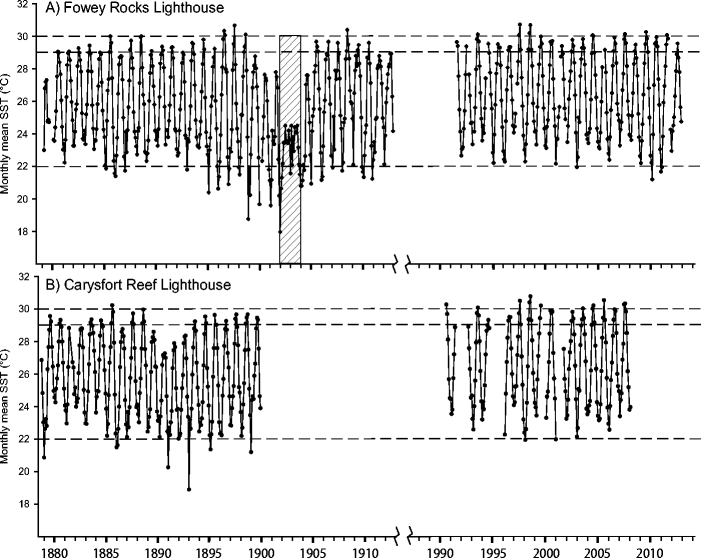 | | Figure 2: Time series of monthly mean water temperature taken by lighthouse keepers in the late nineteenth and early twentieth centuries (Vaughan 1918) and by fixed sensors at the same locations a century later. No supporting evidence for the Fowey data in the shaded portion (1902 and 1903) could be found in air temperature data for Miami or Key West, so these data were eliminated from the statistical analyses as a conservative measure. Dashed lines are for visual reference, marking the upper and lower boundaries within which coral growth is generally optimal. Source: Kuffner et al (2014) |
Denier inconsistency and double standards
There is one thing that deniers are consistent about - inconsistency. Another is double standards. There wasn't any comparable data that the researchers found. But what does Bob care about that? For him, any old data will do. It doesn't have to be comparable. He'd be happy to splice and dice the site-specific measurements with gridded data from HadISST. And yet on the very same day at WUWT there were more moans and protests when fifteen years ago the WMO did that as a cover illustration ( archived here). Not a scientific paper - just a bit of artwork. I'm referring to the WMO putting a chart on the cover of its 1999 annual report, which linked temperatures from a paleo reconstruction with the instrumental record. And that was data that was comparable. Talk about incomprehensible inconsistency!
Multiple sins of omission from Bob Tisdale
Bob committed multiple sins of omission. Not just ignoring the direct observations used by the researchers. For example, he failed to illustrate Figure 3. That might have demonstrated the point the researchers were making better to the chart-illiterate readers at WUWT. You'll soon guess why Bob chose to omit it. It shows up the differences more starkly.
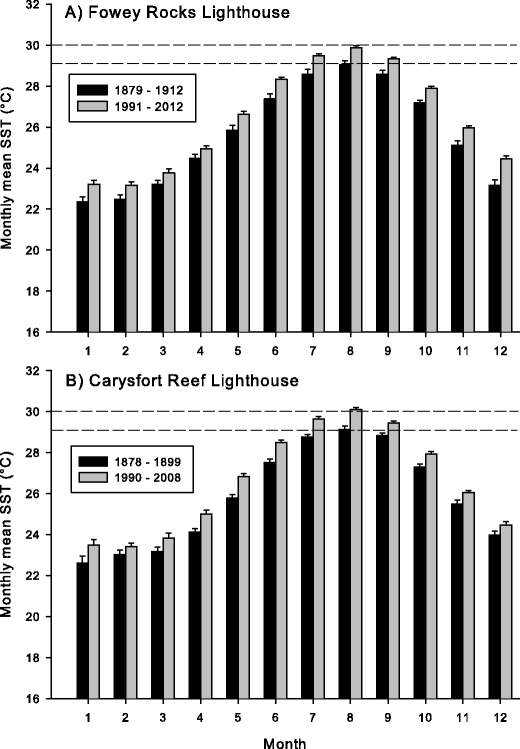 | | Figure 3: Comparisons of mean water temperature for two multi-decadal time periods from the turn of the twentieth and twenty-first centuries at a Fowey Rocks Lighthouse and b Carysfort Reef Lighthouse. Error bars are ± 1 SE, where n = the number of years with three or fewer days of data missing for that month. Dashed lines are for visual reference and correspond with temperatures known to be stressful (29 °C) and very stressful (30 °C) for many coral species. Source: Kuffner et al (2014) |
Bob decides to ignore all the research and site-specific observations and opt for using HadISST. The HadISST data series is derived from a mix of data sources, including ships, buoys and satellites - with gaps in data being interpolated. I guess Bob didn't want to use carefully collected local measurements because why let facts get in the way of a good denier yarn. Bob chose HadISST because he didn't want site specific data. He also chose it over his alternative, HadSST which gives 5x5 grid coverage. HadISST has 1x1 coverage, which at Florida Keys would be around 110 by 111 kilometres.
Bob ignores multiple warnings
Now not only is Bob opting for a coarser data set, which probably won't capture the temperatures affecting the reefs. Not only is his preferred data giving temperature averaged over a much larger area at the surface, not at the depth of or in the specific location of the corals. Not only did he ignore the warning in the paper itself. Not only did he discount the careful measurements taken on site. He's ignoring the fact that the paper describing the Hadley data sets itself carries this warning:
Care must be taken when using HadISST1 for studies of observed climatic variability, particularly in some datasparse regions, because of the limitations of the interpolation techniques, although it has been done successfully [Sheppard and Rayner, 2002]. It is recommended that the noninterpolated SST data set HadSST [Jones et al., 2001] be used alongside HadISST1 for climate monitoring and climate change detection studies, as was done in the Third Assessment Report of the Intergovernmental Panel on Climate Change (IPCC) [Folland et al., 2001a].
When it comes to monitoring sea level, you may recall how deniers want to use the measurements taken on site. They don't trust much else. When it comes to monitoring temperature, deniers want to ignore data that's been "tampered with" - ie corrected after collection. But in this case, because deniers want to pretend that coral bleaching doesn't happen, the world isn't warming etc etc, they decide to ignore the careful measurements taken on site over the years. Data that is much more appropriate when considering the actual reef. Deniers decide that this time around they prefer data that's been "tampered with". Data from multiple sources, with gaps interpolated.
Deniers will grab hold of anything they think will support their position.
Bob ignores the locations and chooses his own area of sea
Another thing is that the area that Bob reported was mostly outside the reef not on it. Bob says in the text that the data he used was 25N-26N, 81W-80W, but all his charts show the area from 24N-25N, 81W-80W. Compare the area of sea surface temperature Bob "analysed" to the spots where actual measurements were taken from, including below the sea surface. I've shown both areas for Bob, there's probably not much difference given the dataset he used. This diagram is from Figure 1 of the paper. As always, click the image to enlarge it.
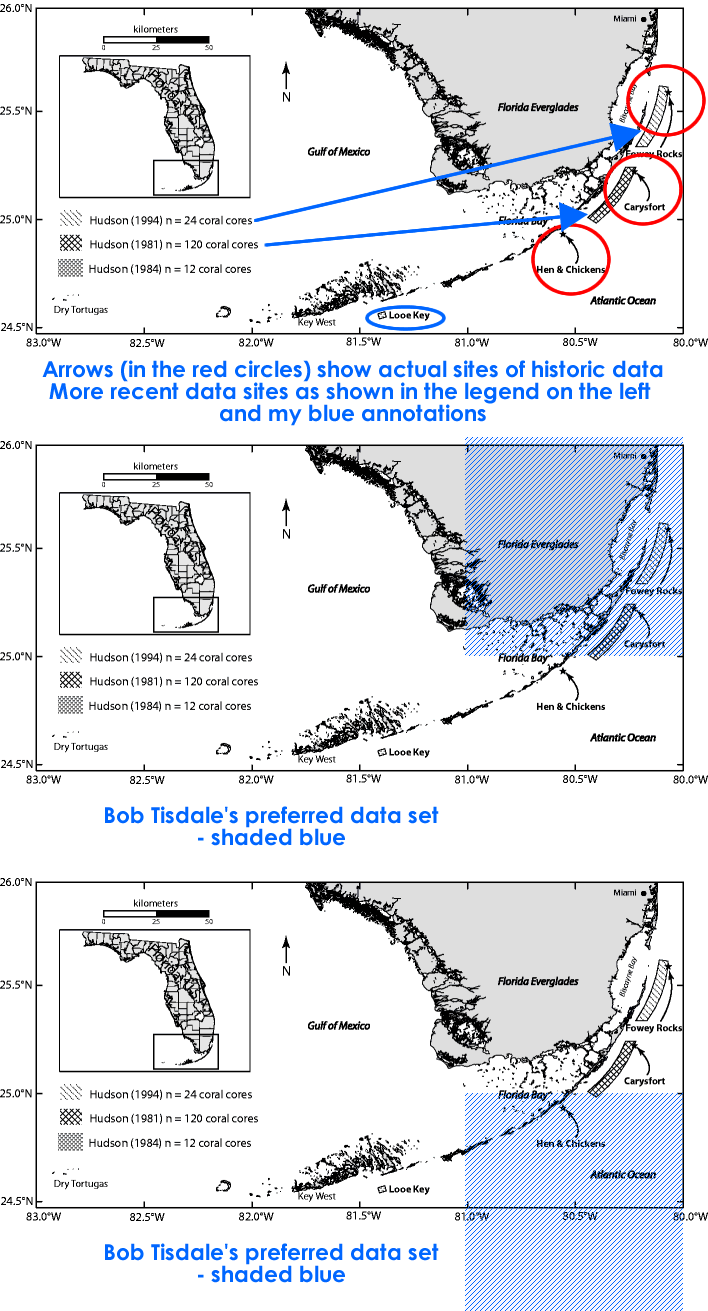 | | Annotated from Figure 1. Map of South Florida and the Florida Keys shows the location of several historic water temperature datasets (arrows). Also shown are reef areas where extensive sampling of live corals for growth studies occurred in the 1970s and 1980s: Key Largo (Hudson 1981b), Looe Key (Hudson 1983), and Biscayne National Park (Hudson et al. 1994). Coral growth data from these publications are summarized in Fig. 5. Source: Kuffner et al (2014) |
Whether Bob's data was from the top or bottom, it seems to me that direct measurements taken right on the reefs, and below the surface, would be much more relevant to this particular research. Much better than Bob's average estimates, taken over a large area and only for the surface of the sea. And not covering at least one of the sites the researchers looked at. I'm with the scientists on this one, not the deniers at WUWT.
Now Bob, not having read the paper (or not understanding it, which has the same effect) put up his charts of averaged, interpolated HadISST sea surface temperatures - mostly annual averages, and said:
Yet, somehow, we’re supposed to believe manmade greenhouse gases are causing harm to the coral in recent years.
And then complained that the scientists singled out the weeks and months when the corals were most at risk of bleaching events. Duh!
Further to this, Kuffner et al. (2014) focused on August, which is the warmest month of the annual cycle in sea surface temperatures for the Northeast Florida Keys. And they listed sea surface temperatures (thresholds) that were stressful (29 deg C) and very stressful (30 deg C) to the corals. Curiously, the Kuffner et al. (2014) Figure 2 (my Figure 1) shows that sea surface temperatures are above the 29 deg C stress threshold nearly every year, even back in the late 1800s. It even showed that there were occasional excursions above the 30 deg C very-stressful threshold in the early data.
Yes, Bob. But if you'd read the paper you'd have seen that it's more than that. They wrote:
The timing of bleaching episodes observed in the Florida Keys between 1989 and 2005 was well explained by maximum monthly mean SST and by the number of days that water temperature was above 30.5 °C (Manzello et al. 2007), and the frequency of bleaching events reported increased over this time period (Oliver et al. 2009).
By using the coarse interpolated data, Bob didn't capture the days where the water temperature the corals themselves were exposed to was above 30.5 degrees. It's not clear if he even looked at maximum temperatures or if he only looked at the mean.
Scoundrels aren't interested in science
Scoundrels like Bob Tisdale aren't interested in science. They are only interested in belittling science and stirring up deniers. They pretend they have some expertise, when in fact they have none at all. Not only that, but they act as if they know it all. Yet what little they do know comes from those very same scientists who they ridicule.
The paper itself is much more nuanced than Bob Tisdale's ridiculous article. It asks as many questions as it answers. It also describes the different impacts on different corals of other changes in their environment - not just water temperature changes.
Bob seems to be convinced that the coral bleachings in recent years can't be from warmer temperatures because he says it hasn't warmed. He's not offered any explanation for what could possibly be causing the bleaching that's happening right now, according to the press release.
blog.hotwhopper.com |



