Ralph is having a book signing around here this weekend, don't know if I can make it. I'd like to, this is a great book!
Unstoppable: The Emerging Left-Right Alliance to Dismantle the Corporate State
by Ralph Nader
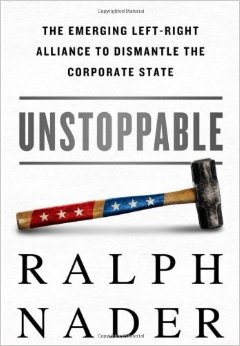
Ralph Nader has fought for over fifty years on behalf of American citizens against the reckless influence of corporations and their government patrons on our society. Now he ramps up the fight and makes a persuasive case that Americans are not powerless. In Unstoppable, he explores the emerging political alignment of the Left and the Right against converging corporate-government tyranny.
Large segments from the progressive, conservative, and libertarian political camps find themselves aligned in opposition to the destruction of civil liberties, the economically draining corporate welfare state, the relentless perpetuation of America’s wars, sovereignty-shredding trade agreements, and the unpunished crimes of Wall Street against Main Street. Nader shows how Left-Right coalitions can prevail over the corporate state and crony capitalism.
He draws on his extensive experience working with grassroots organizations in Washington and reveals the many surprising victories by united progressive and conservative forces. As a participator in, and keen observer of, these budding alliances, he breaks new ground in showing how such coalitions can overcome specific obstacles that divide them, and how they can expand their power on Capitol Hill, in the courts, and in the decisive arena of public opinion.
Americans can reclaim their right to consume safe foods and drugs, live in healthy environments, receive fair rewards for their work, resist empire, regain control of taxpayer assets, strengthen investor rights, and make bureaucrats more efficient and accountable. Nader argues it is in the interest of citizens of different political labels to join in the struggle against the corporate state that will, if left unchecked, ruin the Republic, override our constitution, and shred the basic rights of the American people.
amazon.com
Ralph is encouraging his readers to support Rand Paul.
How Rand Paul Threatens Left and Right
Libertarian-inflected conservatism challenges entrenched political coalitions with a transpartisan appeal.
By JACK HUNTER • October 29, 2014
Vox’s Zack Beauchamp declared last week, “Rand Paul just gave one of the most important foreign policy speeches in decades.” BuzzFeed’s Rosie Gray didn’t see what the big deal was, responding, “I’m confused by these takes on Paul’s speech as if the content was new. He’s been saying the same stuff for some time.”
She’s not wrong. But neither is Beauchamp. In many ways Paul’s foreign policy speech Thursday was nothing new for the senator.
That does not make it any less monumental.
Beauchamp found Paul’s call for a more restrained military approach important because “Paul is signaling that, when he runs for president in 2016, he isn’t going to move toward the Republican foreign policy consensus; he’s going to run at it, with a battering ram.”
Paul’s foreign policy vision is significantly different from every other rumored 2016 GOP presidential candidate. “If he wins,” Beauchamp emphasizes, “he could remake the Republican Party as we know it.”
The Kentucky senator has consistently challenged long-held GOP views on issues like the war on drugs and federal drug sentencing laws by taking positions that once would have been considered almost exclusively left. Paul has introduced legislation ending the practice of civil asset forfeitures—police taking and keeping someone’s property based on nothing more than suspicion—an issue that had previously received little attention in Washington. The libertarian-leaning senator’s well-received address at progressive Berkeley last year on the dangers of the surveillance state would have been unthinkable for almost any Republican during the George W. Bush era.
When even President Obama and Hillary Clinton were hesitant to address the unrest in Ferguson, Missouri in August, Paul did, tackling the dangers of police militarization in a way that would earn him praise across the ideological spectrum. This month Paul met with black leaders in Ferguson. He has been the first potential 2016 presidential candidate of either party to do so.
In 2013, when the senator filibustered John Brennan’s nomination as CIA director over drone policy and due process for U.S. citizens, he swung public opinion a whopping 50 points on an issue that hadn’t even been on most Americans’ radar. The Tea Party loved it so much Republican hawks that generally disagreed with Paul on national security-related civil liberties issues felt compelled to join him on the Senate floor, to thank Rand for taking a “stand.” Code Pink thanked him too.
Last year, The Daily Beast’s David Friedlander asked, “How did Rand Paul become a liberal hero?” Friedlander said Paul had “emerged as one of the nation’s most articulate defenders of progressive values…” and that “should he run (for president), he would represent a new kind of figure on the American political landscape.”
Sometimes it’s hard to figure out who Paul upsets more—liberals who are embarrassed the Republican senator might be more outspoken than most Democrats on core progressive issues, or Republicans whose idea of conservatism is often something very different from—and even antithetical to—Paul’s vision.
Liberals like Mother Jones’ David Corn appear worried about what kind of appeal Paul might have on the left, when they continuously go out of their way to portray Paul in the most unflattering light imaginable. The ideological mirror image of Corn’s fears can be seen at right-wing outlets like the Washington Free Beacon, who fret Paul might be turning Republicans away from the neoconservative post-9/11 foreign policy consensus that defined the Bush years. Like Corn’s recent digs at Paul at Mother Jones, you will be hard pressed to find many positive stories about the son of Ron Paul at the Free Beacon, but you will find consistent attempts to relegate the senator to the fringe. (Disclosure: my own “Southern Avenger” radio history and relationship with Senator Paul would become a well-publicized part of this effort.).
But left and right partisans’ uneasiness is not unwarranted. Many conventional liberals and conservatives grimace at Paul blurring left-right boundaries in ways that make their stock partisanship harder. There has always been a comfort, whether out of genuine conviction or just intellectual laziness, in simply blaming “those conservatives” or “those liberals” for every problem.
In forcing wider and more substantive debates, Paul threatens entrenched political identities in ways that undermine the very premises of those identities. Too much re-examining of what’s “right” and what’s “left” might create problems. For politicians and pundits accustomed to mere mudslinging, Paul’s approach challenges their model. At a time when more Americans than ever are identifying as independents, Paul makes partisans uncomfortable.
When Time dubbed Paul “the most interesting man in politics” this month, former Republican National Committee Chairman Michael Steele observed “I call him the most dangerous man in politics, because he has the ability to draw from the Democrats as well as the Republican bases in a way that could upset a few apple carts if this thing strikes the way he is talking.”
No doubt, Rand Paul will keep talking, and his transpartisan message might keep resonating. That’s what so many in Washington today are afraid of.
Jack Hunter is the Editor of Rare.us and the former New Media Director for Senator Rand Paul.
theamericanconservative.com |



