All gratitude for all the allies who sacrificed to save human rights and freedoms. May we not forget. I will blow the horn for Canada because I have several relatives who gave their lives. But you will celebrate too if you are in allied country. And for the rest: You know your path was not a decent or inclusive path. We leave it behind and join hands.
"As the war progressed, Canada’s successes in battles like those at Vimy Ridge, France and Passchendaele, Belgium, had earned its army the reputation for being the best-attacking Allied troops on the Western Front. When the Allies planned the offensives that would ultimately win the war, Canada’s soldiers were given the responsibility of being at the forefront of the attacks."
Yes, perhaps we were used. But somebody had to show the heroism of humanity.
The Last Hundred Days Introduction
veterans.gc.ca
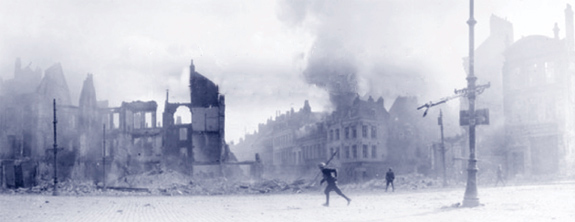
Canadians entering the Square in Cambrai, France, October, 1918. Photo credit: Library and Archives Canada PA-040231
This publication is available upon request in alternate formats.
PDF Version
Canada made great contributions and sacrifices in the First World War. Our many achievements on the battlefield were capped by a three-month stretch of victories at the end of the war during what came to be known as “Canada’s Hundred Days.”
The Western FrontThe First World War was fought from 1914 to 1918 and was the bloodiest war the world had ever seen up to that time. After the outbreak of the war, the fighting in France and Belgium soon turned into a stalemate of trench fighting. The Western Front was a string of trenches stretching from the North Sea to the Swiss border, with the Allied and German armies facing one another across a harsh “No Man’s Land” of barbed wire, shell craters and mud.
Machine guns, snipers and artillery made breaking the enemy defences very difficult. The military leaders on both sides struggled with devising effective new tactics to deal with the realities of this kind of warfare. All too often, soldiers were simply sent “over the top” to charge the enemy trenches head-on in attacks that cost many lives and resulted in no significant gains. It would be 1918 before a major breakthrough on the Western Front finally came.
The 1918 German Spring OffensivesEarly in 1918, the situation looked grim for the Allies. Germany began launching a series of major offensives in March that pushed the Allied lines back, advancing to within 70 kilometres of Paris. Despite these successes, this was to be Germany’s last major effort to win the war as they had over-extended their army. As well, after years of war, their resources of men and supplies were dwindling. Meanwhile, the Allied forces were being reinforced by American troops after the entry of the United States into the war in 1917. The Allies regrouped and stopped the advance, then set about to make their own major push to finally end the war.
Canada's Hundred Days
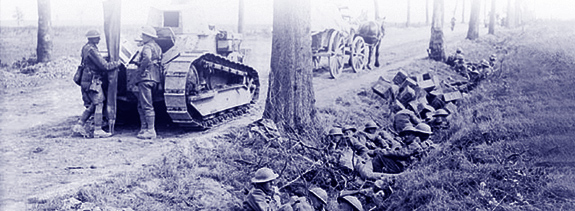
Canadian troops taking cover in a ditch alongside the road from Arras to Cambrai. Photo credit: Library and Archives Canada PA-003153
As the war progressed, Canada’s successes in battles like those at Vimy Ridge, France and Passchendaele, Belgium, had earned its army the reputation for being the best-attacking Allied troops on the Western Front. When the Allies planned the offensives that would ultimately win the war, Canada’s soldiers were given the responsibility of being at the forefront of the attacks.
The Canadian Corps’ reputation was such that the mere presence of Canadians on a section of the front would warn the enemy that an attack was coming. This meant that great secrecy would be involved in the movements of the Canadian Corps. A large offensive was planned in France in August 1918 and Canadian troops were shifted north to Ypres, Belgium. This made the Germans think a major attack was coming there before the Canadians secretly hurried back to the Amiens sector for the real attack. On August 8, Canada led the way in an offensive that saw them advance 20 kilometres in three days. This offensive was launched without a long preliminary artillery bombardment as was usually done (which also warned the enemy that an attack was coming) and the Germans were taken totally by surprise. This breakthrough was a remarkable development and dashed enemy morale, with the German high commander calling it “the black day of the German Army.”
With Allied leaders’ hopes now high for an end to the war in 1918, they kept up the pressure on the Germans. There would be little rest for the victorious Canadians. They were moved back north to the Arras sector and tasked with helping break the Hindenburg Line—now the enemy’s main defensive line. After a week of fierce fighting against some of Germany’s finest troops, in terrain that gave the enemy the advantage, the Canadians broke the Drocourt-Quéant Line in front of the Hindenburg Line by September 2.
Next up was the Canal du Nord, which formed part of the main Hindenburg Line. The partially-completed canal’s earthworks made it a tough position to attack, but Canadian Corps commander Lieutenant-General Sir Arthur Currie came up with a daring plan. His men, along with a British division, would cross a 2,500 metre-wide dry section of the canal. However, this was a bottleneck that could cause Allied troops and equipment to bunch up and become easy targets. To cover the advance, Currie unleashed the heaviest single-day bombardment of the entire war and the September 27 attack was a stunning success. The Canadians broke through three lines of German defence and pressed on to capture Bourlon Wood. Combined with other successes along the British front, the Hindenburg Line was now breached.
The German army may have been retreating but that did not mean they stopped resisting. After further heavy fighting, Canadians helped capture the town of Cambrai and by October 11 the Corps had reached the Canal de la Sensée. This was the last action taken by the Corps as a whole but the individual Canadian divisions continued to fight, overcoming stiff German resistance and helping capture Mont Houy and Valenciennes by the beginning of November.
With German resistance crumbling, the armistice was finally signed on November 11, 1918. Canadians fought to the very end with the war’s last Canadian combat death—Private George Lawrence Price—happening just two minutes before the fighting officially ended. That day saw our soldiers in Mons, Belgium—a place of great symbolic meaning, as this was where the British Army had its first significant battle against the invading Germans in the summer of 1914.
The war was finally over. The Canadian Corps’ accomplishments from August 8 to November 11 were truly impressive—more than 100,000 Canadians advanced 130 kilometres and captured approximately 32,000 prisoners and nearly 3,800 artillery pieces, machine guns and mortars.
HeroismDuring “Canada’s Hundred Days,” 30 Canadians and Newfoundlanders earned the Victoria Cross (VC), the highest award for military valour they could receive. The experiences of two of these men—one who earned his VC at the beginning of this period and one who earned his VC in the final two weeks of the war—serve as examples of the kind of courage that many showed.
On August 8, during the first day of the Battle of Amiens, Lieutenant Jean Brillant of the 22e Bataillon attacked and took an enemy machine gun post, despite being wounded. He then led another attack that captured 15 German machine guns and took 150 prisoners. Again wounded, he organized a charge on German artillery. Two days later, he died and would posthumously be awarded the VC.
The last Canadian VC of the war went to Sergeant Hugh Cairns of the 46th Battalion. At Valenciennes, he charged a series of machine gun posts, neutralizing and capturing the positions and their weapons. He was seriously wounded and died of his wounds on November 2, just nine days before the armistice.
SacrificeThe triumphs during “Canada’s Hundred Days” were impressive, but came at a high price. More than 6,800 Canadians and Newfoundlanders were killed and approximately 39,000 wounded during the last three months of fighting. By the end of the First World War, Canada—at the time a country of less than 8 million citizens—would see more than 650,000 men and women serve in uniform. The conflict took a great toll, with more than 66,000 Canadians and Newfoundlanders dying and 170,000 being wounded. The sacrifices and achievements of those who gave so much in the effort to restore peace and freedom are not forgotten.
LegacyAfter more than four years of fighting, the war was finally over. Many of Canada’s soldiers would serve as part of an occupation force in Germany, however, before finally being sent home in 1919. Canada’s accomplishments had earned it a newfound respect and a recognition—both at home and around the world—that it was an independent country in its own right. This earned Canada a separate signature on the Treaty of Versailles that formally ended the First World War. The war also served as an example of the country’s commitment to defend peace and freedom. It would demonstrate this commitment time and again in the years to come.
Canada Remembers Program
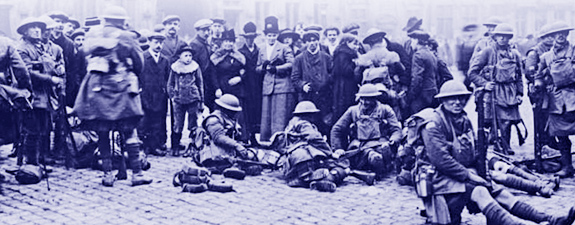
Canadian troops resting in the main square of Mons, Belgium, 11 November 1918. Photo credit: Library and Archives Canada PA-003570
The Canada Remembers Program of Veterans Affairs Canada encourages all Canadians to learn about the sacrifices and achievements made by those who have served—and continue to serve—during times of war and peace. As well, it invites Canadians to become involved in remembrance activities that will help preserve their legacy for future generations.
To learn more about Canada’s role in the First World War, please visit the Veterans Affairs Canada Web site at veterans.gc.ca or call 1-866-522-2122 toll free. |



