NOAA report of the world for November just came out this morning:
November 2014 global temperature ties for seventh highest on record; Year-to-date global temperature highest on record

Selected November 2014 Climate Events & Anomalies
Global temperature highlights: November The combined average temperature over global land and ocean surfaces during November tied with 2008 as the seventh highest for the month, at 1.17°F (0.65°C) above the 20th century average. The margin of error associated with this temperature is ±0.13°F (0.07°C). This ends a streak of three consecutive months with a record warm monthly global temperature.
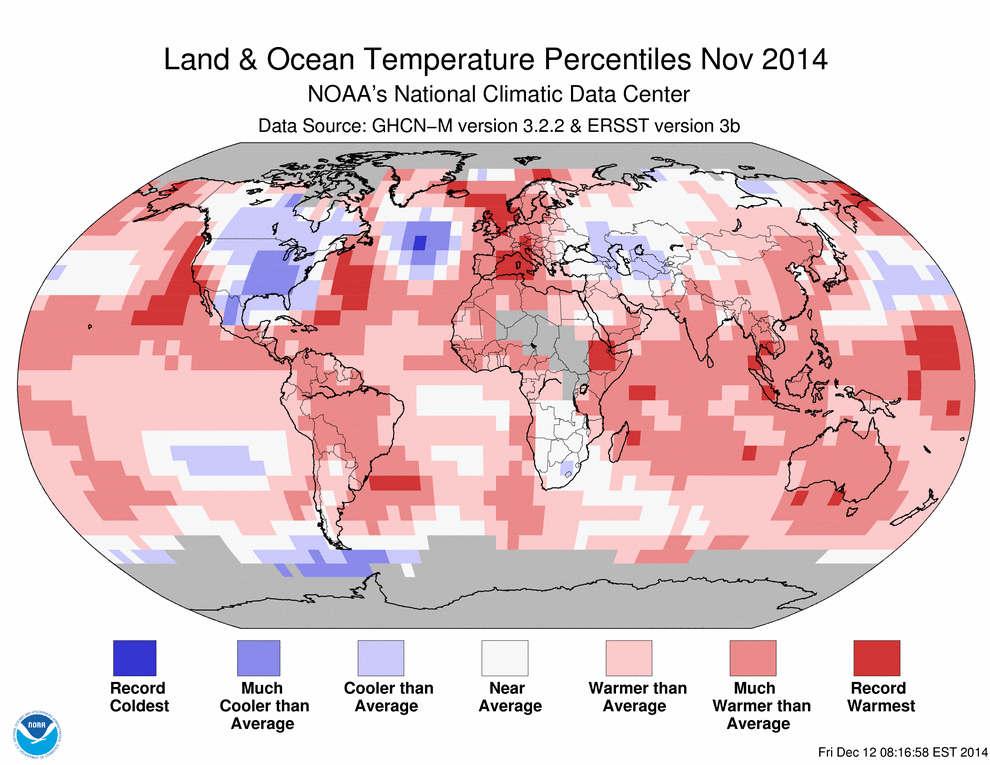
November 2014 Blended Land and Sea Surface
Temperature Percentiles
November 2014 Blended Land & Sea Surface Temperature Anomalies in °C
The global land temperature was the 13th highest on record for November, at 1.46°F (0.81°C) above the 20th century average. The margin of error is ±0.20°F (0.11°C). Warmer-than-average temperatures were evident over most of the global land surface, except for most of North America, parts of southwest Asia, and a few isolated areas of northern Russia. Some national highlights are included below:- The average November maximum temperature for Australia was the highest since records began in 1910, at 3.94°F (2.19°C) above the 1961–1990 average, breaking the previous record set in 2006 and marking the second consecutive month with a record high maximum temperature. The November minimum temperature was third highest on record, contributing to the highest November mean temperature for the country, at 3.38°F (1.88°C) above average and beating the previous record set in 2009.
- Warm southerly winds persisted during November across much of Europe, contributing to especially warm temperatures for this time of year. November was record warm in Austria and Switzerland, while it was third warmest in Denmark and fifth warmest in the UK. Periods of record vary by country, with each dating back more than a century.
- Much of North America was colder than average. Parts of northern Ontario were up to 9°F (5°C) colder than average for the month. The United States observed its 16th coldest November on record.
For the ocean, the November global sea surface temperature was 1.06°F (0.59°C) above the 20th century average of 60.4°F (15.8°C), the highest on record for November, surpassing the previous record set in 1997 by 0.05°F (0.03°C). The margin of error is ±0.07°F (0.04°C). Record warmth was particularly notable across the eastern Pacific Ocean off the western coast of the United States, sections of the equatorial western Pacific, parts of the western North Atlantic, and the eastern north Atlantic near northwestern Europe extending into regions of the Arctic Seas. Neither El Niño nor La Niña was present across the central and eastern equatorial Pacific Ocean during November 2014. NOAA's Climate Prediction Center estimates there is a 65 percent chance that El Niño will be present during the Northern Hemisphere winter and last into the Northern Hemisphere spring 2015.
Precipitation highlights: November Extreme wetness was observed during November across sections of the northern United States, a region of northwestern Algeria, and parts of southwestern Asia east of the Caspian Sea. Extreme dryness was observed across northern coastal Chile, areas of interior northwestern Africa, far eastern Europe into far western Russia, and the Philippines.- Early winter storms left nearly all of Canada and more than half (50.4 percent) of the United States covered with snow at its peak on November 17. This was the second largest November snow cover extent for Canada, falling shy of the record set just last year.
- A "Medicane" (a portmanteau of "Mediterranean" and "hurricane", referring to its several similarities to a tropical storm), named Qendresa, formed east of Tunisia and impacted parts of the Mediterranean on November 7–8, bringing heavy rain and flooding to the region.
- Spain reported its wettest November since 1997, at 180 percent of average November precipitation.
Global temperature highlights: September–November The combined average temperature over global land and ocean surfaces for September–November was the highest on record for this period, at 1.26°F (0.70°C) above the 20th century average of 57.1°F (14.0°C), surpassing the previous record set in 2005 by 0.02°F (0.01°C). The margin of error associated with this temperature is ±0.16°F (0.09°C).The global land temperature was the ninth highest for September–November on record, at 1.62°F (0.90°C) above the 20th century average of 48.3°F (9.1°C). The margin of error is ±0.31°F (0.17°C). Much of southern Australia was record warm, as was much of southern South America, the west coast of the United States, Far East Russia, and parts of southern Europe extending into northwestern Africa.- For the second year in a row, Australia observed its warmest spring (September–November) in the 105-year period of record, at 3.01°F (1.67°C) above the 1961–1990 average. This breaks the previous record, set in 2013, by 0.18°F (0.10°C).
- Austria had its warmest fall since records began in 1767, while Denmark, Germany, France, and Switzerland each reported their second warmest fall on record, with periods of record varying by country, with each dating back more than a century.
For the ocean, the September–November global sea surface temperature was 1.13°F (0.63°C), above the 20th century average of 60.7°F (16.0°C), the highest for September–November on record, surpassing the previous record set in 2003 by 0.11°F (0.06°C).
The margin of error is ± 0.07°F (0.04°C). Much warmer than average temperatures were observed across nearly the entire Indian Ocean. Record warmth was particularly notable across the eastern Pacific Ocean off the western coast of the United States and a large section of the equatorial western Pacific, sections of the northeastern and southeastern Atlantic, regions of the Arctic Oceans. Polar ice highlights: November and September–November

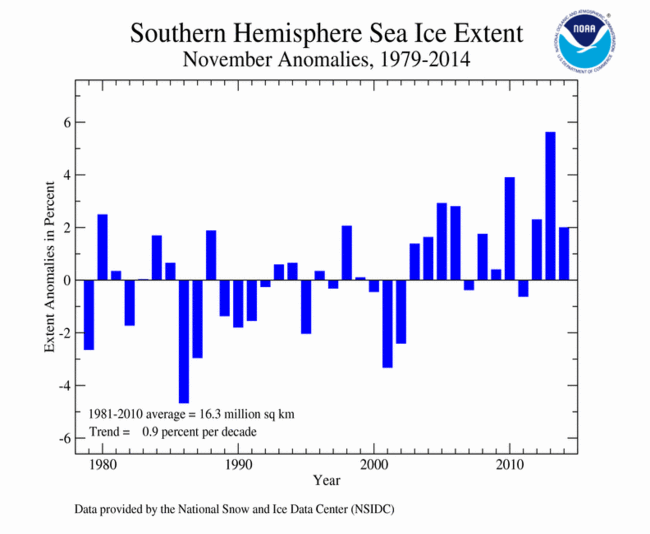
Arctic and Antarctic sea ice extent, from the Global Snow & Ice Report
The average Arctic sea ice extent for November was 4.00 million square miles, 240,000 square miles (5.7 percent) below the 1981–2010 average and the ninth smallest November extent since records began in 1979, according to the National Snow and Ice Data Center. Sea ice extent was below average on the Pacific side of the Arctic and near-average on the Atlantic side.Antarctic sea ice during November was 6.42 million square miles, 130,000 square miles (2.0 percent) above the 1981–2010 average. This was the eighth largest November Antarctic sea ice extent on record.According to data from the Rutgers Global Snow Lab, the Northern Hemisphere snow cover extent during November was 14.12 million square miles, 1.01 million square miles above the 1981–2010. This ranked as the fifth largest November Northern Hemisphere snow cover extent in the 49-year period of record. North America had its record largest November snow cover extent, while Eurasia had its 15th largest. For fall, the Northern Hemisphere snow cover extent was the second largest on record—the North American snow cover extent was also second largest for the season, while the Eurasian snow cover extent was the fourth largest.
Global temperature highlights: Year-to-date

November 2014 Global Supplemental Information.
The first 11 months of 2014 was the warmest such period on record, with a combined global land and ocean average surface temperature of 1.22°F (0.68°C) above the 20th century average of 57.0°F (13.9°C), surpassing the previous record set in 2010 by 0.02°F (0.01°C). The margin of error is ±0.18°F (0.10°C). 2014 is currently on track to be the warmest year on record if the December global temperature is at least 0.76°F (0.42°C) above its 20th century average.The January–November worldwide land surface temperature was 1.71°F (0.95°C) above the 20th century average, the sixth warmest such period on record. The margin of error is ±0.38°F (0.21°C).The global ocean surface temperature for the year-to-date was 1.03°F (0.57°C) above average, the warmest such period on record, surpassing the previous record set in 1998 by 0.07°F (0.04°C). The margin of error is ±0.07°F (0.04°C).
For extended analysis of global temperature and precipitation patterns, please see our full report that will be released on December 17th.
ncdc.noaa.gov |



