History meme - T H E O D O R A (527-565) was a Byzantine empress, the wife of emperor Justinian I, and one of the most powerful women in Byzantine history. Her intelligence and political acumen made her Justinian’s most trusted adviser and enabled her to use the power and influence of her office to promote religious and social policies that favoured her interests. en.wikipedia.org
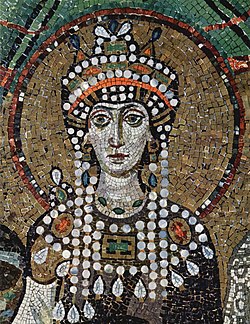
Little is known of Theodora’s early life; Her father was a bear keeper at the Hippodrome in Constantinople and she became a dancer & actress while still young. When Justinian met her, he was attracted by her beauty and intelligence, and made her his mistress, then raised her to the rank of patrician, and in 525 he married her. When Justinian succeeded to the throne in 527, she was proclaimed augusta.
Theodora exercised considerable influence, and many were led to believe that it was she, rather than Justinian, who ruled Byzantium. Her name is mentioned in nearly all the laws passed during that period. She received foreign envoys and corresponded with foreign rulers, functions usually reserved for the emperor. Her influence in political affairs was decisive, as illustrated in the Nika revolt of January 532. The two political factions in Constantinople, the Blues and the Greens, united in their opposition to the government and set up a rival emperor. Justinian’s advisers urged him to flee, but Theodora advised him to stay and save his empire, reportedly saying: “Those who have worn the crown should never survive its loss. Never will I see the day when I am not saluted as empress.”
Although an escape route across the sea lay open for the emperor, Theodora insisted that she would stay in the city, quoting an ancient saying, “Royalty is a fine burial shroud.” Subsequently, Justinian’s general, Belisarius, herded the rioters into the Hippodrome and cut them to pieces.
Theodora is remembered as one of the first rulers to recognize the rights of women, passing strict laws to prohibit the traffic in young girls and altering the divorce laws to give greater benefits to women. She also spent much of her reign trying to mitigate the laws against the monophysites.
Early years[ edit]Theodora, according to Michael Grant, was of Greek Cypriot descent. [4] There are several indications of her possible birthplace. According to Michael the Syrian her birthplace was in Syria; Nicephorus Callistus Xanthopoulos names Theodora a native of Cyprus, while the Patria, attributed to George Codinus, claims Theodora came from Paphlagonia. She was born in 500 AD.
Her father, Acacius, was a bear trainer of the hippodrome's Green faction in Constantinople. Her mother, whose name is not recorded, was a dancer and an actress. [5] Her parents had two more daughters. [6] After her father's death, her mother brought her children wearing garlands into the hippodrome and presented them as suppliants to the Blue faction. From then on Theodora would be their supporter.
Both John of Ephesus and Procopius (in his Secret History) relate that Theodora from an early age followed her sister Komito's example and worked in a Constantinople brothel serving low-status customers; later she performed on stage. [7] Lynda Garland in "Byzantine Empresses: Women and Power in Byzantium, AD 527–1204" notes that there seems to be little reason to believe she worked out of a brothel "managed by a pimp". Employment as an actress at the time would include both "indecent exhibitions on stage" and providing sexual services off stage. In what Garland calls the "sleazy entertainment business in the capital", Theodora earned her living by a combination of her theatrical and sexual skills. [3] In Procopius' account, Theodora made a name for herself with her salacious portrayal of Leda and the Swan. [8]
During this time she met the wife of Belisarius, Antonina, with whom she would remain lifelong friends.
At the age of 16, she traveled to North Africa as the companion of a Syrian official named Hecebolus when he went to the Libyan Pentapolis as governor. She stayed with him for almost four years before returning to Constantinople. Abandoned and maltreated by Hecebolus, on her way back to the capital of the Byzantine Empire, she settled for a while in Alexandria, Egypt. She is said to have met Patriarch Timothy III in Alexandria, who was Miaphysite, and it was at that time that she converted to Miaphysite Christianity. From Alexandria she went to Antioch, where she met a Blue faction's dancer, Macedonia, who was perhaps an informer of Justinian.
She returned to Constantinople in 522 and gave up her former lifestyle, settling as a wool spinner in a house near the palace. Her beauty, wit and amusing character drew attention from Justinian, who wanted to marry her. However, he could not: He was heir of the throne of his uncle, Emperor Justin I, and a Roman law from Constantine's time prevented government officials from marrying actresses. Empress Euphemia, who liked Justinian and ordinarily refused him nothing, was against his wedding with an actress. However, Justin was fond of Theodora. In 525, when Euphemia had died, Justin repealed the law, and Justinian married Theodora. By this point, she already had a daughter (whose name has been lost). Justinian apparently treated the daughter and the daughter's son Athanasius as fully legitimate, [9] although sources disagree whether Justinian was the girl's father.
Life as royalty[ edit]
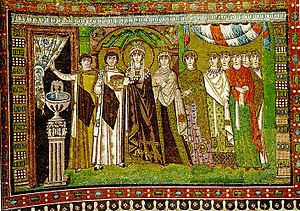
Empress Theodora and attendants (mosaic from Basilica of San Vitale, 6th century).
The Nika Riots[ edit]Theodora proved herself a worthy and able leader during the Nika riots. There were two rival political factions in the Empire, the Blues and the Greens, who started a riot in January 532 during a chariot race in the hippodrome. The riots stemmed from many grievances, some from Justinian's and Theodora's own actions. [10] The rioters set many public buildings on fire, and proclaimed a new emperor, Hypatius, the nephew of former emperor Anastasius I. Unable to control the mob, Justinian and his officials prepared to flee. At a meeting of the government council, Theodora spoke out against leaving the palace and underlined the significance of someone who died as a ruler instead of living as an exile or in hiding, saying, "royal purple is noblest shroud" [11]
Her determined speech convinced them all, including Justinian himself, who had been preparing to run. As a result, Justinian ordered his loyal troops led by two reliable officers, Belisarius and Mundus, to attack the demonstrators in the hippodrome. His generals attacked the hippodrome, killing (according to Procopius) over 30,000 rebels. Despite his claims that he was unwillingly named emperor by the mob, Hypatius was also put to death, apparently at Theodora's insistence. [12] Historians agree that it was Theodora's courage and decisiveness that saved Justinian's reign. Justinian never forgot that it was Theodora who had saved his throne.
Later life[ edit]Following the Nika revolt, Justinian and Theodora rebuilt and reformed Constantinople and made it the most splendid city the world had seen for centuries, building or rebuilding aqueducts, bridges and more than twenty five churches. The greatest of these is Hagia Sophia, considered the epitome of Byzantine architecture and one of the architectural wonders of the world.
Theodora was punctilious about court ceremony. According to Procopius, the Imperial couple made all senators, including patricians, prostrate themselves before them whenever they entered their presence, and made it clear that their relations with the civil militia were those of masters and slaves. They also carefully supervised the magistrates, much more so than previous emperors, possibly to reduce bureaucratic corruption.
Theodora also created her own centers of power like the Hagia Sophia. The eunuch Narses, who in old age developed into a brilliant general, was her protege, as was the praetorian prefect Peter Barsymes. John the Cappadocian, Justinian's chief tax collector, was identified as her enemy, because of his independent influence.
Theodora participated in Justinian's legal and spiritual reforms, and her involvement in the increase of the rights of women was substantial. She had laws passed that prohibited forced prostitution and closed brothels. She created a convent on the Asian side of the Dardanelles called the Metanoia (Repentance), where the ex-prostitutes could support themselves. She also expanded the rights of women in divorce and property ownership, instituted the death penalty for rape, forbade exposure of unwanted infants, gave mothers some guardianship rights over their children, and forbade the killing of a wife who committed adultery. Procopius wrote that she was naturally inclined to assist women in misfortune. [13]
Procopius' Secret History presents a different version of events. For instance, rather than preventing forced prostitution (as in Buildings 1.9.3ff), Theodora is said to have 'rounded up' 500 prostitutes, confining them to a Convent. This, he narrates, even led to suicides as prostitutes sought to escape 'the unwelcome transformation.' (SH 17)
Religious policy[ edit]

Bust of a Byzantine empress, possibly Theodora. 6th century. Museum of Ancient Art in the Castello Sforzesco in Milan, Italy.
Theodora worked against her husband's support of Chalcedonian Christianity in the ongoing struggle for the predominance of each faction. [14] In spite of Justinian being Chalcedonian, Theodora founded a Miaphysite monastery in Sykae and provided shelter in the palace for Miaphysite leaders who faced opposition from the majority of Chalcedonian Christians, like Severus and Anthimus. Anthimus had been appointed Patriarch of Constantinople under her influence, and after the excommunication order he was hidden in Theodora's quarters for twelve years, until her death. When the Chalcedonian Patriarch Ephraim provoked a violent revolt in Antioch, eight Miaphysite bishops were invited to Constantinople and Theodora welcomed them and housed them in the Hormisdas Palace adjoining the Great Palace, which had been Justinian and Theodora's own dwelling before they became emperor and empress.
In Egypt, when Timothy III died, Theodora enlisted the help of Dioscoros, the Augustal Prefect, and Aristomachos the duke of Egypt, to facilitate the enthronement of a disciple of Severus, Theodosius, thereby outmaneuvering her husband, who had been plotting for an Chalcedonian successor as patriarch. But Pope Theodosius I of Alexandria, even with the help of imperial troops, could not hold his ground in Alexandria against Justinian's Chalcedonian followers. When he was exiled by Justinian along with 300 Miaphysites to the fortress of Delcus in Thrace, Theodora rescued him and brought him to the Hormisdas Palace. He lived under her protection and, after her death in 548, under Justinian's.
When Pope Silverius refused Theodora's demand that he remove the anathema of Pope Agapetus I from Patriarch Anthimus, she sent Belisarius instructions to find a pretext to remove Silverius. When this was accomplished, Pope Vigilius was appointed in his stead.
The Chalcedonians argued that Theodora fostered heresy and thus undermined the unity of Christendom.
In Nobatae, south of Egypt, the inhabitants were converted to Miaphysite Christianity about 540. Justinian had been determined that they be converted to the Chalcedonian faith and Theodora equally determined that they should be Miaphysites. Justinian made arrangements for Chalcedonian missionaries from Thebaid to go with presents to Silko, the king of the Nobatae. But on hearing this, Theodora prepared her own missionaries and wrote to the duke of Thebaid that he should delay her husband's embassy, so that the Miaphysite missionaries should arrive first. The duke was canny enough to thwart the easygoing Justinian instead of the unforgiving Theodora. He saw to it that the Chalcedonian missionaries were delayed. When they eventually reached Silko, they were sent away, for the Nobatae had already adopted the Miaphysite creed of Theodosius. |



