"Discrepancy from WHAT?"
From the other stations . For instance, if all stations are normally 0.2 degrees different from site A, and then A gets put in a box, and suddenly the station is 1 degree off, you correct for that.
Don't trouble yourself; you'll learn about it when you get to 4th grade science.
Guest post : Skeptics demand adjustments
Posted on February 9, 2015 by ...and Then There's Physics
This is a guest post from Steven Mosher, who is part of the Berkeley Earth (BEST) team. It’s motivated largely by the recent resurgence of claims of tampering with the temperature records, that I’ve discussed earlier. I won’t say anymore, and Steven’s post starts now:
Christopher Booker win’s the irony of the year award with his piece on adjustments to the temperature record. That’s quite a feat considering it’s only February. His complaint overlooks the clear historical fact that skeptics, above all others, have made the loudest case for the need to adjust the temperature series. Over the years, it’s been skeptics, who have made a vocal case for adjustments . More disturbing is the claim that these adjustments are somehow criminal. We dealt with these type of claims before and completely debunked them.
What is an adjustment? Let’s use a simple example: Social Security COLA. In 2015 the payments people receive from social security will be adjusted to account for the effect of inflation.
“The purpose of the COLA is to ensure that the purchasing power of Social Security and Supplemental Security Income (SSI) benefits is not eroded by inflation. It is based on the percentage increase in the Consumer Price Index for Urban Wage Earners and Clerical Workers (CPI-W) from the third quarter of the last year a COLA was determined to the third quarter of the current year. If there is no increase, there can be no COLA.”
The amount of money you expect to receive will be adjusted upward based on the inflation rate to correct for the distortion that inflation would produce in your purchasing power.
Closer to science we have other examples of adjustments and corrections. Here I select an example from Reagan’s StarWars: Adaptive optics. In 1991 this technology was declassified– thanks to colonel Worden –and today these technologies, like corrections for wavefront distortion, are used to find exo-planets. Ironically, one of the methods used to correct for distortion was developed by climate science skeptics Will Happer and Dyson.
And even a more pedestrian example would be eyeglasses, where we actually distort the “raw data” that enters our eye in order to compensate for and correct our bad vision. Adjustments help us see things clearly.
Adjustments aim at correcting measured data, raw data, in order to improve its quality. In the context of temperature series for land we can break the problem down logically. A temperature observation consists of a temperature measured by a sensor at time and a location. The skeptical concern over the years has been focused on bias or distortion corrupting this raw data: Bias in sensors , bias in observation time and biases that arise due to location.
Sensor Bias:
Climate science skeptics have challenged the legitimacy of sensors in several ways. One example, interesting for historical purposes, is Anthony Watts concern over the changing protocol for painting sensor enclosures . His concern was that changing paints from whitewash to latex may have introduced a bias in the temperature record. It’s picked up by Steve Mcintyre here. And again here, and here. As always the comments are interesting, and here we see a concern that relates to a shift in temperatures that introduce a cooling bias: the switch to the MMTS sensors.
One last example of the skeptics pointing out the need for corrections or adjustments is found here at climate audit ( here). In this particular case the issue would appear to be skeptics complaining that an adjustment hasn’t been made.
The case is fairly clear. Skeptics have been raising issues about the biases caused by changing sensors for quite some time. It follows, of course, that a blanket recommendation to ‘just use the raw data” would not be supported by the very arguments skeptics have raised over the years. Skeptics demonstrate that blindly trusting raw data can lead you to use data that is biased high, or data that is biased low.
Time of Observation Bias:
A sensor reading is taken at particular times during the day. Some sites collect temperature data at very short intervals, seconds in some cases. Other sites collect data on the minute; some on the hour; some 4 times a day, and still others only once a day. Changing the time of observation is a potential source of bias. This bias is well documented in the literature. However, here I want to focus on the skeptics awareness of the problem. A post on climate audit was dedicated to this problem here. More importantly as I found out at that time, commenter JerryB had done a study for the late great skeptic John Daly. His study, circa 2005, is found here. JerryB’s approach was to actually look at the data.
JerryB’s study clearly demonstrated that changing the time of observation will distort the record. Skeptics who have downloaded the actual data have confirmed this for themselves. Finally Nick Stokes has written on this issue here.
Location Changes:
A measurement is taken at a time and place. If you change the place or location, then basic principles suggest that you need to examine or control for changes in the location. This is no news to skeptics who have argued that changes in location may be biasing the record. In fact the entire surface stations project is dedicated to the idea that location matters. It matters when a station moves. It matters when the features of the location change around the sensor. As Watts argues here:
According to NCDC’s MMS database, the Lampasas climate station has been at this location since 10-01-2000. Previous location was an observer residence, which appears to have been a park-like location according to MMS location map. The sensor was apparently converted to the MMTS style seen in the photo in 1986, so the move did not include an equipment change. See the complete survey album here.
But the big surprise of just how bad this location is came from the GISS plot of temperature. It clearly showed the results of the move to this location, causing a jump in temperature almost off the current graph scale. Note that before the move, the temperature trend of Lampasas was nearly flat from 1980-2000.
Summary:
In both science and everyday life, we routinely identify and correct distortions in data. Over the years, in the climate debate, skeptics (and scientists themselves) have pointed out several potential sources of bias and distortion in the temperature record that demand correction. In temperature series, one example of how to start to go about this is detailed by a noteworthy skeptic:
The idea behind the homogenization technique is to identify points in time in each station’s record at which a change of some sort occurred. These are called segment break points. A single station may have a number of segment break points so that its entire record becomes a set of segments each of which requires some adjustment to make a homogeneous time series. Initially, segment break points were identified in every case when one of the following situations occurred: (i) a station move, (ii) a change in time of observation, and (iii) a clear indication of instrument change.
That skeptic was John Christy. He essentially describes the first step of the Berkeley Earth adjustment process.
Given that both skeptics and the mainstream scientists agree that changes in sensors, changes in time of observation and changes in location can bias the record, the question is. What do you do?
Attempt to adjust the data.Only use “good” data.Use the raw data only.Before we even debate that decision, however, we can start by looking at whether the question really matters. Here, for example, is a comparison of BerkeleyEarth with No adjustments, BerkeleyEarth with metadata adjustments only, and BerkeleyEarth will all adjustments

https://andthentheresphysics.wordpress.com/2015/02/09/guest-post-skeptics-demand-adjustments/
There are simultaneous adjustments to all the stations and satellite data in the world.
Why shouldn't there be?
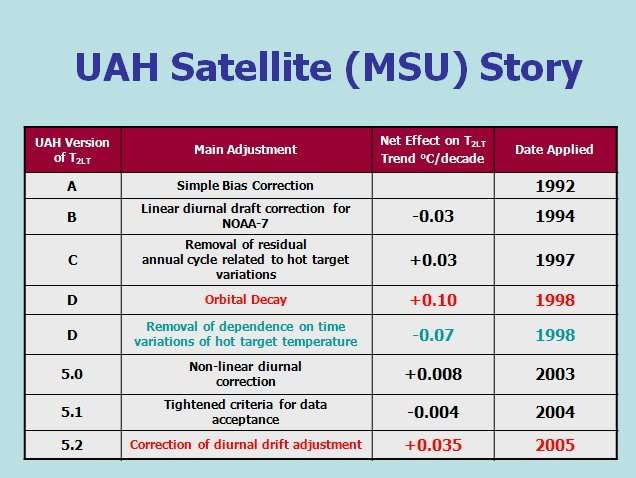
Figure 2: Major corrections to the UAH temperature trend over the years.
Message 29903200 |



