you are gonna vote for this Hillary Clinton fired for lies, unethical behavior
Jerry Zeifman, a lifelong Democrat, supervised the work of 27-year-old Hillary Rodham on the committee. Hillary got a job working on the investigation at the behest of her former law professor, Burke Marshall, who was also Sen. Ted Kennedy’s chief counsel in the Chappaquiddick affair. When the investigation was over, Zeifman fired Hillary from the committee staff and refused to give her a letter of recommendation – one of only three people who earned that dubious distinction in Zeifman’s 17-year career.
Why?
“Because she was a liar,” Zeifman said in an interview last week. “She was an unethical, dishonest lawyer. She conspired to violate the Constitution, the rules of the House, the rules of the committee and the rules of confidentiality.”
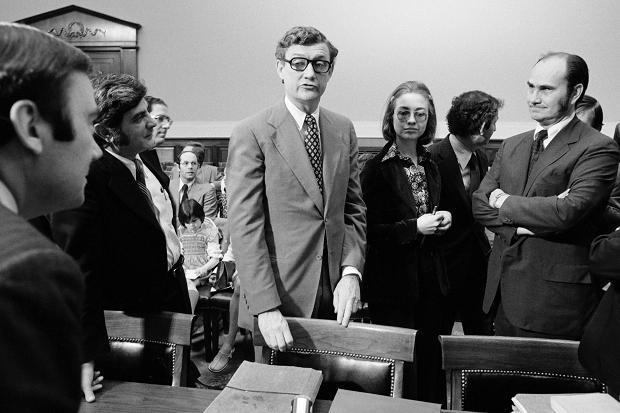
How could a 27-year-old House staff member do all that? She couldn’t do it by herself, but Zeifman said she was one of several individuals – including Marshall, special counsel John Doar and senior associate special counsel (and future Clinton White House Counsel) Bernard Nussbaum – who engaged in a seemingly implausible scheme to deny Richard Nixon the right to counsel during the investigation.
Why would they want to do that? Because, according to Zeifman, they feared putting Watergate break-in mastermind E. Howard Hunt on the stand to be cross-examined by counsel to the president. Hunt, Zeifman said, had the goods on nefarious activities in the Kennedy Administration that would have made Watergate look like a day at the beach – including Kennedy’s purported complicity in the attempted assassination of Fidel Castro.
The actions of Hillary and her cohorts went directly against the judgment of top Democrats, up to and including then-House Majority Leader Tip O’Neill, that Nixon clearly had the right to counsel. Zeifman says that Hillary, along with Marshall, Nussbaum and Doar, was determined to gain enough votes on the Judiciary Committee to change House rules and deny counsel to Nixon. And in order to pull this off, Zeifman says Hillary wrote a fraudulent legal brief, and confiscated public documents to hide her deception.
The brief involved precedent for representation by counsel during an impeachment proceeding. When Hillary endeavored to write a legal brief arguing there is no right to representation by counsel during an impeachment proceeding, Zeifman says, he told Hillary about the case of Supreme Court Justice William O. Douglas, who faced an impeachment attempt in 1970.
“As soon as the impeachment resolutions were introduced by (then-House Minority Leader Gerald) Ford, and they were referred to the House Judiciary Committee, the first thing Douglas did was hire himself a lawyer,” Zeifman said.
The Judiciary Committee allowed Douglas to keep counsel, thus establishing the precedent. Zeifman says he told Hillary that all the documents establishing this fact were in the Judiciary Committee’s public files. So what did Hillary do?
“Hillary then removed all the Douglas files to the offices where she was located, which at that time was secured and inaccessible to the public,” Zeifman said. Hillary then proceeded to write a legal brief arguing there was no precedent for the right to representation by counsel during an impeachment proceeding – as if the Douglas case had never occurred.
The brief was so fraudulent and ridiculous, Zeifman believes Hillary would have been disbarred if she had submitted it to a judge.
Zeifman says that if Hillary, Marshall, Nussbaum and Doar had succeeded, members of the House Judiciary Committee would have also been denied the right to cross-examine witnesses, and denied the opportunity to even participate in the drafting of articles of impeachment against Nixon.
Of course, Nixon’s resignation rendered the entire issue moot, ending Hillary’s career on the Judiciary Committee staff in a most undistinguished manner. Zeifman says he was urged by top committee members to keep a diary of everything that was happening. He did so, and still has the diary if anyone wants to check the veracity of his story. Certainly, he could not have known in 1974 that diary entries about a young lawyer named Hillary Rodham would be of interest to anyone 34 years later.
But they show that the pattern of lies, deceit, fabrications and unethical behavior was established long ago – long before the Bosnia lie, and indeed, even before cattle futures, Travelgate and Whitewater – for the woman who is still asking us to make her president of the United States.
Franklin Polk, who served at the time as chief Republican counsel on the committee, confirmed many of these details in two interviews he granted me this past Friday, although his analysis of events is not always identical to Zeifman’s. Polk specifically confirmed that Hillary wrote the memo in question, and confirmed that Hillary ignored the Douglas case. (He said he couldn’t confirm or dispel the part about Hillary taking the Douglas files.)
To Polk, Hillary’s memo was dishonest in the sense that she tried to pretend the Douglas precedent didn’t exist. But unlike Zeifman, Polk considered the memo dishonest in a way that was more stupid than sinister.
“Hillary should have mentioned that (the Douglas case), and then tried to argue whether that was a change of policy or not instead of just ignoring it and taking the precedent out of the opinion,” Polk said.
Polk recalled that the attempt to deny counsel to Nixon upset a great many members of the committee, including just about all the Republicans, but many Democrats as well.
“The argument sort of broke like a firestorm on the committee, and I remember Congressman Don Edwards was very upset,” Polk said. “He was the chairman of the subcommittee on constitutional rights. But in truth, the impeachment precedents are not clear. Let’s put it this way. In the old days, from the beginning of the country through the 1800s and early 1900s, there were precedents that the target or accused did not have the right to counsel.”
That’s why Polk believes Hillary’s approach in writing the memorandum was foolish. He says she could have argued that the Douglas case was an isolated example, and that other historical precedents could apply.
But Zeifman says the memo and removal of the Douglas files was only part the effort by Hillary, Doar, Nussbaum and Marshall to pursue their own agenda during the investigation.
After my first column, some readers wrote in claiming Zeifman was motivated by jealousy because he was not appointed as the chief counsel in the investigation, with that title going to Doar instead.
Zeifman’s account is that he supported the appointment of Doar because he, Zeifman, a) did not want the public notoriety that would come with such a high-profile role; and b) didn’t have much prosecutorial experience. When he started to have a problem with Doar and his allies was when Zeifman and others, including House Majority Leader Tip O’Neill and Democratic committee member Jack Brooks of Texas, began to perceive Doar’s group as acting outside the directives and knowledge of the committee and its chairman, Peter Rodino.
(O’Neill died in 1994. Brooks is still living and I tried unsuccessfully to reach him. I’d still like to.)
This culminated in a project to research past presidential abuses of power, which committee members felt was crucial in aiding the decisions they would make in deciding how to handle Nixon’s alleged offenses.
According to Zeifman and other documents, Doar directed Hillary to work with a group of Yale law professors on this project. But the report they generated was never given to the committee. Zeifman believes the reason was that the report was little more than a whitewash of the Kennedy years – a part of the Burke Marshall-led agenda of avoiding revelations during the Watergate investigation that would have embarrassed the Kennedys.
The fact that the report was kept under wraps upset Republican committee member Charles Wiggins of California, who wrote a memo to his colleagues on the committee that read in part:
Within the past few days, some disturbing information has come to my attention. It is requested that the facts concerning the matter be investigated and a report be made to the full committee as it concerns us all.
Early last spring when it became obvious that the committee was considering presidential “abuse of power” as a possible ground of impeachment, I raised the question before the full committee that research should be undertaken so as to furnish a standard against which to test the alleged abusive conduct of Richard Nixon.
As I recall, several other members joined with me in this request. I recall as well repeating this request from time to time during the course of our investigation. The staff, as I recall, was noncommittal, but it is certain that no such staff study was made available to the members at any time for their use.
Wiggins believed the report was purposely hidden from committee members. Chairman Rodino denied this, and said the reason Hillary’s report was not given to committee members was that it contained no value. It’s worth noting, of course, that the staff member who made this judgment was John Doar.
In a four-page reply to Wiggins, Rodino wrote in part:
Hillary Rodham of the impeachment inquiry staff coordinated the work. . . . After the staff received the report it was reviewed by Ms. Rodham, briefly by Mr. Labovitz and Mr. Sack, and by Doar. The staff did not think the manuscript was useful in its present form. . . .
In your letter you suggest that members of the staff may have intentionally suppressed the report during the course of its investigation. That was not the case.
As a matter of fact, Mr. Doar was more concerned that any highlight of the project might prejudice the case against President Nixon. The fact is that the staff did not think the material was usable by the committee in its existing form and had not had time to modify it so it would have practical utility for the members of the committee. I was informed and agreed with the judgment.
Mr. Labovitz, by the way, was John Labovitz, another member of the Democratic staff. I spoke with Labovitz this past Friday as well, and he is no fan of Jerry Zeifman.
“If it’s according to Zeifman, it’s inaccurate from my perspective,” Labovitz said. He bases that statement on a recollection that Zeifman did not actually work on the impeachment inquiry staff, although that is contradicted not only by Zeifman but Polk as well.
Labovitz said he has no knowledge of Hillary having taken any files, and defended her no-right-to-counsel memo on the grounds that, if she was assigned to write a memo arguing a point of view, she was merely following orders.
But as both Zeifman and Polk point out, that doesn’t mean ignoring background of which you are aware, or worse, as Zeifman alleges, confiscating documents that disprove your argument.
All told, Polk recalls the actions of Hillary, Doar and Nussbaum as more amateurish than anything else.
“Of course the Republicans went nuts,” Polk said. “But so did some of the Democrats – some of the most liberal Democrats. It was more like these guys – Doar and company – were trying to manage the members of Congress, and it was like, ‘Who’s in charge here?’ If you want to convict a president, you want to give him all the rights possible. If you’re going to give him a trial, for him to say, ‘My rights were denied,’ – it was a stupid effort by people who were just politically tone deaf. So this was a big deal to people in the proceedings on the committee, no question about it. And Jerry Zeifman went nuts, and rightfully so. But my reaction wasn’t so much that it was underhanded as it was just stupid.”
Polk recalls Zeifman sharing with him at the time that he believed Hillary’s primary role was to report back to Burke Marshall any time the investigation was taking a turn that was not to the liking of the Kennedys.
“Jerry used to give the chapter and verse as to how Hillary was the mole into the committee works as to how things were going,” Polk said. “And she’d be feeding information back to Burke Marshall, who, at least according to Jerry, was talking to the Kennedys. And when something was off track in the view of the Kennedys, Burke Marshall would call John Doar or something, and there would be a reconsideration of what they were talking about. Jerry used to tell me that this was Hillary’s primary function.”
Zeifman says he had another staff member get him Hillary’s phone records, which showed that she was calling Burke Marshall at least once a day, and often several times a day.
A final note about all this: I wrote my first column on this subject because, in the aftermath of Hillary being caught in her Bosnia fib, I came in contact with Jerry Zeifman and found his story compelling. Zeifman has been trying to tell his story for many years, and the mainstream media have ignored him. I thought it deserved an airing as a demonstration of how early in her career Hillary began engaging in self-serving, disingenuous conduct.
Disingenuously arguing a position? Vanishing documents? Selling out members of her own party to advance a personal agenda? Classic Hillary. Neither my first column on the subject nor this one were designed to show that Hillary is dishonest. I don’t really think that’s in dispute. Rather, they were designed to show that she has been this way for a very long time – a fact worth considering for anyone contemplating voting for her for president of the United States.
By the way, there’s something else that started a long time ago.
“She would go around saying, ‘I’m dating a person who will some day be president,’” Polk said. “It was like a Babe Ruth call. And because of that comment she made, I watched Bill Clinton’s political efforts as governor of Arkansas, and I never counted him out because she had made that forecast.”
Bill knew what he wanted a long time ago. Clearly, so did Hillary, and her tactics for trying to achieve it were established even in those early days.
Vote wisely.
The views expressed in this opinion article are solely those of their author and are not necessarily either shared or endorsed by WesternJournalism.com. |



