"Sit in the car until you can't breathe. Now, multiply that by a billion."
Add in the CO2 from the manufacturing of the car X the number of factories and steel mills in the world.
The Little Ape That Could Posted on 21 January 2016 by Glenn Tamblyn
(with apologies to Arnold Munk)
A couple of years ago, on a panel TV show about climate change on the BBC, an audience member commented that they thought the idea that humanity could influence something like the earth's climate was arrogant. There is an important insight here if we unpack this thought a little.
Is it arrogant to think we should seek to influence the climate? Yes, possibly, depending on your point of view. But that wasn't their point I think. Their point was that thinking we could influence the climate is arrogant. But it isn't arrogant; neither is it humble.
It is a measurement.
How powerful does 'something' have to be to influence the climate? And how powerful are we now? Both of these are questions that we can estimate quantitative answers to.
The simple fact is, that over my lifetime - I was born in 1957 - or somewhat longer, humanity's power has grown enormously, and we haven't really noticed. This has been called the Great Acceleration and it has happened in one lifetime.
So lets look at some measurements, some data on just how powerful we have become.
More People.For most of human history the world's population was less than one billion people. In the time of Christ it was perhaps 200-300 million. We only reached one billion around 1800, two billion around 1925, three billion around 1960. We have added a billion people every 14 years or so since then.
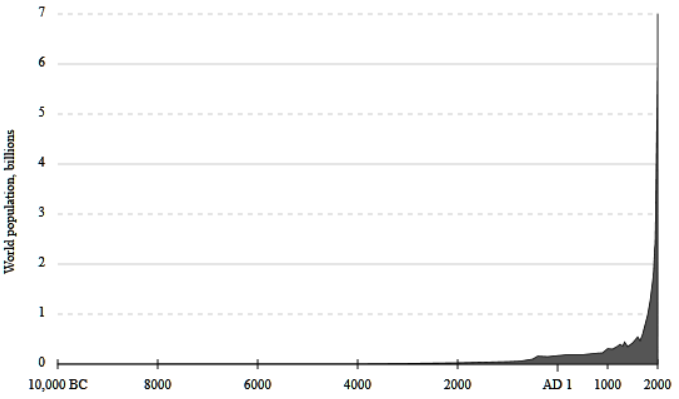
"Population curve" by El T - originally uploaded to en.wikipedia as Population curve.svg. The data is from the "lower" estimates at census.gov
For a child born after the end of WWII, the world's population tripled in their lifetime. This has never ever happened to any other generation before them in all of history, and is unlikely to ever happen again. They, we, are a unique generation in history.
My parents, their children and grandchildren have lived through the most momentous change in all of human history. Not simply the rise of technology, the electronic revolution, space travel. But more importantly sanitation, medicines and contraception - my grandfather was one of 8 children, only 4 survived to adulthood. Today we would be appalled by this. For all of our ancestors this was normal.
Our ancestors would be utterly astounded; ours would seem an alien world where such change is possible.
Because for them things changed little in a lifetime. A citizen of the 6th century would see little different if they traveled 100 years into the future; kings and princes come and go, perhaps lines on maps change, but ordinary daily life hardly changed in a lifetime.
But for us it feels normal that such vast change occurred because that is just what happened. We don't have a frame of reference, deep inside, to know that today is utterly astonishing; we have stepped outside of everything our ancestors called normal.
Yet unconsciously we possibly still project our ancestors view of themselves onto our lives today as well; that is the view we inherited from them. We don't realize that we are alienated from them, to them we are 'strangers in a strange land'.
If the power of humanity depends on how many of us there are, our power has tripled in a single lifetime. If ever there were to be a day when we had the power to significantly impact the planet, surely it is today; our power has grown 25-30 fold since the time of Christ, just on numbers alone.
And more powerful people.But we haven't just multiplied in numbers. So many of us, as individuals, are far, far more powerful than our ancestors could ever have dreamed of being.
Recently I added a veranda to my house. I needed a machine to drill the post holes for the veranda posts. I drove a small SUV with a trailer to a nearby town to hire a machine to excavate the post holes and return it the same day. The machine had a 25 horsepower (HP) motor. My car had a 130 kW engine - roughly 175 HP.
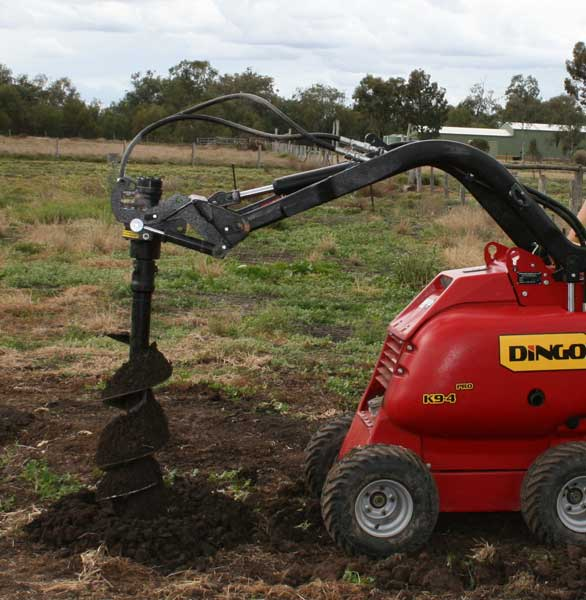
Just to drill some holes in the ground, I had access to the average power of 200 horses! In centuries past what would you have called someone who could muster 200 horses to a task when they needed to? A very wealthy and powerful man; it probably would have been a man back then. But I, as an ordinary citizen, could now muster that just because I needed it.
When you are ironing a shirt, look at the rating plate on the iron. Usually the iron is 1400-1600 watts - two HP. Two horses available to you just so you can iron a shirt!
When Australia was being settled by Europeans (native Australians rightly prefer the word invaded) the journey from the city of Melbourne to my town took around 10 days on foot. Now I can commute that distance for work in 1 1/2 hours.
There are so many more of us, and we are so much more powerful than all of our ancestors. But we don't notice because that is all just normal now. The utterly extraordinary is just mundane to us.
Some numbers, from the big world perspective.Do you eat meat? A hamburger, chicken risotto, roast lamb, bacon? Drink milk, eat eggs, cheese, yoghurt? All obtained from our domesticated animals. Just how much of the world is made up of us and our domestic animals? How much is still 'wild' animals?
Here are some examples of the numbers of different species:
Species Number per species (approx) Domesticated|
| Apes & Primates | Homo Sapiens | 7,300,000,000 | Yes? | | Borneo Gibbon | 250-375,000 | No | | Chimpanzee | 170-300,000 | No | | Western Gorilla | 95,000 | No | | Orangutan | 45-70,000 | No | | Most small primates | 1000's to 10's of 1000's | No | | | | | | | | | | | Carnivores | Dogs | 400,000,000 | Yes | | Cats | 600,000,000 | Yes | | American Black Bear | 900,000 | No | | Brown Bear | 200,000 | No | | Bush Dog | 110,000 | No | | Sea Otter | 100,000 | No | | Leopard | 75,000 | No | | Lion | 30-40,000 | No | | Polar Bear | 20-25,000 | No | | Tiger | 4,000 | No | | Sea Lions and Seals | 10's of 1,000,000's | No | | | | | | Ungulates - Hoofed Animals
| Cattle & buffalo | 1,400,000,000 | Yes | | Sheep & Goats | 1,900,000,000 | Yes | | Pigs | 980,000,000 | Yes | | Mules | 10,000,000 | Yes | | Donkeys | 40,000,000 | Yes | | Horses | 58,000,000 | Yes | | Impala | 2,000,000 | No | | Springbok | 2,000,000 | No | | Zebra | 660,000 | No | | Elk | 1,500,000 | No | | Blue Duiker | 7,000,000 | No | | Wildebeest | 1,500,000 | No | | Hippopotamus | 125-148,000 | No | | Giraffe | 80,000 | No | | Elephant | ~ 500,000 | No | | Most other ungulates | 100's of 1000's. | No |
And there are nearly 20 billion chickens!
All told, it is estimated that, of the mass of all land vertebrates, humanity and our domesticated animals make up over 95%. By weight, of all higher land animals - mammals, birds, reptiles and amphibians - less than 5% are 'wild'. We have nearly domesticated the wild....
skepticalscience.com |



