SI
SI
discoversearch

We've detected that you're using an ad content blocking browser plug-in or feature. Ads provide a critical source of revenue to the continued operation of Silicon Investor.  We ask that you disable ad blocking while on Silicon Investor in the best interests of our community.  If you are not using an ad blocker but are still receiving this message, make sure your browser's tracking protection is set to the 'standard' level.
Politics : Formerly About Advanced Micro Devices -- Ignore unavailable to you. Want to Upgrade?


To: Land Shark who wrote (929168)4/5/2016 10:12:59 AM
From: longnshort1 Recommendation

Recommended By
FJB

  Respond to of 1578068
 
RELATED: Student newspaper loses funding – again – after running op-ed critical of Black Lives Matter

The argument at Wesleyan is not about free speech per se but “who gets to have access to free speech,” he said, apparently referring to activists’ complaints that they can’t share their perspective if they aren’t paid (the Argus only has two paid staff positions).

Freedom of the press “is not free and equal,” because society needs equality before free speech means anything, Martinez said.

Let that sink in. Without “equality,” a term that the average college student tosses off as mindlessly as a Snapchat photo, the founding principle of the United States is pointless.

“I am for the First Amendment and I am not an intolerant dictator,” Martinez concluded. He got a lot of sympathetic laughs from students.


To: Land Shark who wrote (929168)4/5/2016 12:14:12 PM
From: Brumar891 Recommendation

Recommended By
TideGlider

  Respond to of 1578068
 
If Sweden and Germany Became US States, They Would be Among the Poorest States

...
if it were to join the US as a state, Sweden would be poorer than all but 12 states, with a median income of $27,167.
..........

With the exception of Luxembourg ($38,502), Norway ($35,528), and Switzerland ($35,083), all countries shown would fail to rank as high-income states were they to become part of the United States. In fact, most would fare worse than Mississippi, the poorest state.

For example, Mississippi has a higher median income ($23,017) than 18 countries measured here. The Czech Republic, Estonia, Greece, Hungary, Ireland, Italy, Japan, Korea, Poland, Portugal, Slovenia, Spain, and the United Kingdom all have median income levels below $23,000 and are thus below every single US state. Not surprisingly, the poorest OECD members (Chile, Mexico, and Turkey) have median incomes far below Mississippi.

Germany, Europe's economic powerhouse, has a median income ($25,528) level below all but 9 US states.
..............

We Should Adjust for Purchasing-Power Differences Among States

But, I'm really being too conservative with the US numbers here. I'm comparing OECD countries to US states based on a single nation-wide purchasing power number for the US. We've already accounted for cost of living at the national level (using PPP data), but the US is so much larger than all other countries compared here, we really need to consider the regional cost of living in the United States. Were we to calculate real incomes based on the cost of living in each state, we'd find that real purchasing power is even higher in many of the lower-income states than we see above.
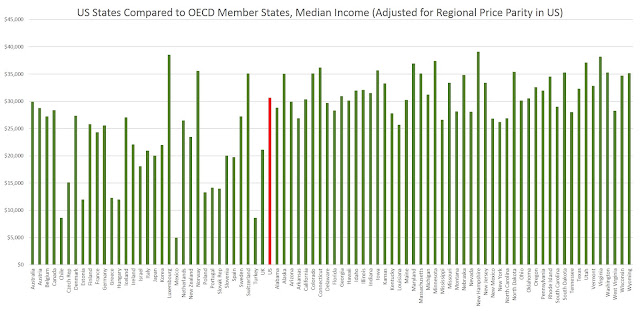


We now see that there's less variation in the median income levels among the US states. That makes sense because many states with low median incomes also have a very low cost of living. At the same time, many states with high median incomes have a very high cost of living.

Now that we've accounted for the low cost of living in Mississippi, we find that Mississippi ($26,517) is no longer the state with the lowest median income in real terms. New York ($26,152) is now the state with the lowest median income due to its very high cost of living.

This has had the effect of giving us a more realistic view of the purchasing power of the median household in US states. It is also more helpful in comparing individual states to OECD members, many of which have much higher costs of living than places like the American south and midwest. Now that we recognize how inexpensive it is to live in places like Tennessee, Florida, and Kentucky, we find that residents in those states now have higher median incomes than Sweden (a place that's 30% more expensive than the US) and most other OECD countries measured.

Once purchasing power among the US states is taken into account, we find that Sweden's median income ($27,167) is higher than only six states: Arkansas ($26,804), Louisiana ($25,643), Mississippi ($26,517), New Mexico ($26,762), New York ($26,152) and North Carolina ($26,819).

We find something similar when we look at Germany, but in Germany's case, every single US state shows a higher median income than Germany. Germany's median income is $25,528. Things look even worse for the United Kingdom which has a median income of $21,033, compared to $26,517 in Mississippi.

.....................
mises.org

Oh, btw, Canada is poorer than Texas:

1.bp.blogspot.com

;>)


To: Land Shark who wrote (929168)4/5/2016 3:07:16 PM
From: Broken_Clock  Read Replies (1) | Respond to of 1578068
 
Your messiah just threw BP a rather large bone. Are there ANY corporate masters he doesn't serve?
+++

Published on

Tuesday, April 05, 2016

by
Common Dreams

Tax Windfall for Deepwater Horizon Settlement a 'Major Coup for BP'

'Treating the worst oil spill in U.S. history as an ordinary and necessary business expense boggles the mind'

by
Nika Knight, staff writer


"Making the American taxpayer pick up BP's bill for cleaning the disastrous Deepwater Horizon spill is an outrage," presidential hopeful Bernie Sanders tweeted on Monday. (Photo: Sean Gardner/Reuters)

In the six years since BP's catastrophic Deepwater Horizon spill poured millions of gallons of oil into the Gulf of Mexico, environmentalists, Gulf coast residents, and politicians have clamored for justice. But Monday's historic $20 billion settlement against the oil giant is not what they hoped it would be.

The settlement's terms are so generous to BP that it amounts to a tax break worth billions—as some observers predicted.

A whopping $15 billion of the $20 billion settlement can be written off by BP as a "normal operating expense," meaning the multinational corporation will pay only a fraction of the total settlement amount and American taxpayers will be left with the majority of the astronomical costs of the company's mistake.

"We are saddened to learn that the gross negligence of BP continues to enjoy taxpayer subsidies," said Lukas Ross, climate and energy campaigner with the environmental group Friends of the Earth.

"Treating the worst oil spill in U.S. history as an ordinary and necessary business expense boggles the mind," Ross continued. "Nearly six years to the day since this tragedy began to unfold, it is clear that we have still failed to learn all the lessons of the Deepwater Horizon."

Presidential hopeful Bernie Sanders also voiced his disapproval of the deal:

Legal journalist at Forbes Robert W. Wood notes that just $5.5 billion of the settlement "is indicated explicitly as a penalty under the Clean Water Act," and it is only this portion of the settlement which is not tax-deductible. However, "the federal government could have received as much as a $13.7 billion penalty under that Act based on a recent finding by a New Orleans judge that the spill was the result of 'gross negligence,'" he argues.

"The oil giant already wrote off the cost of its cleanup effort after the spill," Wood writes, "Yet remediation is supposed to be tax deductible and penalties are not. Even for this penalty money, though, companies often find a way to deduct payments unless the settlement or consent documents expressly prohibit it."

The massive tax break "is a major coup for BP," says Wood, "which is doing all it can to make sure BP doesn’t stand for 'big penalty.'"

Of course, BP wasn't the only player making sure this was the outcome. Huffington Post reporter Nick Visser delves into how U.S. officials took deliberate steps to ensure BP could evade paying the majority of the settlement:

Shortly after BP agreed to the terms of the settlement last year, 53 members of Congress asked Attorney General Loretta Lynch to deny the company the ability to deduct the expenses from its taxes. Such a provision would've matched the terms of the $5.5 billion in fines for the company's violation of the Clean Water Act, which prohibit the company from claiming them as a business expense.

The International Business Times notes the U.S. tax code allows punitive damages to be written off as a business expense, as BP will be allowed. But provisions added to settlements can restrict this freedom.

BP is not only receiving this eye-popping tax break for being behind the worst oil spill in U.S. history—the company has actually expanded operations in the Gulf in the years since, as the Atlantic reported in 2014.


This work is licensed under a Creative Commons Attribution-Share Alike 3.0 License

