Templeton's $38 Billion CIO Sees Bond Refugees Distorting Stocks
by Tom Redmond
April 20, 2016 — 11:00 AM EDT Updated on April 20, 2016 — 10:03 PM EDT
A penchant for safety in global stock markets is about to blow up in investors’ faces, says Norm Boersma, the $38 billion chief investment officer of Templeton Global Advisors Ltd.
Bond defectors seeking better returns have pushed up valuations in equities less sensitive to the economy, creating the potential for a “sharp correction,” according to Boersma, who is also president of the company. Templeton’s approach of picking beaten-down stocks will recover after one of the worst periods of underperformance for value investing in a century, he said, noting he sees opportunities in financial and energy shares.
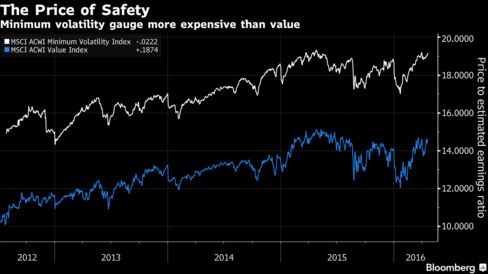
Quantitative easing after the 2008 financial crisis depressed yields on debt, encouraging investors into the equity market in search of higher payouts. Even with bonds repeatedly defying predictions that their three-decade rally will end, asset managers have piled into so-called defensive shares, and into technology stocks including Amazon.com Inc., Apple Inc. and Microsoft Corp. A measure of equities seen as the safest bets reached an all-time high this week.
t’s “driven by a need to be in the equity markets but a fear of the more volatile areas,” Boersma said in an interview during a visit to Tokyo last week. “Clients are actively looking for low-volatility managers. Volatility is something you take on in order to get a higher return. It’s difficult to both have a higher return and take all the risk out of it.”
All this has made markets more difficult for stock pickers. Some 88 percent of U.S. equity funds trailed their benchmarks in the five years through 2015, according to S&P Dow Jones Indices. Franklin Templeton Investments, Templeton Global Advisors’ parent, saw 13 straight months of outflows from its funds through the end of February, with clients pulling $70.6 billion, data from Morningstar Inc. show. The Templeton Growth Fund, the largest managed by Boersma with $13.6 billion in assets, lost 7.8 percent in the past year, according to data compiled by Bloomberg.
It doesn’t feel good,” Boersma said. “Everybody is struggling. Hedge fund managers have struggled, long-only managers. It’s been right across the board. When things are highly correlated, then it’s difficult to get paid for making bets.”
Value RecoveryBoersma says that while he’s partly “talking his own book” in predicting a recovery in value shares, history’s on his side. He says there have only been two other times over the past century where value stocks have done this badly relative to growth -- 1942 and 2000 -- and they were both buying opportunities. A gauge of global value shares outperformed their growth peers in four of the five years from the collapse of the dot.com bubble through 2004.
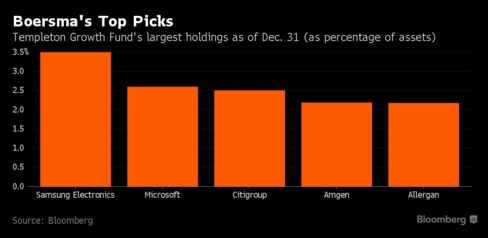
The Templeton Growth Fund, which despite its name pursues a value strategy, counted Samsung Electronics Co., Microsoft and Citigroup Inc. as its largest holdings at the end of last year. The fund has achieved an average annual total return of 12 percent from its inception in 1954 through 2015. In the five years since Boersma became its manager, it returned 5.1 percent a year.
Expect more turbulence in the months ahead, says Boersma, as investors watch China, Federal Reserve decisions on raising interest rates and the U.K. vote on seceding from Europe.
Still, the Templeton veteran says none of this will do much damage. China will probably “muddle through,” the Fed will lift rates once or twice, and the Brexit referendum will have little impact on continental Europe, he says. The prospect of Donald Trump becoming the next U.S. president also doesn’t faze him, after the favorite for the Republican nomination said he’d build a wall and have Mexico pay for it and increase tariffs on imported Chinese goods to as much as 45 percent.
Presidential Race“The president doesn’t necessarily have the ability to change all that stuff,” Boersma said. “You watch it and you shake your head, but in terms of anybody being able to go out there and change the world in very short order and turn everything on its head, I think that that’s probably not that easy to do -- which is probably lucky.”
If anything, the biggest risk Boersma sees is the boom in products that try to avoid it. The iShares MSCI USA Minimum Volatility ETF, a U.S. exchange-traded fund, has had assets surge to $12.5 billion since inception in October 2011. The PowerShares S&P Low Volatility Portfolio now has $6.9 billion after starting in May that year. Flows into U.S. equity ETFs over the past two years have been more than twice as large as those for bonds. The MSCI ACWI Minimum Volatility Index trades at 19.1 times estimated earnings, compared with 14.6 for the MSCI ACWI Value Index. The value measure rose 0.2 percent on Wednesday, while the low-volatility gauge dropped 0.6 percent.
Educating Investors
Boersma, who spends half his time on investing and the rest running the company, says the tough slog for the value style since 2008 must soon come to an end. The rally in global equities since mid-February shows some evidence of this, with MSCI’s all-country value measure beating both its growth and low-volatility equivalents. In the meantime, he says he’ll keep working on making sure his investors don’t panic.
“We spend a lot of time trying to educate people that, when something hasn’t worked for a while, that’s an opportunity, not a risk,” he said. “That’s part of the reason value investing works. People tend to get caught up in emotions and overdo things both on the upside and the downside.”
http://www.bloomberg.com/news/articles/2016-04-20/templeton-s-38-billion-ceo-sees-bond-refugees-distorting-stocks
------------------
(editorial note in March of 2000 it took legendary value investor Julian Robertson's liquidation of his value oriented Tiger Fund to create a bottom in value stocks while we saw a massive collapse in technology and .com stocks... many of which are still not back to their 2000 price levels. including CSCO, YHOO, INTC, AMD, NOK, HPQ, ORCL briefly clawed it's way back to near 2000 and is still below it. companies like Broadcom and CHTR reorganized so that you can no longer see how grossly overvalued they were back in 2000.
JP)
|



