NexGen Energy (NXE-T) Makes New High Grade Discovery 4.7 km Northeast of the Arrow Deposit
Aug 11, '16 - NR
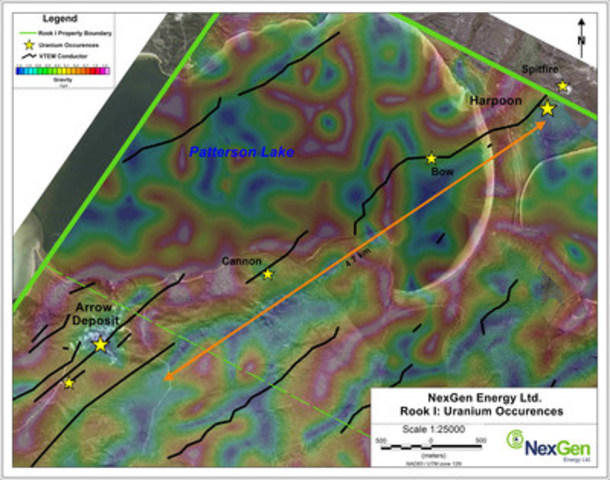
NexGen Energy is pleased to report the discovery of a new high grade zone of mineralization 4.7 km northeast of the Arrow Deposit as part of our on-going summer drilling program on our 100% owned, Rook I property, Athabasca Basin, Saskatchewan.
Regional drilling approximately 4.7 km northeast of Arrow has resulted in a new discovery of high grade uranium mineralization. Discovery hole HP-16-08 intersected 17.0 m of continuous mineralization (220.0 to 237.0 m) including 4.5 m of off-scale radioactivity (>10,000 to >61,000 cps). This new zone has been named the Harpoon Discovery and is defined by the presence of strong visible uranium mineralization and includes dense accumulations of massive to semi-massive pitchblende mineralization. The discovery hole was a 250 m step-out along trend to the northeast of hole HP-16-06 (also reported in this news release), which encountered 1.5 m of continuous mineralization (<500 to 2200 cps) from 303.0 to 304.5 m. The Harpoon Discovery is on land and starts at a vertical depth of approximately 210 m.
In addition, uranium occurrences between Arrow and along trend to the northeast at Harpoon have now been traced over a mineralized strike length of 5.6 km all within the Rook I property.
Radioactivity results for the discovery hole and three other holes drilled in the same area are included in this press release. The area was first drilled in the summer of 2015 with four holes (see news release dated September 22, 2015).
Highlights:
Harpoon Discovery
Drill hole HP-16-08 intersected 17.0 m of continuous mineralization (220.0 to 237.0 m) including 4.5 m of off-scale radioactivity (>10,000 to >61,000 cps) and dense accumulations of massive to semi-massive pitchblende with maximum radioactivity exceeding 61,000 cps.
HP-16-06 intersected 1.5 m of continuous mineralization (<500 to 2200 cps) from 303.0 to 304.5 m, and is located 250 m to the southwest of HP-16-08 towards the Arrow Deposit.
The Harpoon Discovery is located on a Rook I internal mineral disposition (northeast of green dashed line in Figure 1) which is subject to a 2% net smelter return royalty (the "NSR") of which 1% can be repurchased by the Company for $1 million which is held by Advanced Royalty Corp. In addition, Harpoon is subject to a 10% production carried interest held by Rio Tinto Uranium Corporation ("Rio Tinto") which provides Rio Tinto with a right to 10% of potential future production provided Rio Tinto pays NexGen their 10% pro rata portion of the collective expenditure from June 20, 2005.
Table 1: Harpoon Discovery Drill Hole Data
|
|
| Drill Hole
| Athabasca
Group -
Basement
Unconformity
Depth (m)
| Handheld Scintillometer Results (RS-120)
| Hole ID
| Azimuth
| Dip
| Total
Depth
(m)
| From (m)
| To (m)
| Width (m)
| CPS Range
| HP-16-05
| 320
| -70
| 558.00
| 125.10
| 292.00
| 293.50
| 1.50
| <500 - 890
| HP-16-06
| 320
| -70
| 540.00
| 126.70
| 303.00
| 304.50
| 1.50
| <500 - 2200
| HP-16-07
| 320
| -70
| 578.00
| 128.90
| No Significant Intersections
| HP-16-08
| 305
| -70
| 396.00
| N/A
| 220.00
| 237.00
| 17.00
| <500 - >61000
|
|
|
|
|
|
|
|
|
|
Parameters:
Maximum internal dilution 2.00 m downhole
All depths and intervals are meters downhole
"Anomalous" means >500 cps (counts per second) total count gamma readings by gamma scintillometer type RS-120
"Off-scale" means >10,000 cps (counts per second) total count gamma readings by gamma scintillometer type RS-120
Where "Min cps" is <500 cps, this refers to local low radiometric zones within the overall radioactive interval
Activities & Financial
The summer 2016 program comprising 35,000 m of drilling is continuing with seven drill rigs active.
The Company has cash on hand of approximately $91 million.
Plan maps and a drill core photo of the Harpoon Discovery are shown in Figures 1 to 3.
Garrett Ainsworth, Vice-President, Exploration and Development, commented "The intensity of high grade uranium mineralization across the continuous 17 m wide interval at the Harpoon Discovery is consistent with that encountered in the High Grade A2 Domain of the Arrow Deposit. The exploration principles that have led to these high grade discoveries will continue to be utilized along the 9.5 km strike length of Patterson conductor corridor contained within our Rook I property."
Leigh Curyer, Chief Executive Officer commented: "This is an extremely exciting development for NexGen and our shareholders. The Rook I property is delivering multiple high grade discoveries and is still in its infancy when you consider the relatively limited drilling along the Patterson Corridor to date. The focus on targeted regional drilling along with Arrow infill and expansion is meeting all objectives of the summer program. Our technical team led by Garrett Ainsworth, has again proven their clear understanding of the controlling features of high grade uranium mineralization in this region and are eager to drill the multiple targets that have been defined. Given the nature of the Harpoon discovery, we are currently seeking additional drilling capacity to the current summer 35,000 m summer program in order to maintain the resource development optimization of Arrow."
Conference Call
NexGen will host a conference call today, August 11, 2016 at 12:00 p.m. Eastern Standard Time. Participants may join the conference call using the following call-in details:
Participant Toll Free Dial-In: +1 888 231-8191
Participant International Dial-In: +1 647 427-7450
A replay of this conference call will be available until September 10, 2016. The playback numbers are:
Local/International: +1 416 849 0833
North America Toll Free: +1 855 859 2056
Playback Passcode: 65134733 #
Harpoon Discovery Drilling
HP-16-05
Hole HP-16-05 was drilled at an angled orientation (-70° dip) to the northwest (320° azimuth) to test a VTEM conductor associated with a circular gravity anomaly. The hole was collared between HP-15-02 (formerly RK-15-66a) and HP-15-03 (formerly RK-15-69). Both holes intersected anomalous radioactivity in close association with a graphitic shear zone. Assays confirmed that HP-15-03 intersected 0.05% U3O8 over 2.5 m (see news release dated September 22, 2015). Hole HP-15-05 intersected strongly bleached and desilicified Athabasca Group sandstones between 113.8 m and the unconformity at 125.1 m. Basement lithologies consisted largely of semipelitic gneiss, quartzite and intrusive gneisses of varying composition. Intermittent clay, hematite and chlorite alteration was encountered throughout the basement. A total composite mineralization of 1.5 m (<500 to 890 cps) was intersected between 292.0 and 293.5 m. Mineralization occurred within a clay- and chlorite-altered graphitic shear zone. The hole was terminated at 558.0 m.
HP-16-06
Hole HP-16-06 was drilled at an angled orientation (-70° dip) to the northwest (320° azimuth) to test a VTEM conductor associated with a circular gravity anomaly. It was collared as a 55 m northeast step-out from HP-16-05. The hole intersected strongly bleached and desilicified Athabasca Group sandstones between 120.0 m and the unconformity at 126.7 m. Basement lithologies consisted largely of semipelitic and intrusive gneisses of varying composition. Intermittent clay, hematite and chlorite alteration was encountered throughout the basement. A total composite mineralization of 1.5 m (<500 to 2200 cps) was intersected between 303.0 and 304.5 m. Mineralization occurred within a clay- and chlorite-altered graphitic shear zone. The hole was terminated at 540.0 m.
HP-16-07
Hole HP-16-07 was drilled at an angled orientation (-70° dip) to the northwest (320° azimuth) to test a VTEM conductor associated with a circular gravity anomaly. It was collared as a 55 m southwest step-out from HP-16-06. The hole intersected bleached Athabasca Group sandstones between 126.1 m and the unconformity at 128.9 m. Basement lithologies consisted largely of semipelitic and intrusive gneisses of varying composition. Intermittent clay, hematite and chlorite alteration was encountered throughout the basement. No anomalous radioactivity associated with uranium was intersected before the hole was terminated at 578.0 m.
HP-16-08
Hole HP-16-08 was drilled at an angled orientation (-70° dip) to the northwest (320° azimuth) to test a VTEM conductor associated with a circular gravity anomaly. It was designed to test the prospective structure 200 m northeast of HP-16-06 and -07 and at a shallower depth. Due to the suspected presence of extreme desilicification, no intact Athabasca Group sandstones were recovered. Basement lithologies were intersected beginning at 135.0 m and consisted largely of semipelitic and intrusive gneisses of varying composition. Continuous mineralization was intersected over 17.0 m including 4.5 m of off-scale radioactivity (>10,000 to >61,000 cps) between 220.0 and 237.0 m. Visible uranium mineralization occurs as massive to semi-massive veins, worm-rock styles, chemical solution fronts, disseminations, replacement bodies and fracture coatings. It is hosted within a chloritic and graphitic shear zone that is heavily clay altered. Strong clay alteration occurs extensively above the mineralized zone. The hole was terminated at 396.0 m.
Technical Information
Natural gamma radiation in drill core reported in this news release was measured in counts per second (cps) using a Radiation Solutions Inc. RS-120 gamma-ray scintillometer. The reader is cautioned that total count gamma readings may not be directly or uniformly related to uranium grades of the rock sample measured; they should be used only as a preliminary indication of the presence of radioactive minerals. All intersections are downhole. True thicknesses are yet to be determined.
Split core samples will be taken systematically, and intervals will be submitted to SRC Geoanalytical Laboratories (an SCC ISO/IEC 17025: 2005 Accredited Facility) of Saskatoon for analysis. All samples sent to SRC will be analyzed using ICP-MS for trace elements on partial and total digestions, ICP-OES for major and minor elements on a total digestion, and fusion solution of boron by ICP-OES. Mineralized samples are analyzed for U3O8 by ICP-OES and select samples for gold by fire assay. Assay results will be released when received and after stringent internal QA/QC protocols are passed.
All scientific and technical information in this news release has been prepared by or reviewed and approved by Mr. Garrett Ainsworth, P.Geo., Vice President – Exploration & Development for NexGen. Mr. Ainsworth is a qualified person for the purposes of National Instrument 43-101 Standards of Disclosure for Mineral Projects ("NI 43-101"), and has verified the sampling, analytical, and test data underlying the information or opinions contained herein by reviewing original data certificates and monitoring all of the data collection protocols.
For details of the Rook I Project including the quality assurance program and quality control measures applied and key assumptions, parameters and methods used to estimate the mineral resource set forth above please refer to the technical report entitled "Technical Report on the Rook 1 Property, Saskatchewan, Canada" dated effective April 13, 2016 (the "Rook 1 Technical Report") prepared by Mark B. Mathisen and David Ross, each of whom is a "qualified person" under NI 43-101. The Rook I Technical Report is available for review under the Company's profile on SEDAR at www.sedar.com.
About NexGen
NexGen is a British Columbia corporation with a focus on the acquisition, exploration and development of Canadian uranium projects. NexGen has a highly experienced team of uranium industry professionals with a successful track record in the discovery of uranium deposits and in developing projects through discovery to production.
NexGen owns a portfolio of highly prospective uranium exploration assets in the Athabasca Basin, Saskatchewan, Canada, including a 100% interest in Rook I, location of the Arrow Discovery in February 2014 and Bow Discovery in March 2015. The Arrow Deposit's maiden Inferred mineral resource estimate is 201.9 M lbs U3O8 contained in 3.48 M tonnes grading 2.63% U3O8.
SOURCE NexGen Energy Ltd.
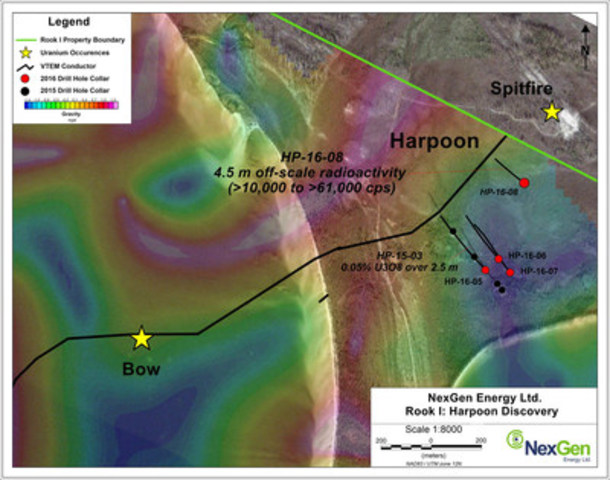
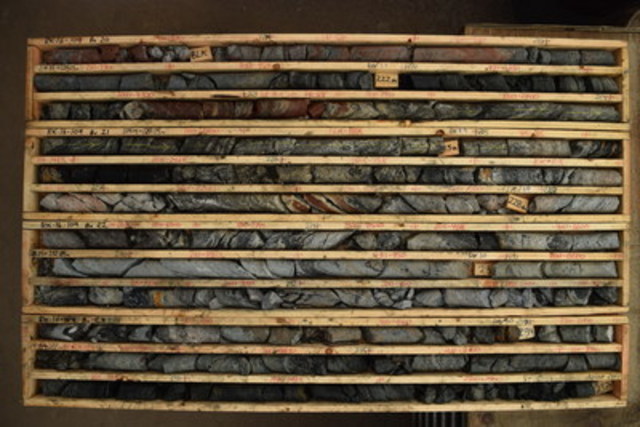
Image with caption: "Figure 1: Plan Map Showing Location of the Harpoon Discovery (CNW Group/NexGen Energy Ltd.)". Image available at: http://photos.newswire.ca/images/download/20160811_C1340_PHOTO_EN_751305.jpg
Image with caption: "Figure 2: Harpoon Discovery Drill Hole Locations (CNW Group/NexGen Energy Ltd.)". Image available at: http://photos.newswire.ca/images/download/20160811_C1340_PHOTO_EN_751307.jpg
Image with caption: "Figure 3: Photo of Mineralization Intersected in Drill Hole HP-16-08 (CNW Group/NexGen Energy Ltd.)". Image available at: http://photos.newswire.ca/images/download/20160811_C1340_PHOTO_EN_751309.jpg

Leigh Curyer, Chief Executive Officer, NexGen Energy Ltd.,
+1 604 428 4112,
lcuryer@nexgenenergy.ca ,
www.nexgenenergy.ca ;
Travis McPherson, Corporate Development Manager, NexGen Energy Ltd.,
+1 604 428 4112,
tmcpherson@nexgenenergy.ca ,
nexgenenergy.ca |



