SI
SI
discoversearch

We've detected that you're using an ad content blocking browser plug-in or feature. Ads provide a critical source of revenue to the continued operation of Silicon Investor.  We ask that you disable ad blocking while on Silicon Investor in the best interests of our community.  If you are not using an ad blocker but are still receiving this message, make sure your browser's tracking protection is set to the 'standard' level.
Politics : Politics of Energy -- Ignore unavailable to you. Want to Upgrade?


To: Brumar89 who wrote (73977)1/3/2017 12:19:06 PM
From: Eric  Read Replies (1) | Respond to of 86355
 
Well they would obviously like them to last forever.

More and more folks are getting off of them and don't have a recurring energy bill.

Folks are a lot smarter today than the ff companies think!


To: Brumar89 who wrote (73977)1/3/2017 12:58:37 PM
From: Eric  Read Replies (1) | Respond to of 86355
 
Solar Could Beat Coal to Become the Cheapest Power on Earth

by
Jessica Shankleman
and
Chris Martin

January 2, 2017, 4:00 PM PST January 3, 2017, 4:16 AM PST

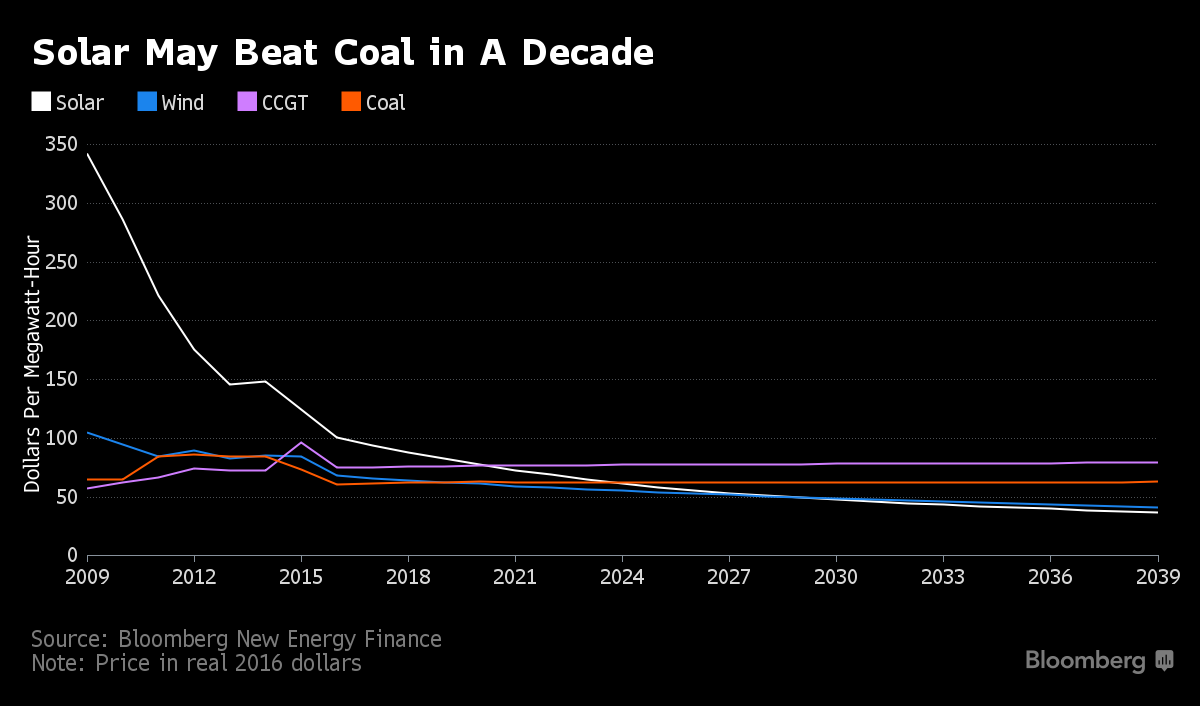
Global average solar cost may fall below coal within 10 years

Countries from Saudi Arabia to Mexico planning auctions
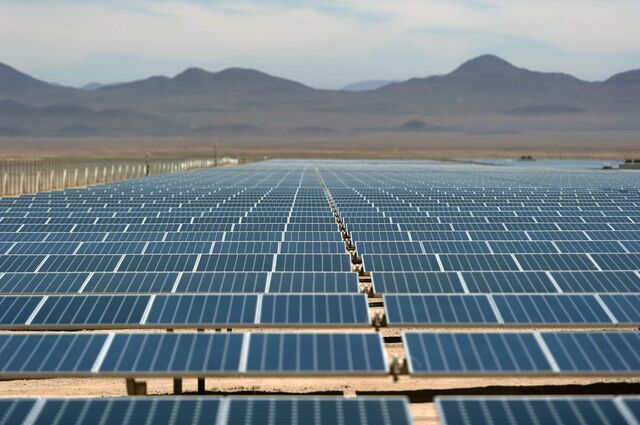


A solar farm in the Atacama desert, northern Chile.

Photographer: Vladimir Rodas/AFP via Getty Images

Solar power is now cheaper than coal in some parts of the world

In less than a decade, it’s likely to be the lowest-cost option almost everywhere


In 2016, countries from Chile to the United Arab Emirates broke records with deals to generate electricity from sunshine for less than 3 cents a kilowatt-hour, half the average global cost of coal power. Now, Saudi Arabia, Jordan and Mexico are planning auctions and tenders for this year, aiming to drop prices even further.

Taking advantage: Companies such as Italy’s Enel SpA and Dublin’s Mainstream Renewable Power, who gained experienced in Europe and now seek new markets abroad as subsidies dry up at home.

Since 2009, solar prices are down 62 percent, with every part of the supply chain trimming costs. That’s help cut risk premiums on bank loans, and pushed manufacturing capacity to record levels. By 2025, solar may be cheaper than using coal on average globally, according to Bloomberg New Energy Finance.

“These are game-changing numbers, and it’s becoming normal in more and more markets," said Adnan Amin, International Renewable Energy Agency ’s director general, an Abu Dhabi-based intergovernmental group. "Every time you double capacity, you reduce the price by 20 percent.”


Better technology has been key in boosting the industry, from the use of diamond-wire saws that more efficiently cut wafers to better cells that provide more spark from the same amount of sun. It’s also driven by economies of scale and manufacturing experience since the solar boom started more than a decade ago, giving the industry an increasing edge in the competition with fossil fuels.

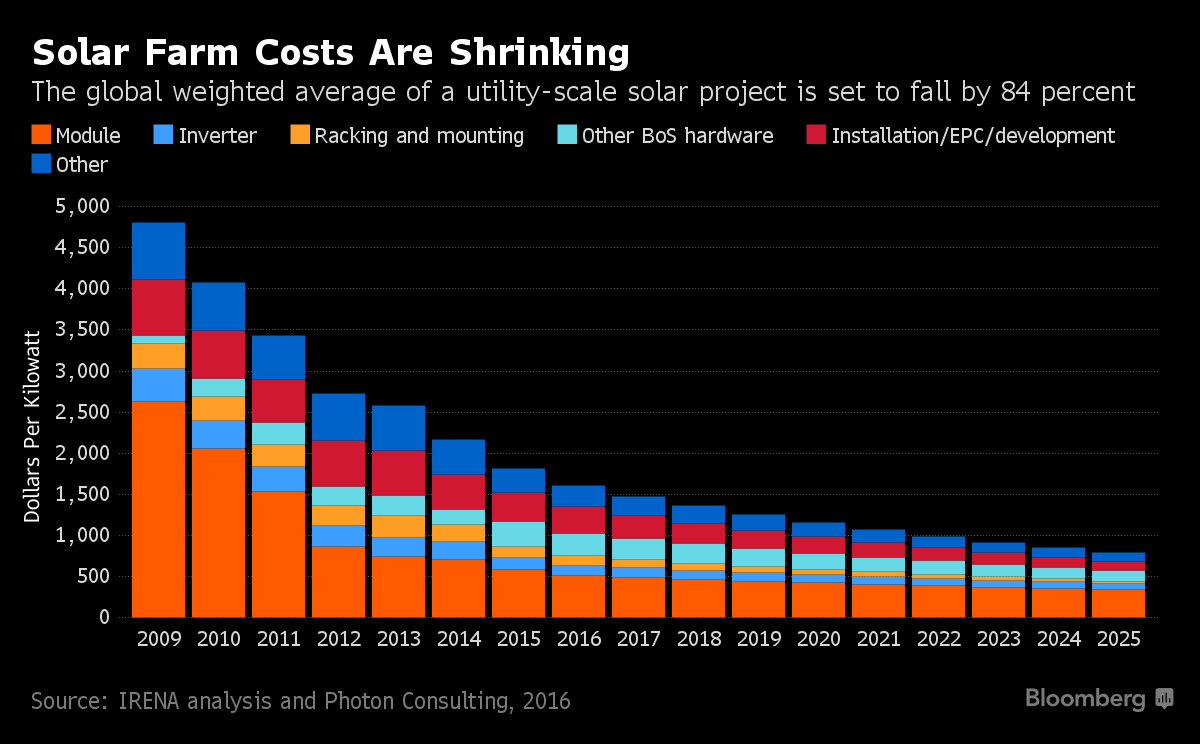
The average 1 megawatt-plus ground mounted solar system will cost 73 cents a watt by 2025 compared with $1.14 now, a 36 percent drop, said Jenny Chase, head of solar analysis for New Energy Finance.

That’s in step with other forecasts.
  • GTM Research expects some parts of the U.S. Southwest approaching $1 a watt today, and may drop as low as 75 cents in 2021, according to its analyst MJ Shiao.
  • The U.S. Energy Department’s National Renewable Energy Lab expects costs of about $1.20 a watt now declining to $1 by 2020. By 2030, current technology will squeeze out most potential savings, said Donald Chung, a senior project leader.
  • The International Energy Agency expects utility-scale generation costs to fall by another 25 percent on average in the next five years.
  • The International Renewable Energy Agency anticipates a further drop of 43 percent to 65 percent for solar costs by 2025. That would bring to 84 percent the cumulative decline since 2009.
The solar supply chain is experiencing “a Wal-Mart effect” from higher volumes and lower margins, according to Sami Khoreibi, founder and chief executive officer of Enviromena Power Systems, an Abu Dhabi-based developer.

The speed at which the price of solar will drop below coal varies in each country. Places that import coal or tax polluters with a carbon price, such as Europe and Brazil, will see a crossover in the 2020s, if not before. Countries with large domestic coal reserves such as India and China will probably take longer.

Coal’s Rebuttal

Coal industry officials point out that cost comparisons involving renewables don’t take into account the need to maintain backup supplies that can work when the sun doesn’t shine or wind doesn’t blow. When those other expenses are included, coal looks more economical, even around 2035, said Benjamin Sporton, chief executive officer of the World Coal Association.

“All advanced economies demand full-time electricity,” Sporton said. “Wind and solar can only generate part-time, intermittent electricity. While some renewable technologies have achieved significant cost reductions in recent years, it’s important to look at total system costs.”

Even so, solar’s plunge in price is starting to make the technology a plausible competitor.

In China, the biggest solar market, will see costs falling below coal by 2030, according to New Energy Finance. The country has surpassed Germany as the nation with the most installed solar capacity as the government seeks to increase use to cut carbon emissions and boost home consumption of clean energy. Yet curtailment remains a problem, particularly in sunnier parts of the country as congestion on the grid forces some solar plants to switch off.


Sunbelt countries are leading the way in cutting costs, though there’s more to it than just the weather. The use of auctions to award power-purchase contracts is forcing energy companies to compete with each other to lower costs.

An August auction in Chile yielded a contract for 2.91 cents a kilowatt-hour. In September, a United Arab Emirates auction grabbed headlines with a bid of 2.42 cents a kilowatt-hour. Developers have been emboldened to submit lower bids by expectations that the cost of the technology will continue to fall.

“We’re seeing a new reality where solar is the lowest-cost source of energy, and I don’t see an end in sight in terms of the decline in costs,” said Enviromena’s Khoreibi.

bloomberg.com


To: Brumar89 who wrote (73977)1/4/2017 6:56:07 AM
From: Eric  Read Replies (1) | Respond to of 86355
 
Solar now cheapest new form of energy in nearly 60 countries


By Sher Watts Spooner
Sunday Jan 01, 2017 · 10:00 AM PST


Solar mirrors in Morocco. Developing countries are learning that installing solar power is the most cost-effective method of generating electricity.

Donald Trump and the climate deniers and fossil fuel company backers he’s nominated for his cabinet don’t realize it—or refuse to believe it—but the world is starting to pass them by when it comes to developing new sources of power. In the developing world, solar power is becoming the most cost-effective new source of electricity.

In nearly 60 lower-income countries, the average price of solar energy has dropped to $1.65 million per megawatt in 2016, just below wind at $1.66 million per megawatt. That means new energy development projects will focus on solar energy rather than wind power.

“Unsubsidized solar is beginning to outcompete coal and natural gas on a larger scale, and notably, new solar projects in emerging markets are costing less to build than wind projects,” says a report from Bloomberg New Energy Finance, a research and analysis organization for those investing in the energy industry.

According to a mid-December story from Bloomberg Technology about the report, called Climatescope:
This year has seen a remarkable run for solar power. Auctions, where private companies compete for massive contracts to provide electricity, established record after record for cheap solar power. It started with a contract in January to produce electricity for $64 per megawatt-hour in India; then a deal in August pegging $29.10 per megawatt-hour in Chile. That’s record-cheap electricity—roughly half the price of competing coal power.

“Renewables are robustly entering the era of undercutting” fossil fuel prices, BNEF Chairman Michael Liebreich said in a note to clients.
Undercutting fossil fuel prices. In other words, doing it more cheaply. And when you’re building a new infrastructure for electricity with limited resources—and you’re a country with abundant sunshine—you go with the least expensive option. And that ain’t coal, gas, or oil.

This chart shows the average cost of new wind and solar projects from 58 emerging-market economies. The countries studied include China, India, and Brazil.


The Bloomberg data show how the price of solar power has dropped to a third of what it was in 2010.
The low-cost contracts discussed in the Bloomberg report are for new projects. It adds:
When all the 2016 completions are tallied in coming months, it’s likely that the total amount of solar photovoltaics [PVAs] added globally will exceed that of wind for the first time. The latest BNEF projections call for 70 gigawatts of newly installed solar in 2016 compared with 59 gigawatts of wind.

The overall shift to clean energy can be more expensive in wealthier nations, where electricity demand is flat or falling and new solar must compete with existing billion-dollar coal and gas plants. But in countries that are adding new electricity capacity as quickly as possible, “renewable energy will beat any other technology in most of the world without subsidies,” said Liebreich.
This new development of cheaper solar power is being described as a turning point in the energy industry. “The world ... is adding more capacity for clean energy each year than for coal and natural gas combined. Peak fossil-fuel use for electricity may be reached within the next decade,” according to the story in Bloomberg.

Another story about the report in Science Alert discussed how the growth in solar marks some new milestones.
Solar is booming for a number of reasons, including falling equipment costs, new business models like Tesla's home batteries, growing investment, and a rise in clean energy policies.

It's also worth noting that prices fluctuate across the world, and solar isn't the cheapest deal everywhere just yet — the cost depends on sunshine availability, plus the energy contracts that are already in place, and what government subsidies are on offer.

But it's still a landmark moment for new energy costs in developing nations, and goes hand-in-hand with renewable energy now having become the largest source of new power capacity in the world. …

Last year, China invested $103 billion in solar projects, more than the US ($44.1 billion), the UK ($22.2 billion), and Japan ($36.2 billion) put together.
Other points from the Climatescope report:
  • Steep solar equipment cost efficiencies are catalyzing build and driving economic growth.
  • Cheap solar, innovative business models, and a new breed of entrepreneurs are revolutionizing how energy access issues are addressed in least developed nations.
  • Developed economies are accelerating funding for clean energy in emerging markets.
  • Clean energy policies are becoming more widely adopted across Sub-Saharan Africa.
  • In ranking and profiling emerging markets for their ability to attract capital for low-carbon energy projects, the top-scoring markets were China, Chile, Brazil, Uruguay, South Africa, and India.
As James Rado and Gerome Ragni wrote in the 1967 musical Hair, “Let the Sunshine In.” The words were for a different context, but they seem strangely prophetic today.:

We starve, look at one another, short of breath
Walking proudly in our winter coats
Wearing smells from laboratories
Facing a dying nation of moving paper fantasy
Listening for the new told lies
With supreme visions of lonely tunes.

dailykos.com

