Climate change
Climate Consensus - the 97%
New studies show Rex Tillerson is wrong about climate risks
The remaining climate change uncertainties point toward higher risks and greater urgency for action
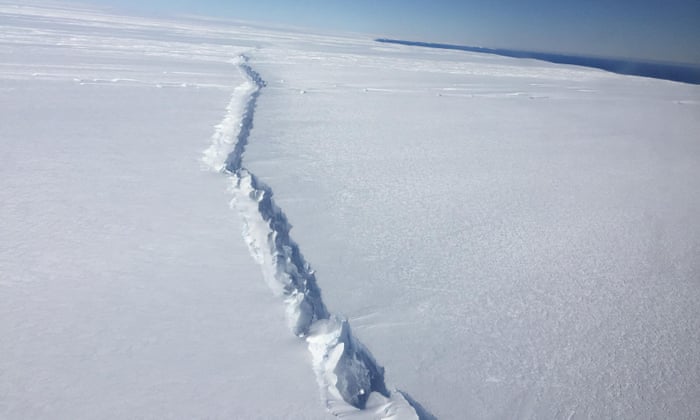
A crack in Antarctic Larsen C Ice Shelf, as seen during IceBridge’s “Pine Island 5” mission on Nov. 4, 2016. Ice is rapidly destabilizing near both of Earth’s poles, and poses threats of rapid large-scale sea level rise. Photograph: Nathan Kurtz/IceBridge/NASA
Dana Nuccitelli
Monday 16 January 2017 06.00 EST Last modified on Monday 16 January 2017 12.06 EST
President-elect Donald Trump’s nominee for Secretary of State – and until recently the CEO of ExxonMobil – Rex Tillerson was given a confirmation hearing by the Senate Foreign Relations Committee last week. In his testimony, Tillerson accepted the reality of human-caused global warming and that “The risk of climate change does exist and the consequences of it could be serious enough that action should be taken.”
While he accepted the problem exists, Tillerson nevertheless proceeded to downplay its risks, saying:
The increase in the greenhouse gas concentrations in the atmosphere are having an effect, our ability to predict that effect is very limited.
Many climate scientists took issue with that statement, and for good reason. Climate models have been very accurate in their projections about many consequences of human carbon pollution. It’s true that there’s uncertainty in just how quickly some of those consequences will be triggered. The bad news is that recent studies have shown that many of those consequences are happening more quickly than climate scientists anticipated. Greater climate uncertainty translates into more urgency to tackle the problem, not less.
The Gulf Stream could shut down sooner than anticipated
The Gulf Stream – which keeps the UK and surrounding area significantly warmer than it would otherwise be – is part of the Atlantic Meridional Overturning Circulation (AMOC). Research has shown it could shut down as a result of global warming:
In 1997, the oceanographer Wallace Broecker, of Columbia University in New York, suggested that if the Gulf stream turned off, winter temperatures in the British Isles could fall by an average of 11°C - plunging Blackpool or Berwick to the same temperatures as Spitsbergen, inside the Arctic circle. Any dramatic drop in temperature could have devastating implications for agriculture - and for Europe’s ability to feed itself.
Just how quickly such a shutdown could happen has been a subject of debate and research among climate scientists. A study published in Science Advances in early January corrected for a bias recently identified in climate models that acted to keep the AMOC and Gulf Stream more stable than it appears to be in reality:
Freshwater continually flows into the northern Atlantic through precipitation, rivers and ice-melting. But supply of salty waters from the south, through the Gulf Stream System, balances this. If however the current slows, there is less salt supply, and the surface ocean gets less salty. This fresher water is lighter than saltier water and therefore cannot sink into the depths so easily. Since this sinking – the so-called deep water formation – drives the Gulf Stream System, the current continues to weaken. There is a critical point when this becomes an unstoppable vicious circle. This is one of the classic tipping points in the climate system.
In most climate models, the AMOC imports fresh water, which would make the circulation more stable. According to recent observational data, the AMOC is actually exporting fresh water. The authors of the study corrected for this bias, and ran the models in a scenario of an abrupt doubling of atmospheric carbon dioxide levels from about 350 to 700 ppm.
This is a more extreme scenario than a more gradual ramping up of carbon levels, but importantly, the study did not account for meltwater flowing into the Atlantic from the melting Greenland ice sheet. Recent research has shown that Greenland meltwater may significantly weaken the AMOC in the coming decades.
Under the study’s scenario, the AMOC lost a third of its strength after 100 years, and broke down within about 300 years. As a result, average winter temperatures over parts of northern and western Europe would become 7°C colder than today.
Arctic and Antarctic ice is melting fast
Global sea ice has also been tracking at record-shattering low levels.
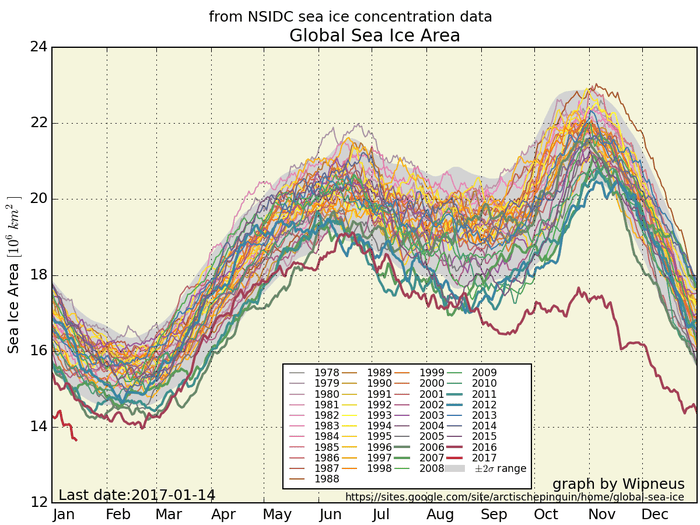
Global sea ice extent data from the National Snow and Ice Data Center. The 2016-2017 records lows are shown in red.
Climate scientists have known for about a decade that Arctic sea ice is declining faster than climate models anticipated. In 2016, Antarctic sea ice also hit an extreme record low, but until recently, had been stable and even expanding slightly. Counter-intuitively, global warming is one of the causes of that Antarctic sea ice expansion, as climate scientists Andreas Schmittner and Peter Clark explained:
When the ocean temperatures warm, it causes more direct melting of the ice sheet below the surface, and it increases the number of icebergs that calve off the ice sheet … The cold, fresh water freezes more easily, creating additional sea ice despite warmer temperatures that are down hundreds of meters below the surface.
In December, they published a study in Nature finding that not only would the collapse of the Antarctic ice sheet cause large-scale sea level rise, but that it would also increase global climate variability, which translates into greater risks.
Another study published in Science Advances in December found that Totten glacier in East Antarctica is melting from below due to warming ocean waters. During the Pliocene epoch 3 million years ago, global temperatures were about 2 to 3°C hotter than today, but sea levels were a whopping 25 meters (80 feet) higher. The melting of East Antarctic ice may help explain that tremendous sea level rise.
Meanwhile, a massive iceberg the size of Delaware is poised to break off the Larsen C ice shelf on the Antarctic Peninsula, much as the Larsen B ice shelf did starting in 2002:
Nasa: Antarctic ice shelf will fall apart | Science News
youtube.com
Collapse of the Larsen B ice shelf in Antarctica. Scientists have also concluded that the collapse of the West Antarctic ice sheet is already underway and is likely unstoppable. The loss of the entire ice sheet would eventually cause up to a 4-meter (13-foot) sea level rise over several centuries.
These are some of the consequences that led the Department of Defense – unlike Tillerson – to consider climate change an imminent threat.
Tillerson might undermine international climate negotiations
Senator Jeff Merkley’s (D-OR) questioning in the hearing revealed that Tillerson is not very concerned about climate change and doesn’t think America should be a leader on the issue. He wouldn’t pull the US out of international climate negotiations, but he might very well undermine them.
That should normally be enough to disqualify Tillerson from being Secretary of State and in charge of America’s role in those negotiations. The problem is that if the Senate rejects Tillerson, Trump might very well nominate an outright science denier to the position. However, Tillerson would likely support lifting sanctions against Russia, which would allow ExxonMobil to extract tremendous reserves of oil from the country.
In neither case would the US take the needed action to curb the climate risks that Trump and his picks deny. While Tillerson does accept the reality of climate change and that it poses some risks, he denies that those risks are serious. Functionally he might not be very different than a Secretary of State who outright denies climate change. Such are the choices we face under a President Trump.
theguardian.com |



