Trump's Immigration Ban Was Clumsy But He's Right About Radical Islam
huffingtonpost.com
13-16 minutes
Ayaan Hirsi Ali
Author, Heretic: Why Islam Needs a Reformation Now
I was a Muslim refugee once. I know what it’s like. I know what it’s like to gamble your entire future on a one-way ticket to a foreign land, what it’s like to fill in the forms, not knowing for sure what the right answers are. I know what it’s like to fear rejection, deportation and the dangers that await you back home.
Yet today I am an American citizen, one who has more reason than most to fear Islamic extremism. And that’s why I want to plead with my fellow Americans to calm down and think rationally about the dilemmas and trade-offs that we face.
When Donald Trump set out his views on Islamic extremism in a campaign speech last August, I was surprised and excited. In particular, Trump’s pledge that, if elected president, he would focus on the ideology underlying the violence — and not only on the acts of violence themselves — was a welcome departure from the approach taken by his predecessor, Barack Obama.
Liberals who have been so quick to heap opprobrium on President Trump should read that speech. In it, he rightly condemned “the hateful ideology of radical Islam” for “its oppression of women, gays, children and nonbelievers.” And he argued persuasively for a non-military response to the threat: “Just as we won the Cold War, in part, by exposing the evils of communism and the virtues of free markets, so too must we take on the ideology of Radical Islam.” Best of all, in my eyes, Trump promised that his “administration will be a friend to all moderate Muslim reformers in the Middle East, and will amplify their voices.”
Our administration will be a friend to all moderate Muslim reformers in the Middle East and will amplify their voices. Donald Trump, August 2016 Finally, I thought, we could have a commander-in-chief who understands the true nature of the challenge we face — who sees that we need more than drone strikes abroad and empty domestic programs supposed to counter “violent extremism.”
Perhaps it was my high expectations that made last Friday’s executive order on immigration so puzzling. It was, apart from anything else, clumsy. It caught border protection agents and customs officials by surprise. It sowed confusion and fear among travelers, immigrants and legal permanent residents. Its poor execution was a gift to the president’s critics.
In halting the entry of all refugees, and in appearing to be directed against Muslims — including even those who had worked for the U.S. military as interpreters — it was much too broad. In temporarily banning citizens from just seven countries, however, it was also too narrow (citizens from Pakistan, Saudi Arabia and several North African countries have also been implicated in terrorism).
True, the president had made clear back in August that this was part of what he intended to do. “We will have to temporarily suspend immigration from some of the most dangerous and volatile regions of the world that have a history of exporting terrorism,” he said. “As soon as I take office, I will ask the State Department and the Department of Homeland Security to identify a list of regions where adequate screening cannot take place. We will stop processing visas from those areas until such time as it is deemed safe to resume based on new circumstances or new procedures.”
But what got lost in the hysteria that followed last Friday’s announcement was that these are temporary measures, not the foundation for future policy. As Trump said in August, his administration “will establish a clear principle that will govern all decisions pertaining to immigration: we should admit into this country those who share our values and respect our people ... In addition to screening out all members or sympathizers of terrorist groups, we must also screen out any who have hostile attitudes towards our country or its principles — or who believe that Sharia law should supplant American law. Those who do not believe in our Constitution, or who support bigotry and hatred, will not be admitted for immigration into the country. Only those who we expect to flourish in our country — and to embrace a tolerant American society — should be issued immigrant visas.”
If that is still the Trump administration’s plan, then it has my support. Let me explain why.
We must screen out those who have hostile attitudes towards our country or its principles. Donald Trump, August 2016 As I said, I was once a Muslim refugee. En route to Canada to consummate a marriage arranged against my will by my father, I fled from Frankfurt Airport to the Netherlands and requested asylum.
It was not easy. I learned Dutch. I worked in a factory to make ends meet, and also worked as an interpreter for abused Muslim women. But I worked hard. And I studied.
I received a master’s degree in political science from the University of Leiden, where I read John Locke, Voltaire and John Stuart Mill. I eventually rejected Islam as a system that was too intolerant of free thought. I later emigrated to the United States, after I found that the Dutch were themselves not quite as committed to free thought and free speech as I had been led to believe.
My story is unusual, but it is not unique. In the course of working with Muslim communities over the past two decades, I have come to distinguish between four types of Muslim immigrants: adapters, menaces, coasters and fanatics.
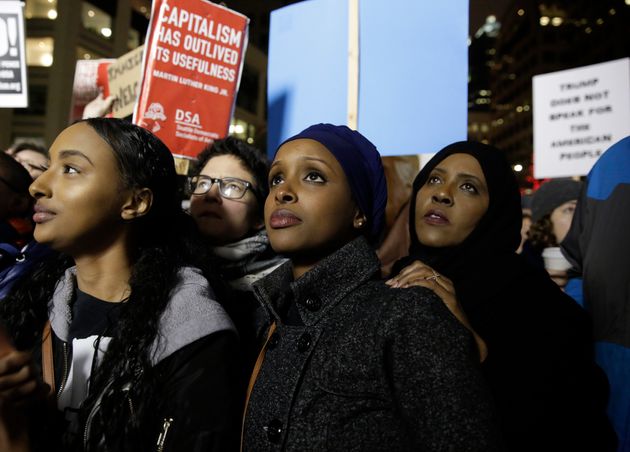 JASON REDMOND via Getty Images JASON REDMOND via Getty Images
Somali refugees at a rally for immigrants and refugees. Seattle, Jan. 29. Many Muslim immigrants have adapted over time by adopting the core values of Western democracies, using the freedoms they have found in the West to learn, educate themselves and their children, find gainful employment, start businesses, vote and take part in politics and thrive in many ways.
Then there are those individuals — mostly young men — who choose to become menaces in their homes and outside in public. Some have been subjected to domestic violence and then commit it themselves. Others drop out of school, commit crimes big and small, and spend periods of their lives in prison.
A third group of Muslim immigrants are the “coasters” — men and women with little or no formal education who thankfully accept welfare, live off it and invite their families from abroad to come and partake of it. They see no reason to work because the kind of jobs available to them are the menial, repetitive sort that are “beneath” them and pay only a bit more than the benefits they claim.
Finally, there are the fanatics — those use the freedoms of the countries that gave them sanctuary to spread an uncompromising practice of Islam.
These different categories are not rigidly separate. A coaster’s children can become adapters; some menaces clean up their acts; some fanatics get disillusioned with the pursuit of religious utopia. It also goes the other way, however. Menaces can turn into fanatics, sometimes as a result of exposure to Islamism in prison. Even the children of adapters can embrace fanaticism.
We cannot pretend that all Muslim immigrants are perfect adapters; but similarly, we cannot assume that no Muslim immigrants are fanatics. In our immigration policy, we need to make all possible effort to welcome adapters and exclude troublemakers. The question is how.
Many Muslim immigrants have adapted over time by adopting the core values of Western democracies. As an immigrant of Somali origin, I have no objection to other people coming to America to seek a better life for themselves and their families. My concern is with the attitudes many of these new Muslim Americans will bring with them — and with our limited capacity for changing those attitudes.
According to projections in a 2011 Pew report, more than a third of Muslim immigrants to the U.S. between 2010 and 2030 will be from just three countries: Pakistan, Bangladesh and Iraq. Only Iraq was targeted by President Trump’s executive order. Another Pew study of opinion in the Muslim world shows just how many people in these countries hold views that most Americans would regard as extreme. (Data on opinion are unavailable for the other two big “sender” countries, Somalia and Iran, both of which were targeted by the executive order.)
In a survey of Muslims who believe Sharia law should be official national law in their country, three-quarters of Pakistanis and almost half of Bangladeshis and Iraqis think that those, like me, who leave Islam should suffer the death penalty. More than 80 percent of Muslims in Pakistan and around two-thirds of Muslims in Bangladesh and Iraq regard Sharia law as the revealed word of God. Only tiny fractions would be comfortable if their daughters married Christians. Only a minority regards honor killings of women as “never justified.” More than a quarter of Bangladeshi Muslims, 13 percent of Pakistani Muslims and 7 percent of Iraqi Muslims think suicide bombings in defense of Islam are often or sometimes justified.
 NurPhoto via Getty Images NurPhoto via Getty Images
Members of the Bangladesh Caliphate Movement at a rally to protest the country’s secular education syllabus. Dhaka, May 6, 2016. People with views such as these pose a threat to us all, not because those who hold them will all turn to terrorism. Most will not. But such attitudes imply a readiness to turn a blind eye to the use of violence and intimidation tactics against, say, apostates and dissidents — and a clear aversion to the hard-won achievements of Western feminists and campaigners for minority rights. Admitting individuals with such views is not in the American national interest.
Contrary to some of the president’s more strident critics, restrictions on foreign immigration are not immoral per se. Canada, for example, accepts only whole families, single women or children from Syria, but excludes single men as a possible security threat. Most countries have such rules. Recent terrorist cases suggest that the U.S. could do with tightening its rules, or applying them more rigorously.
The Tsarnaev family came to the U.S. on tourist visas and over time gained asylum. Dzhokhar Tsarnaev, the younger of the two brothers responsible for the Boston marathon bombings, received his green card in 2007 and became a U.S. citizen in 2012 on the anniversary of the 9/11 attacks.
The culprit behind the pressure cooker bombings in New York was Ahmad Khan Rahami. He was born in Afghanistan and came to the United States when his father requested asylum. He was a naturalized U.S. citizen at the time of the attacks.
The Chattanooga shooting of July 2015, in which four Marines and a Navy sailor were killed, was carried out by Muhammad Abdulazeez. Born in Kuwait, he was a naturalized U.S. citizen.
Tashfeen Malik, one of the killers in the San Bernardino massacre in December 2015, entered the United States on a K-1 fiancee visa with a Pakistani passport.
Contrary to some of the president’s more strident critics, restrictions on foreign immigration are not immoral per se. In retrospect, all these cases were not vetted closely enough. Yet two further points immediately follow from this. First, the different statuses of these perpetrators — children of asylum seekers, recipients of tourist visas, fiancée visas, permanent residents, naturalized citizens — show that it is not enough to focus on refugees alone. Indeed, no refugee has yet committed a terrorist act.
Second, and more importantly, the problem of Islamist terrorism will not be solved by immigration controls and extreme vetting alone. That’s because the problem is already inside our borders.
Several perpetrators of recent attacks were U.S. citizens who were born and raised in the United States: Maj. Nidal Hasan, who killed 13 and wounded more than 30 at Fort Hood in 2009, was born in Virginia in 1970 to Palestinian parents who had immigrated to the U.S. And the other culprit in San Bernardino was Syed Rizwan Farook, a U.S. citizen born in Chicago in 1987 to parents who had immigrated from Pakistan. The Orlando night club shooter who killed 49 and injured 53 was Omar Seddique Mateen, a U.S. citizen born in New York in 1986 to Afghan parents.
The Obama administration had a flawed solution to this problem, which it called countering violent extremism. The Trump administration needs a completely new approach that targets not just violence, but the proponents of subversive Islamist views — the phenomenon of dawa or proselytizing. This ideological indoctrination is the essential prelude to acts of jihad, yet for too long it has been going on with impunity.
Muslims march in a pride parade in London. June 25, 2016. Addressing the problem of Islamist terrorism will require much more than better immigration controls, though we certainly need those. It will necessitate the systematic dismantling of the ideological infrastructure of dawa, which is already well established right here in the United States.
President Trump was right back in August. The threat posed by “the hateful ideology of radical Islam” needs to be countered. American citizens — including immigrants — must be protected from that ideology and the violence that it promotes. But the threat is too multifaceted to be dealt with by executive orders. That is why Trump was right to argue in August for a commission of some kind — I would favor congressional hearings — to establish the full magnitude and nature of the threat.
Until we recognize that this ideology is already in our midst, we shall expend all our energies in feverish debates about executive orders, when what is needed is cool, comprehensive legislation. |



