SI
SI
discoversearch

We've detected that you're using an ad content blocking browser plug-in or feature. Ads provide a critical source of revenue to the continued operation of Silicon Investor.  We ask that you disable ad blocking while on Silicon Investor in the best interests of our community.  If you are not using an ad blocker but are still receiving this message, make sure your browser's tracking protection is set to the 'standard' level.
Politics : Politics of Energy -- Ignore unavailable to you. Want to Upgrade?


To: Brumar89 who wrote (74688)2/6/2017 11:13:08 AM
From: Brumar89  Respond to of 86356
 
Climate “Science” on Trial; The Smoking Gun Files


The Evidence: Smoking Gun #1: Al Gore’s Ice Core CO2 Temperature Chart
Smoking Gun #2: 600 Million Year Geologic Record
Smoking Gun #3: The IPCC Climate Models Fail…Miserably
Smoking Gun #4: There simply isn’t enough Anthropocentric CO2 to make a difference
Smoking Gun #5: Water Vapor is by far the most significant Green House Gas (GHG)
Smoking Gun #6: Antarctica isn’t warming
Smoking Gun #7: Antarctica isn’t warming, but the Oceans are
Smoking Gun #8: Atmospheric Temperatures follow ocean temperatures, not atmospheric CO2.
Smoking Gun #9: Atmospheric CO2 follows ocean temperatures, not man’s combustion.
Smoking Gun #10: Record High Day Time Temperatures is NOT evidence of AGW
Smoking Gun #11: The Scientific Method is Ignored, The Null is not Rejected
Smoking Gun #12: Doubling CO2 has NO MEASURABLE IMPACT on the lower atmosphere temperature, none
Smoking Gun #13: The ground measurement data supporting the AGW Theory is very suspect
Smoking Gun #14: The relationship between CO2 and Temperature simply isn’t linear
Smoking Gun #15: Climate “Science” Temperature Reconstructions are not reproducible outside the “Peer Review” community
Smoking Gun #16: The rate of change in the Sea level is not increasing (2nd derivative)
Smoking Gun #17: The rate of change in Temperature is unaffected by Anthropogenic CO2.
Smoking Gun #18: The rate of change in atmospheric CO2 isn’t related to Anthropogenic CO2 production.
Smoking Gun #19: The Equatorial Upper Tropospheric “Hot Spot” simply doesn’t exist.
Smoking Gun #20: 35 Years Ago We Had A Coming Ice Age and a 10 Year Supply of Oil
Smoking Gun #21: The Climategate Emails expose scientific collusion, malpractice and highly unethical, deceitful, deceptive and unscientific practices.
Smoking Gun #22: Climate “Science” isn’t science at all. Some described it as “Politicized” science, but in reality, it is just cleverly disguised politics.
Smoking Gun #23: The costs of fighting climate change are astronomical, and the benefits are basically immeasurable.
Smoking Gun #24: What Einstein concluded Global Warming and more CO2 are bad anyway?
Smoking Gun #25: Atmospheric temperature follows atmospheric H2O, not CO2?
Smoking Gun #26: PDO/ADO and other Natural Cycles You’ve Never Heard of…and for good reason.
Smoking Gun #27: The Climate Slush Fund; wasting other people’s money, tracking where it goes, and finding better uses for it
Smoking Gun #28: The Global Warming Inquisition; documenting the Climate Bullies and their unhindered workplace harassment
Smoking Gun #29: Global Sea Ice Sophistry
Smoking Gun #30: The Consensus is more Con and NonSense than Science
Smoking Gun #31: CO2 Cools the Atmosphere
Smoking Gun #32: Data Chiropractors “Adjust” Data
Smoking Gun #33: CO2 is a weak GHG, it has no Dipole
Smoking Gun #34: Confirmed Mythbusters Busted Practicing Science Sophistry

The bottom line is this “science” would “ not stand up in court.” The global warming movement isn’t about science, it is about persuading public opinion. Once this “science” does get dragged into court, the Climate Alarmists get convicted for sophistry. Focus on the real science, and the Climate Alarmists will lose every argument. If the Climate Alarmists do win, it will cost society an absolute fortune, and the benefits will be immeasurably minuscule.

https://co2islife.wordpress.com/2017/01/17/climate-science-on-trial-the-smoking-gun-files/


Climate “Science” on Trial; Data Chiropractioners “Adjust” Data


Post publishing this article, this new information was released: Exposed: How world leaders were duped into investing billions over manipulated global warming data

I was going to write an article on the lack of integrity of the climate data, but Anthony Watts does a far better job that I could ever hope to do. Here is a video of him explaining the issues.

Stephen Goddard has a wonderful blog tracking all the data Shenanigans:

Alterations To Climate Data CRU Temperature Fraud Data Tampering At USHCN/GISS Hansen – The Climate Chiropractor Hide The Decline NASA Sea Level Fraud The Definitive Data On The Global Warming/Climate Change Scam Spectacularly Poor Climate Science At NASA 1970s Global Cooling Scare Weather Stations are inconsistent everchanging samples

The Hockeystick was a data construction joke

Hide the Decline” exposes unethical and dishonest behavior at best

A half truth is often twice the lie, hiding the truth from the public

BOMBSHELL – NOAA whistleblower says Karl et al. “pausebuster” paper was hyped, broke procedures.

This one is just too funny not to highlight.

The solution to this problem is to have “Open Source” data sets, where any “adjustments” are transparent, documented, publicized and critiqued. Additionally, the raw data is never altered. The same approach should be used for the opaque, sequestered, and unchallenged climate models used to support public policies.


https://co2islife.wordpress.com/2017/01/29/climate-science-on-trial-data-chiropractioners-manipulate-data/


To: Brumar89 who wrote (74688)2/7/2017 8:24:42 AM
From: Eric  Read Replies (1) | Respond to of 86356
 
Debunking Daily Mail’s ‘astonishing evidence’ about global temperature rise

By Zeke Hausfather on 7 February 2017


Carbon Brief

This is a guest post by Zeke Hausfather, a climate scientist and energy systems analyst at Berkeley Earth, an independent temperature analysis project.


In an article in today’s Mail on Sunday, David Rose makes the extraordinary claim that “world leaders were duped into investing billions over manipulated global warming data”, accusing the US National Oceanic and Atmospheric Administration (NOAA) of manipulating the data to show more warming in a 2015 study by Tom Karl and coauthors.

What he fails to mention is that the new NOAA results have been validated by independent data from satellites, buoys and Argo floats and that many other independent groups, including Berkeley Earth and the UK’s Met Office Hadley Centre, get effectively the same results.

NOAA’s results are independently verified

The new NOAA record published in Karl et al primarily updated their ocean temperature record. While they also released a revised land record based on data from the International Surface Temperature Initiative (and the related Global Historical Climatology Network version 4 beta product – GHCNv4), the land record was largely similar to their prior record and was responsible for relatively little of the increase in warming they showed.


Figure 1 from Karl et al 2015. Almost all of the difference between the trends in the new and old temperature records were due to updates to ocean temperatures.

I recently led a team of researchers that evaluated NOAA’s updates to their ocean temperature record. In a paper published last month in the journal Science Advances, we compared the old NOAA record and the new NOAA record to independent instrumentally homogenous records created from buoys, satellite radiometers, and Argo floats. Our results, as you can see in the chart below, show that the new NOAA record agrees quite well with all of these, while the old NOAA record shows much less warming.

This was due to two factors: the old NOAA record spliced together warmer ship data with colder buoy data without accounting for the offset between the two; and the new NOAA record puts more weight on higher-quality buoy records and less weight on ship records (versus the old NOAA record which treated ships and buoys equally). You can read more about the study in Carbon Brief’s article.
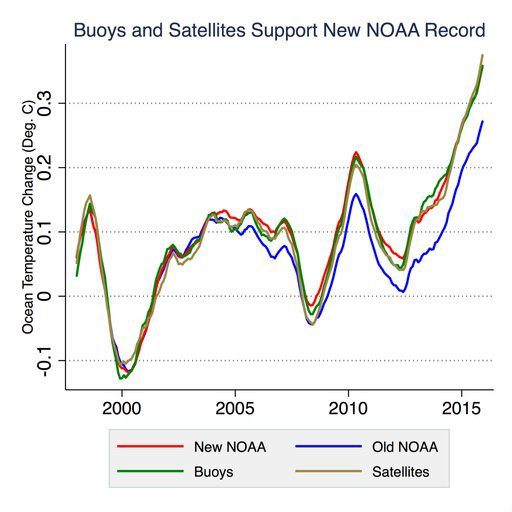

Global sea surface temperatures from the old NOAA record (ERSSTv3b), the new NOAA record (ERSSTv4), and instrumentally homogenous records from buoys and satellites. See Hausfather et al 2017 for details, as well as comparisons with shorter Argo-based records.

The fact that the new NOAA record is effectively identical with records constructed only from higher quality instruments (buoys, satellite radiometers, and Argo floats) strongly suggests that NOAA got it right and that we have been underestimating ocean warming in recent years.

John Kennedy, a researcher at the UK’s Met Office in charge of their ocean temperature product, agrees that NOAA’s new record is probably the most accurate in the last two decades, remarking: “At a global scale, those adjustments really do seem to work and the ERSSTv4 adjustments [NOAA’s new record] work best of all.”

Rose’s claim that NOAA’s results “can never be verified” is patently incorrect, as we just published a paper independently verifying the most important part of NOAA’s results.

NOAA’s land data similar to other records

The land record that NOAA used in the Karl et al paper was a sneak peak at their new GHCNv4, which increases the number of global land stations from the 4,400 currently used to around 25,000.

This is quite similar to the Berkeley Earth land temperature record, which uses a similar number of stations. There is little reason to think that the inclusion of more station data will give us less accurate results.

The Karl et al land record ends up quite similar to the old one, though it shows about 5% more warming since 1970, mostly attributable to the inclusion of additional stations in the Arctic. As the chart below demonstrates, their results are quite similar to those of Berkeley Earth as well as the current operational NOAA land record (based on GHCN version 3), and also agree quite well with the latest version of GHCNv4.
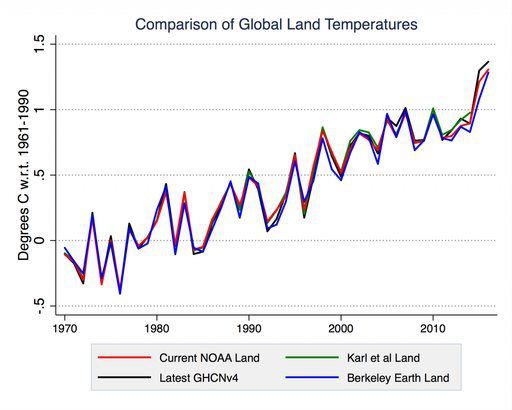

Global land temperature records including the current official NOAA land temperature record (based on GHCNv3), the Karl et al land record, a land record based on the latest GHCNv4 data, and the Berkeley Earth land record.

The new NOAA temperature record is also by no means an outlier when compared to other groups producing global (land and ocean) surface temperature records. It shows less warming in recent years than records from Berkeley Earth, NASA, and Cowtan and Way, and a bit more warming than found in the Hadley Centre/CRU record. The old NOAA record, on the other hand, was on the bottom of the pack, with less warming than found by the other groups.

If folks don’t like the NOAA data, they will get the exact same story using surface temperature data from any other group, with no detectable sign of a “hiatus” or “pause” through to the present.


Global land/ocean temperature records from NOAA, NASA, Berkeley Earth, Hadley/UAE, and Cowtan and Way. Note that the old (pre-Karl et al) NOAA temperature record is only available through the end of 2014.

NOAA did make their data available In his article, David Rose relies on reports from a researcher at NOAA who was unhappy about the data archiving associated with the Karl et al paper. While I cannot speak to how well the authors followed internal protocols, they did release their temperature anomalies, spatially gridded data land and ocean data, and the land station data associated with their analysis. They put all of this up on NOAA’s FTP site in early June 2015, at the time that the Karl et al paper was published.

As someone who works on and develops surface temperature records, the data they provided would be sufficient for me to examine their analysis in detail and see how it compared to other groups. In fact, I used the data they provided shortly after the paper was published to do just that. While it would have been nice for them to publish their full analysis code online as well as the data, I’m sure they would have provided it to any researchers who asked.

Rose also makes a big deal about the fact that NOAA’s new ocean temperature product adjusts buoys up to match ship data versus adjusting ship data down to match buoys. This turns out to be a bit of a red herring; since scientists are interested in the change in temperatures over time, you end up with the same increase in temperatures (e.g, the temperature trend) if you apply the offset to one or the other.

Because climate scientists work with temperature anomalies (rather than absolutes), the direction of the offset doesn’t have any effect on the resulting temperature series. On the other hand, not correcting for the offset between ships and buoys results in a spurious cooling bias, and a record that differs a lot from the buoys themselves as we found in our paper.

Rose’s article presents a deeply misleading graph where he shows an arbitrary offset between NOAA’s data and the Hadley land/ocean dataset. This is an artefact of the use of different baselines; Hadley’s “0C” value is relative to the average temperature from 1961-1990, while NOAA’s is relative to the average temperature from 1901-2000 (a period which includes the colder early 20th century).


Comparison of published HadCRUT4 and NOAA global land/ocean monthly temperature anomalies.

This comparison ends up being spurious, because each record uses a different baseline period to define their temperature anomaly. As the chart below shows, when you correctly put the two datasets on the same baseline (eg, with respect to the 1961-1990 period), you find no offset in recent years between the two, though there is slightly more warming in the NOAA dataset due to the higher weight they give more reliable buoy data in their analysis.


Comparison of HadCRUT4 and NOAA global land/ocean monthly temperature anomalies put on a common 1961-1990 baseline.

Similarly, if you simply download the NOAA and Hadley ocean temperature datasets you would find that the published Hadley values are actually higher than the published NOAA ocean values in recent years. This is because Hadley uses a 1961-1990 baseline for their ocean temperature product while NOAA uses a 1971-2000 baseline. Putting both datasets on a common baseline is essential to performing accurate comparisons.

Further updates to come from NOAA NOAA is planning on further updates to their sea surface temperature record this year to incorporate Argo data and to make some adjustments to their spatial interpolation technique. Based on the preliminary results that their team presented at the American Geophysical Union meeting late last year, their new record (ERSSTv5) will have about 10% less warming than their current record (ERSSTv4) over the 2000-2015 period, largely due to changes in the way that they account for areas with limited data. Their upcoming record will still show 50% more warming than the old NOAA record (ERSSTv3b).

While NOAA’s data management procedures may well need improvement, their results have been independently validated and agree with separate global temperature records created by other groups.

The “astonishing evidence” that David Rose purports to reveal in no way changes our understanding of modern warming or our best estimates of recent rates of warming. It does not in any way change the evidence that policymakers have at their disposal when deciding how to address the threats posed by climate change.

If anything, there is strong independent evidence that NOAA’s new record may be the most accurate one over the last two decades, at least for the two-thirds of the world covered in ocean.

reneweconomy.com.au

Source: Climate Central. Reproduced with permission.


To: Brumar89 who wrote (74688)2/7/2017 9:20:20 PM
From: Alastair McIntosh1 Recommendation

Recommended By
Eric

  Read Replies (2) | Respond to of 86356
 
What your "high level whistle blower" has to say about data tampering. (There wasn't any. "But rather really of timing of a release of a paper that had not properly disclosed everything it was.")

'Whistleblower' says protocol was breached but no data fraud

The federal climate scientist hailed by conservatives as a whistleblower for allegedly revealing manipulated global warming data said yesterday he was actually calling out a former colleague for not properly following agency standards for research.

In an interview with E&E News yesterday, former National Oceanic and Atmospheric Administration principal scientist John Bates had a significantly more nuanced take on the controversy that has swirled since a top House Republican hailed his blog post as proof that the agency "played fast and loose" with temperature data to disprove the theory of a global warming "pause."

Bates accused former colleagues of rushing their research to publication, in defiance of agency protocol. He specified that he did not believe that they manipulated the data upon which the research relied in any way.

"The issue here is not an issue of tampering with data, but rather really of timing of a release of a paper that had not properly disclosed everything it was," he said.

Bates, who recently retired from NOAA's National Climatic Data Center, claimed in his post that the agency rushed research disproving the global warming pause to publish in Science magazine before the December 2015 Paris climate talks. Climate skeptics have called that proof of massive fraud among federal climate researchers and said it allowed world leaders to be "duped" into signing the Paris climate agreement to reduce carbon emissions from fossil fuel use.

Bates said the NOAA study relied on land data that were "experimental." Typically, NOAA officials can publish research that relies partially on experimental data, as long as the data are properly identified, especially if there is an urgent situation that requires something to go out quickly because it is related to human health, safety and the environment.

The publishing safeguards are important, he said, because they help protect federal research against lawsuits. Bates added that science suffers if its results cannot be reproduced.

Yesterday, the House Science, Space and Technology Committee portrayed Bates' allegations as a bombshell that required immediate investigation.

Committee Chairman Lamar Smith (R-Texas) has issued subpoenas and has for nearly two years attempted to obtain scientists' emails involved in the global warming pause research. A Science Committee aide yesterday said Bates' revelation was evidence that NOAA needed further investigation because its own employees were identifying significant policy breaches.

The aide said the committee would again seek the emails of federal researchers, and if a formal request were ignored, another round of subpoenas could be issued or scientists might be forced to testify in front of the committee.

"I think the brushback that the committee received, and the chairman received consistently, about how science is capable of policing itself and doesn't need anyone outside asking questions, even when the science being discussed is paid for and performed by scientists paid for with the taxpayer's money and used to implement far-reaching federal policies or justify implementation of far-reaching federal policies, doesn't really work," the aide said.

'An incredibly bizarre claim'Bates laid out his claims, which are largely technical and related to the sharing of data, on the blog run by Judith Curry, a climate scientist who has broken with many colleagues and called into question the actual extent of humanity's influence on the planet.

The report's authors, Bates wrote, put a "thumb on the scale — in the documentation, scientific choices, and release of datasets — in an effort to discredit the notion of a global warming hiatus and rush to time the publication of the paper to influence national and international deliberations on climate policy."

The NOAA administrator under former President Obama, Kathryn Sullivan, refused to turn over the emails because she said doing so could chill the scientific process by making it harder for researchers to communicate openly while they were actively engaged in research. Smith's committee threatened her with criminal charges. The issue is expected to become part of the committee's hearing today into the use of scientific research in crafting federal regulations.

Yesterday, a NOAA spokesman did not directly address the specific allegations, other than to say that they are currently under review.

"NOAA is charged with providing peer-reviewed data to the American public and stands behind its world-class scientists," said the spokesman, who declined to be named. "NOAA takes seriously any allegation that its internal processes have not been followed and will review the matter appropriately."

Whether the research was published to influence the Paris climate talks is a moot point, said Andrew Light, a senior member of the State Department's climate talks negotiating team in 2015. He said the talks had already been underway for about four years when the paper was published and that 188 nations were relying on a tremendous amount of research to support their goal of reducing humans' carbon emissions to slow the warming of the planet. They had also already crafted proposed reductions by the time the research was published, he said.

"I never heard it discussed once, let alone this one NOAA report, discussed in Paris, the run-up to Paris or anything after Paris, so this is really just an incredibly bizarre claim," Light said.

Bates: Be careful of biasFor many years, climate scientists were puzzled by an apparent plateau in global temperature rise from 1998 to 2012 as ocean temperatures stayed consistent. The 2015 research paper addressed the issue when it found there was no pause because the method to collect ocean temperatures was flawed.

Since then, multiple independent studies have confirmed NOAA's findings, including one published last month in Science Advances.

Buoys and satellites support NOAA record

[+]

A study earlier this year using data from buoys, satellites and Argo floats backs up a challenge of the so-called global warming pause by NOAA. Graph courtesy of the University of York Department of Chemistry.

That study replicated NOAA's findings by accounting for different methods of temperature collection over time. For instance, data collected in the engine rooms of ships show slightly elevated levels of warming compared with those collected by buoys. When researchers accounted for that discrepancy, the so-called global warming pause disappears, researchers found.

The American Geophysical Union, which represents thousands of scientists who study climate, pointed out that the results of the 2015 study had been discussed in peer-reviewed journals and that multiple studies had independently backed up the findings.

The reports do not change the fundamental understanding of climate change science, AGU President Eric Davidson wrote in his blog yesterday.

"These types of statements by policymakers that attempt to take one study/dispute and blow it out of proportion are both unhelpful and misleading," he wrote. "We will be working with the science committee to demonstrate the scientific consensus on climate change and to encourage them not to interfere with the scientific process."

Yesterday, Bates said he was contacted by the Science Committee for the first time only after the story broke. He said he has not communicated with anyone there before and was not a whistleblower for the committee previously but that he expected to be invited to Washington to testify at a future hearing.

He said he would accept such an invitation, but cautioned scientists against advocating policy.

"You really have to provide the most objective view and let the policymakers decide from their role," Bates said. "I'm getting much more wary of scientists growing into too much advocacy. I think there is certainly a role there, and yet people have to really examine themselves for their own bias and be careful about that."

eenews.net

