Friends of yours?
22 refugees entered Manitoba near Emerson border over the weekend
Number of asylum seekers walking from U.S. to the province continues to grow
CBC News
16 Minutes Ago

Farham Ahmed and 18 other refugees walked across the border into Manitoba on Saturday night. (Tyson Koschik/CBC)
The temperature dipped below –20 C as a large group of refugees trudged through snowy Manitoba fields near the U.S. border Saturday.
Farhan Ahmed says he couldn't feel his fingers or his toes as he walked about 12 kilometres along a road.
"It was very, very cold and it was icy that night," Ahmed said.
Over the weekend, RCMP said, 22 people crossed the border near Emerson, located about 100 kilometres south of Winnipeg — 19 on Saturday and three on Sunday.
Hundreds of asylum seekers entering Manitoba near Emerson border 'They almost froze to death': Refugees frostbitten after walking to Manitoba borderAhmed and his group, including a family with children, finally called 911 for help. RCMP brought the refugees to a Canada Border Services Agency location where they could make their refugee claims.
"They gave us heat. If we didn't get that, I couldn't feel my hands. I couldn't feel my hands, it was hard," Ahmed said.
The number of asylum seekers crossing the Canada-U.S. border into Manitoba on foot instead of through official crossings has drastically increased in the last few months, said Rita Chahal, the executive director of Manitoba Interfaith Immigration Council.
"In January alone there were about 39, 40 files opened," she said.
Record number of refugees checking in at Welcome PlaceTen files were opened last week and, with the recent group over the weekend, Chahal said there will be at least 20 more this week.
Since April 2016, the council has opened 270 files, with a large increase in the fall.
Fleeing from violence
Ahmed grew up in a small town in Somalia where his father was a local chief. In June 2014, Ahmed said, his father was murdered, and since he was the oldest son, his life was also threatened.
"I … received calls that I would be next and I would be killed," he said.
As a father of three and the breadwinner for his family, Ahmed had a tough choice. But in the end he decided to flee in order to find safety and freedom for his family elsewhere.
The last time he saw his wife was on June 23, 2014, three days after his father's death. His journey then led him to Brazil, Venezuela, Colombia, Panama, Costa Rica, Nicaragua, Honduras, Guatemala and Mexico before he finally landed in the United States in October 2014.

(Left) Farhan Ahmed and another refugee say they couldn't feel their fingers or their toes during their journey across the border on Saturday. (Tyson Koschik/CBC)
Ahmed said he was initially detained in Texas before being transferred to the Buffalo Federal Detention Facility.
He was kept in the facility, trying to make an asylum claim, until February 2015, when his application was denied and he was told he would be deported.
However, Ahmed said there was a mix-up in paperwork, and he was released under supervision and moved in with family in Ohio.
"They gave me work authorization and then I became a truck driver. I used to drive. I became a taxpayer," he said.
"I was supporting my family in Somalia, my wife and my kids."
Helping freezing refugees 'not at all uncommon' in Manitoba border town Frostbitten refugee will lose fingers, toe after 7-hour trek to cross U.S.-Canada borderFinally, life seemed to be going Ahmed's way — but it wouldn't last. Immigration officers showed up looking for Ahmed in Ohio last year while he was out driving.
Ahmed thought about trying his luck again with an asylum claim, but when Donald Trump signed the executive order barring citizens from seven Muslim-majority countries, including Somalia, from entering the U.S. he figured there was no hope.
"That's not human rights. That was not what I was wishing when I was in Somalia, when I was coming," he said.

Hundreds of refugees have been crossing near this border in Emerson, Man. (Ron Boileau/CBC)
'Canada is a good country'
On Saturday, Ahmed decided to take the risk of wintry roads and uncertain fields to find refuge in Canada.
He said his group was driven about five kilometres from the Canadian border. Their driver told them if they went to the border crossing they would be deported, Ahmed said, so they would have to walk through the fields.
The group walked for about four hours, Ahmed said, before they called 911 and were picked up by police and brought to a CBSA centre.
Already, Ahmed said, he is feeling welcomed.
"Canada is a good country. It is a friendly country," he said.
"I wish we [can get] protection because I cannot go back to Somalia and I have a wife and kids that I haven't seen in like two, three years. I wish Canada that they give me a new life. That I can [bring] my wife and kids."
'We saw what happened in the airports': Asylum seekers from U.S. surge into Manitoba Support and solidarity: How Manitobans can help Muslim refugees
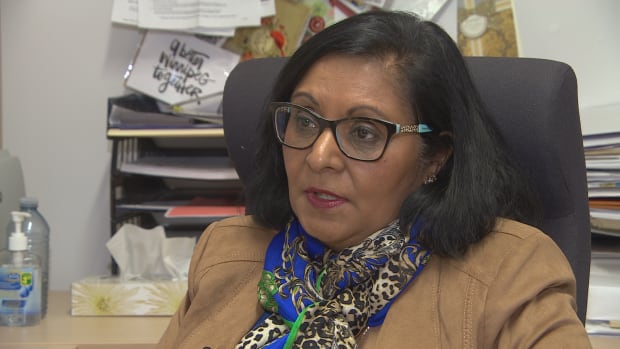
Rita Chahal, the executive director of Manitoba Interfaith Immigration Council, says they have had to deal with a large growth in refugee files. (Tyson Koschik/CBC)
All of the recent refugees have expressed deep gratitude, Chahal said.
While the workload is overwhelming for the small staff at the Manitoba Interfaith Immigration Council, she said it's important that all of the refugees are given the chance for a fair hearing.
"At the end of the day our focus is on the human aspect, the human face, and it's people's lives," she said.
"They have taken risks to get to freedom and what we want to do is help them get their bearings first of all, and help navigate them through the social and the legal system that they are entitled to."
However, with Manitoba's mild winter switching to colder temperatures, Chahal said she's worried about safety. Referring to the Ghanaian refugees who lost their fingers after crossing on Christmas Eve and the image of Alan Kurdi, a three-year-old Syrian boy who drowned in the Mediterranean Sea, Chahal said they "want to be sure that we aren't going to see that image on a Prairie field."
"People are taking huge risks. We know that they are not thrill seekers; they are simply running for their lives."

cbc.ca |



