SI
SI
discoversearch

We've detected that you're using an ad content blocking browser plug-in or feature. Ads provide a critical source of revenue to the continued operation of Silicon Investor.  We ask that you disable ad blocking while on Silicon Investor in the best interests of our community.  If you are not using an ad blocker but are still receiving this message, make sure your browser's tracking protection is set to the 'standard' level.
Politics : Politics of Energy -- Ignore unavailable to you. Want to Upgrade?


To: Brumar89 who wrote (75402)3/15/2017 11:00:57 AM
From: Eric  Read Replies (1) | Respond to of 86355
 
But the real reality is they are net net still taking more and more CO2 up.

Prove it otherwise.

Where is your "peer reviewed" paper to prove it otherwise?


To: Brumar89 who wrote (75402)3/16/2017 9:22:17 AM
From: Eric  Respond to of 86355
 
Great Barrier Reef

Stopping global warming is only way to save Great Barrier Reef, scientists warn

Improvements to water quality or fishing controls don’t prevent underwater heatwaves damaging coral, studies of mass bleaching events reveal
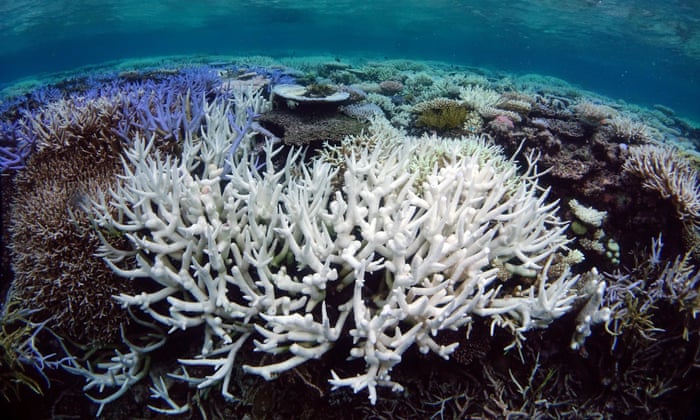

The Great Barrier Reef has been hit by mass bleaching for an unprecedented second year running. Photograph: Chris Jones/Great Barrier Reef Marine Park Authority

Joshua Robertson

@jrojourno

Wednesday 15 March 2017 18.29 GMT Last modified on Wednesday 15 March 2017 20.31 GMT

The survival of the Great Barrier Reef hinges on urgent moves to cut global warming because nothing else will protect coral from the coming cycle of mass bleaching events, new research has found.

The study of three mass bleaching events on Australian reefs in 1998, 2002 and 2016 found coral was damaged by underwater heatwaves regardless of any local improvements to water quality or fishing controls.

The research, authored by 46 scientists and published in Nature, raises serious questions about Australia’s long-term conservation plan for its famous reef, which invests heavily in lifting water quality but is silent on climate-change action.

The researchers said the findings of their paper, Global Warming and Recurrent Mass Bleaching of Corals, applied to coral reefs worldwide.
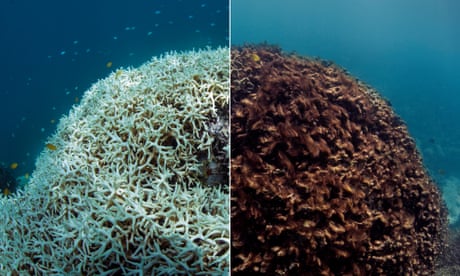


The Great Barrier Reef: a catastrophe laid bare

Read more theguardian.com

Its publication comes the same day its lead author, Terry Hughes, is due to embark on an aerial survey to confirm the extent of another mass bleaching event on the Great Barrier Reef.

It is the first mass bleaching to occur for a second consecutive year on the reef, which suffered its worst ever damage in 2016 when 22% of coral was killed off in a single hit.

The study, which was unable to take in the effects of the latest event, warned a fourth mass bleaching event “within the next decade or two” gave the badly damaged northern section of the reef a “slim” chance of ever recovering to its former state.

Hughes said the latest event, which was notable for having nothing to do with the warming effect of El Niño weather patterns, highlighted how research on mass bleaching, even when fast-tracked, was unable to keep pace with the reef’s current state.

“It broke my heart to see so many corals dying on northern reefs on the Great Barrier Reef in 2016,” Hughes said.

“With rising temperatures due to global warming, it’s only a matter of time before we see more of these events. A fourth event after only one year would be a major blow to the reef.”

Hughes said he hoped coming weeks would “cool off quickly and this year’s bleaching won’t be anything like last year”.

“The severity of the 2016 bleaching was off the chart.”

Hughes, the convener of the National Coral Bleaching Taskforce, said the study clearly showed the need for climate change action in Australia’s reef conservation plan.

He said it also showed the folly of Australian and Queensland government support for one of the world’s largest coalmines, Adani’s proposed Carmichael mine, which will export coal in ships through reef waters.

This was not only because of the carbon emissions from the coal, but also from dredging and marine traffic through the reef.

Australia must choose between coal and coral – the Great Barrier Reef depends on it
Jon C Day, Alana Grech and Jon Brodie for the Conversation


Read more theguardian.com

“In its weakened state, the reef cannot afford the Adani mine,” he said.

The publication of the research comes the same week as Queensland government officials meet with Unesco officials in Paris to appeal for more time to make good on conservation efforts to ward off an “in-danger” listing for the reef. It also coincides with a visit by the Queensland premier, Annastacia Palaszczuk, to India to lobby Adani to proceed with its mine plan.

The study found that 91% of coral on the reef had suffered from bleaching over the past two decades.

The researchers concluded that “local management of coral reef fisheries and water quality affords little, if any, resistance to recurrent severe bleaching events: even the most highly protected reefs and near-pristine areas are highly susceptible to severe heat stress.”

“On the remote northern Great Barrier Reef, hundreds of individual reefs were severely bleached in 2016 regardless of whether they were zoned as no-entry, no-fishing, or open to fishing, and irrespective of inshore–offshore differences in water quality.”

Likewise, past exposure to bleaching, or relative resistance among certain corals to minor bleaching, gave no protection in the face of severe heat stress, the study found.

Local protection of fish stocks and improved water quality “may, given enough time, improve the prospects for recovery”.

“However, bolstering resilience will become more challenging and less effective in coming decades because local interventions have had no discernible effect on resistance of corals to extreme heat stress, and, with the increasing frequency of severe bleaching events, the time for recovery is diminishing.
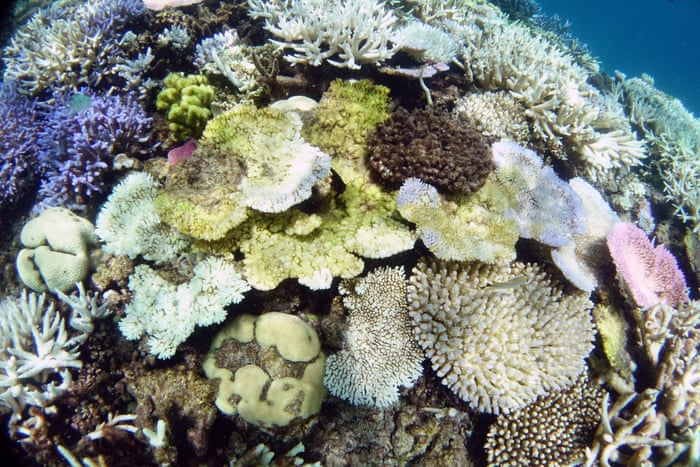

Fully bleached and fluorescent bleached branching corals on the Great Barrier Reef, March 2016. Photograph: Chris Jones/Great Barrier Reef Marine Park Authority

“Securing a future for coral reefs, including intensively managed ones such as the Great Barrier Reef, ultimately requires urgent and rapid action to reduce global warming.”

Bleaching comes when heat stress forces corals to expel tiny photosynthetic algae, which leaves them stark white.

Prolonged heat stress will kill the corals, but death rates take at least six months to confirm.

The researchers said fast-growing coral took 10-15 years to fully recover while longer-lived corals “necessarily take many decades”.

This kind of “sustained absence of another severe bleaching event (or other significant disturbance) … is no longer realistic while global temperatures continue to rise”, they said.

theguardian.com


To: Brumar89 who wrote (75402)3/16/2017 9:23:06 AM
From: Eric  Read Replies (2) | Respond to of 86355
 
Pollution

‘Airpocalypse’ smog events in China linked to melting ice cap, research reveals

Stagnant weather caused by fast-melting Arctic ice helped create conditions for China’s recent extreme air pollution events, scientists say


Very rapid change in polar warming is having a large impact on China’s air pollution, say researchers. Photograph: AP

Damian Carrington

@dpcarrington

Wednesday 15 March 2017 18.00 GMT Last modified on Wednesday 15 March 2017 18.06 GMT

Climate change played a major role in the extreme air pollution events suffered recently by China and is likely to make such “airpocalypses” more common, new research has revealed.

The fast-melting ice in the Arctic and an increase in snowfalls in Siberia, both the result of global warming, are changing winter weather patterns over east China, scientists found. Periods of stagnant air are becoming more common, trapping pollution and leading to the build up of extreme levels of toxic air.

The work is the latest to show that changes in the rapidly warming Arctic are already leading to severe impacts for hundreds of millions of people across North America, Europe and Asia. The US has also seen a rise in episodes of stagnant air, which may be leading to higher air pollution there.


Arctic ice melt 'already affecting weather patterns where you live right now'

Read more theguardian.com

“The very rapid change in polar warming is really having a large impact on China,” said Prof Yuhang Wang, at Georgia Tech in the US, who led the new research. “Emissions in China have been decreasing over the last four years, but the severe winter haze is not getting better.”

“Mostly that’s because of a very rapid change in the high polar regions where sea ice is decreasing and snowfall is increasing,” he said. “This perturbation keeps cold air from getting into the eastern parts of China, where it would flush out the air pollution.”

The new research is convincing, according to Prof Jennifer Francis, at Rutgers University in the US, who said people should be concerned at the growing evidence that the thawing Arctic is having major consequences further south. “Not all the impacts of a melting Arctic are bad – such as taking the edge off of winter cold snaps – but most of the effects will have a negative impact on the billions of people living in temperate regions,” she said.

Air pollution causes 1.4 million early deaths every year in China and the “airpocalypse” in 2013, when levels soared to 10 times national limits, grabbed global attention. The US embassy had been tweeting data on the “crazy bad” air, which led the Chinese government to open up its reporting and then to crack down on pollution later in 2013.

However, despite cuts in emissions helping clear the air in summer, the winter haze remained a serious problem, leading Wang’s team to investigate. Their research, published in the journal Science Advances, found that periods of stagnant air over east China correlated closely with years of very low Arctic ice and high snowfall in Siberia.

They then used climate models to show that these changes in the Arctic could cause domes of high pressure in the region, under which low winds meant air pollution builds up instead of being blown away.

The 2013 “airpocalypse” followed the record low Arctic ice in late 2012 and record high snow in northern Siberia. Arctic ice plunged to its second lowest extent in late 2016 and China was again hit with an extreme air pollution event this winter. “2013 was off the chart” in terms of poor ventilation conditions over east China, said Wang. “And the winter of 2016-17 was nearly as bad.”


Thick haze in eastern China during the extreme air pollution event January 2017. Photograph: VIIRS/Suomi NPP/Nasa

The researchers concluded that “extreme haze events in winter will likely occur at a higher frequency in China” as climate change continues to heat up the Arctic. Wang said this should drive an increased urgency in cutting both air pollution and the carbon emissions that cause global warming.

“When you look at haze reduction, it is not just about reducing emissions of air pollutants, it is also about reducing emissions of greenhouses gases from China and all the other countries in the world, so we can possibly slow down the rapidly changing Arctic climate,” Wang said.

The emissions of greenhouse gases from human activity is responsible for at least half, and possibly up to two-thirds, of the fall in summer sea ice in the Arctic since the late 1970s, according to recent research.

theguardian.com


To: Brumar89 who wrote (75402)3/16/2017 9:37:10 AM
From: Eric  Read Replies (1) | Respond to of 86355
 
NASA concur with the Japanese Global Temperature Anomaly for February

Truly astonishing figures for a ENSO/La Nada year


NASA Goddard Space Flight Center – Global and Hemispheric Monthly Means (Temperature anomaly) for February 2017

Global Means (Land/Sea Surface). . . . . +1.10°C (2nd Warmest on record)
Northern Hemisphere . . . . . . . . . . . . . . . +1.45°C (2nd Warmest on record)
Southern Hemisphere . . . . . . . . . . . . . . .+0.75°C (Joint 1st Warmest on record)

data.giss.nasa.gov

