SI
SI
discoversearch

We've detected that you're using an ad content blocking browser plug-in or feature. Ads provide a critical source of revenue to the continued operation of Silicon Investor.  We ask that you disable ad blocking while on Silicon Investor in the best interests of our community.  If you are not using an ad blocker but are still receiving this message, make sure your browser's tracking protection is set to the 'standard' level.
Politics : Politics of Energy -- Ignore unavailable to you. Want to Upgrade?


To: Brumar89 who wrote (75916)4/7/2017 8:04:41 AM
From: Eric  Respond to of 86355
 
Pollution

How conniving carmakers caused the diesel air pollution crisis

Cheating, dodging rules and heavy lobbying by motor manufacturers fuelled the toxic air the UK is struggling with today
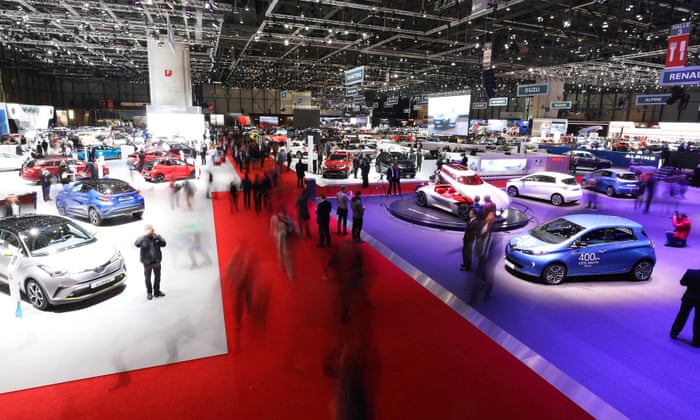

Cars displayed at the Geneva International Motor Show, Switzerland. The automobile industry intentionally circumvented rules to clean up diesel pollution, experts say. Photograph: Chris Ratcliffe/Bloomberg/Getty Images

Damian Carrington, Environment editor

@dpcarrington

Friday 7 April 2017 11.32 BST Last modified on Friday 7 April 2017 11.39 BST

Conniving car makers and their lobbying might, assisted by the 2008 financial crash, were the key factors in producing the diesel-fuelled air pollution crisis the UK is struggling with today, according to key observers of the disaster.

Earlier government decisions to incentivise diesel vehicles, which produce less climate-warming carbon dioxide, sparked the problem but were made in good faith. The heart of the disaster is instead a giant broken promise: the motor industry said it would clean up diesel but instead cheated and dodged the rules for years.

The result has been that the air people breathe in cities and towns is now heavily polluted with toxic nitrogen dioxide, causing 23,500 premature deaths a year in the UK and affecting many schools. The government, whose inadequate plans have twice been declared illegal, will come up with a new, court-ordered strategy as soon as next week.

“We were told by the vehicle manufacturers the [diesel emissions] limits would be met and there was no problem,” said Greg Archer, who was managing the UK government’s air pollution research two decades ago, when new tax breaks led to the diesel boom. “What of course actually happened was those limits were not met on the road, as the car manufacturers started to turn down the after-treatment systems and cheat the tests.”

The government’s chief scientific adviser at the time, Sir David King, tells the same story: “I was convinced the [motor manufacturers] could manage the problem. It turns out we were wrong.”

The European Union has set increasingly tough emissions standards for NO2 since 2000, which would have kept levels down. But rather than deliver cars that met these limits in everyday driving, manufacturers created vehicles that passed the tests, conducted in standard conditions on rollers, but emitted pollutants at higher levels once out of the test centre.

This sharp practice was motivated by the opportunity to shave costs or avoid the inconvenience of drivers needing to top up pollution-busting chemicals more than once a year. It has led to the bizarre situation where diesel cars produce 10 times more toxic air pollution than heavy trucks and buses, as the latter have always faced strict tests.

By the mid-2000s, however, it was clear to air pollution experts that something was very wrong. NO2 levels were rising in cities, not falling, and on-the-road testing was starting to show that diesel vehicles were belching out vastly more pollution than they were supposed to.

In 2005, the European commission decided real-world tests were needed to close the loopholes the car makers were exploiting and aimed to put these into force in 2009. But then came the financial crash and falling car sales, leading to ever more intense lobbying against tighter rules from the motor industry. A “regulatory holiday” ensued, according to Archer.

The tougher tests will finally begin in September, eight years late and only because of the VW “dieselgate” scandal, in which the German motor giant was caught red-handed by US – not EU – regulators.

The European parliament’s inquiry into the scandal, approved this week, is stark on the cause of these “excessive” delays: the “choices of political priorities [by national governments], lobby influence and constant pressure from the industry that directed the focus ... to avoiding burdens on industry in the aftermath of the 2008 financial crisis”.

A glimpse of the backroom dealing done by national governments to protect their powerful car makers from greener regulations – whether NO2 or CO2 – was revealed in 2013. Germany offered to derail an EU cap on bankers’ bonuses, which the UK opposed, in return for British support in sidelining the stricter car regulations: all were duly kicked into the long grass.

While VW were caught in outright cheating, virtually all manufacturers have systematically circumvented the intended pollution limits. “There is strong evidence that vehicle manufacturers have employed a wide range of practices that are, in effect, defeat devices by another name,” said Louise Ellman MP, chair of the UK parliament’s transport committee, in 2016.

The realisation that NO2 emissions are out of control has coincided with the growing realisation of their toxicity: earlier research had concentrated only on the particle pollution from exhausts. “We have now reached a point where we have reached a high level of NO2 and we have now got health evidence against NO2 – it’s perfect storm,” said Prof Frank Kelly, an eminent air pollution expert at Kings College London.

Motor manufacturers were well aware their vehicles were highly polluting on the road, Kelly said: “The car industry knew that, and they still know that. The car industry really has got a major role in this debacle.” Even after the VW dieselgate scandal, the vast majority of new diesel cars still pollute far above official EU limits.


Emissions from new diesel cars are still far higher than official limit

Read more theguardian.com

Steve Gooding, director of the motoring group, the RAC Foundation, said: “The real-world emissions performance of many vehicles has turned out to be a far cry from the hoped-for improvements the standards were intended to deliver. Going forward we need a testing regime we can all trust and cars that meet or preferably exceed the required standard.”

The new, more realistic tests will help, but with each nation responsible for approving the cars that its domestic companies produce, the tendency for leniency could continue. The European parliament’s proposal for an independent, EU-level regulator was rejected this week by centre-right MEPs, including those from the UK’s Conservative party.

“Car manufacturers have consistently failed to hit air pollution limits for diesel cars – it is about time prime minister Theresa May put the interests of people’s health above the interests of the car industry,” said Anna Heslop, of the environmental law firm ClientEarth, which has twice had the UK government’s plans to tackle air pollution declared illegally poor at the high court.

“With the government’s new air quality plans due before 24 April, she has the chance to prove that she can do this,” said Heslop. “Successive governments have got it wrong over diesel and the current government has had seven years to put it right and has done nothing to address the problem.”

ClientEarth and others say the motor industry should recall and refit the polluting vehicles it sold in the UK to emit less NO2, as has happened in Germany and France.

The car industry now welcomes the new testing regime it previously lobbied against. “It is well known that the existing emissions test is outdated, and industry welcomes a new, more robust regime coming this September,” said Tamzen Isacsson, at the SMMT trade body. “This will see cars tested on the road for the first time, meaning that the UK will be part of the toughest emissions standards in the world.”

Isacsson also noted: “Industry has invested billions into reducing emissions and has drastically reduced or banished pollutants such as particulates, sulphur and carbon monoxide, while the [latest] diesels are delivering vastly lower NO2 emissions.”

Archer remains unconvinced: “The car industry continues to be as obstructive as they have always been. Nothing has changed.”

But he has seen the start of change at the very top of the motor companies, he said: “When I talk to people on the boards of the companies, many now see there is a huge change underway, to electric, connected, digital cars and that that transformation is coming very fast.”

With Tesla overtaking Ford in value, green car sales rising fast and bans on diesel cars planned in some European cities, it may be the replacement of diesels, not cleaning them up, that finally clears the air.

theguardian.com


To: Brumar89 who wrote (75916)4/7/2017 8:08:42 AM
From: Eric  Respond to of 86355
 
Markets & Policy

Trump Voters and Democrats Agree on More Clean Energy, New Polling Finds


Photo Credit: Meister Photos / Shutterstock.com

North Carolina voters across the spectrum want more renewables, even if they don’t pick their candidate on that issue.

by Julian Spector
April 06, 2017

A spate of recent polls indicate Donald Trump's victory in November should not be taken as a ratification of his energy policy.

Last month, a Republican polling firm in North Carolina published a survey of voters in that state that found strong bipartisan approval for candidates who support expanding renewable generation and energy efficiency. That's notable in this politically significant state, which swung for Obama in 2008 but voted Republican in the last two presidential elections. It elected Democratic Governor Roy Cooper in November, but he has to contend with a strong Republican majority in the legislature.

The pollsters have three years of data showing that, while politicians who push for more fossil fuel development attract Republicans and repel Democrats, politicians who expand clean energy choices can draw a broad base of voter support.

Meanwhile, the Trump administration moved ahead last week with plans to scrap President Barack Obama's climate change policies, which were designed to shift electricity production away from coal and toward cleaner alternatives. The administration has prioritized coal extraction, while proposing budget cuts to Department of Energy programs that foster renewable energy innovation.

The North Carolina poll, along with other studies, suggest that even people who voted for Trump have different priorities about the future of American energy.

A few months ago a different Republican firm, Public Opinion Strategies, found that 75 percent of Trump voters surveyed wanted action to accelerate the development and use of clean energy.

This week, the latest nationwide Quinnipiac University Poll found that 76 percent of Americans are very or somewhat concerned about climate change, and 68 percent say it's possible to tackle climate change while protecting jobs.

Energy never became a top-line issue in the 2016 campaign. How does voter sentiment in favor of expanding renewable generation influence state and national energy policy that's heading in the other direction?

North Carolina Republicans want more clean energy choices

Strategic Partners Solutions, a conservative issue management firm in Raleigh run by two veteran Republican political strategists, conducted the Carolina survey on behalf of Conservatives for Clean Energy. That client is interested in using renewable energy as an issue to get more Republicans elected; the pollsters want to understand voter sentiment.

Whereas the expansion of fossil fuels divides the North Carolina populace, the poll results show, renewables have the potential to excite a diverse coalition.

"You need to be looking for issues that lend themselves to a broader base of support rather than issues that have a narrow base of support," said SPS Principal Paul Shumaker, who has advised state Republican leaders over the past 30 years including U.S. Senators Richard Burr and Thom Tillis. "If you want to build a broader-base coalition around energy policy, clean energy has to be in the mix."

A candidate who supports more fossil fuel development elicited mixed responses from voters -- 76.4 percent of Republican voters said they were more likely to support, but 60.5 percent of Democrats and 51.8 percent of unaffiliated voters were more likely to oppose.

When asked about a candidate "who supports policies that encourage renewable energy options such as wind, solar and waste to energy technologies," 83.2 percent of the whole survey population said they were more likely to support. That number has been above 80 percent for all three years of the poll.


(Image credit: Strategic Partners Solutions)

Among Republican voters, 79.1 percent were more likely to support. And among Trump voters specifically, 73.5 percent said they would more likely support a pro-renewables candidate.

"On the fossil fuels, you saw the Trump people really like that and the Clinton people really didn't like it," Shumaker said. "When you got into the clean energy, both voting sets were more inclined to be for it."

The implication here for a Republican putting together a campaign in North Carolina is that a choice to go full steam ahead with fossil fuels will make the base happy, but won't draw many voters from outside the base. A decision to embrace clean energy, though, will appeal to most Republican voters while also drawing in new support from outside of the party.

Republican candidates actually have more to gain from campaigning on renewables than Democrats, Shumaker said. Support for renewables among Democrats is already a given, but among Republicans, where it's not taken for granted, it can be a notable differentiator.

"The conservative embracing the clean energy set is like Nixon going to China," Shumaker said.

Efficiency and portfolio standards popular too

Voters supported legislation to support home or business energy efficiency upgrades by an even higher margin than renewables. Getting more specific, the pollsters asked about raising the state's renewable portfolio standard from 12.5 percent to 25 percent. This proposal split Republican voters just about in half, while drawing 60.5 percent support from Democrats.


(Image credit: Strategic Partners Solutions)

The pollsters then offered the anti-raise respondents further details about the effects of the renewables mandate, including job creation, increased local government revenues and rural economic development. After those additional insights, overall support for the higher RPS rose to more than two-thirds in each case.

That indicates that Republican politicians who talk to their constituents about the benefits of higher renewable energy deployment could draw support not just from a majority of Republicans, but also from Democrats. The key seems to be framing clean energy policy in terms of job creation and economic growth.

It turns out, most voters polled aren't satisfied with the monopolistic energy generation status quo, and want their state leaders to create more choices for electricity consumers. Republicans outpaced Democrats in their support for third-party electricity sales, with 81.7 percent.

Why this hasn't mattered at the ballot box, yet

It's fair to question whether a poll on energy policy sentiment can accurately predict voter behavior.

The brief questions over the phone can't capture the complexity and ramifications of third-party electricity sales, for instance, or what a higher penetration of intermittent generation means for the balancing of the grid. Someone might be willing to voice support for renewables when that statement costs nothing, but balk at the prospect of paying a slight premium on the monthly utility bill.

It's also pretty much impossible to remove every trace of bias from a questionnaire, Shumaker noted.

"You could make the argument that 'clean energy' is already a biased term," he said. "What’s important here is the trend lines."

His firm has seen consistent sentiments over the years. The support for increasing the role of clean energy is not some blip in response to current events; it has legs.

As for whether the survey simplifies matters too much, recall that the actual energy discourse we saw on the presidential campaign rarely got more detailed. The issue barely surfaced in the debates. A poll that tested voter response to acronym-laden grid policy papers wouldn't have much to say about campaign rhetoric.

North Carolina voted for Trump by a 3.6 percent margin, so state Republicans did not vote based on their support for additional renewables. In the poll, a plurality of Republicans, Democrats and independents singled out jobs and the economy as the most pressing issue facing them today.

"Candidate selection is not single dimensional, it’s not one issue," Shumaker said. "As long as energy prices and traditional energy sources are inexpensive, clean energy has a much harder job. This is more about a vision and a necessity for good planning into the future."

Clean energy's likeliest path to influencing the ballot is through its economic implications. Solar farms tend to go up in the rural parts of North Carolina, areas that have been hit hard by factory closures and a lack of economic development. Even if energy prices remain cheap, state lawmakers competing for rural districts could win points by supporting renewables as a way to bring jobs home.

"You’ve got to be looking at a policy that provides for stable supplies, long-term energy independence, coupled with long-term economic stability, not just for the consumers but for the producers as well," Shumaker said.

Trump got the votes he needed to decide national energy policy for the next four years. If the grassroots support for renewables observed in these polls becomes more visible, though, it could sway members of Congress up for election in two. They have the ultimate power to cut DOE funding or walk back renewable tax credits.

For renewables advocates, the challenge isn't so much convincing voters, as getting them to vote based on their energy convictions.

greentechmedia.com

