SI
SI
discoversearch

We've detected that you're using an ad content blocking browser plug-in or feature. Ads provide a critical source of revenue to the continued operation of Silicon Investor.  We ask that you disable ad blocking while on Silicon Investor in the best interests of our community.  If you are not using an ad blocker but are still receiving this message, make sure your browser's tracking protection is set to the 'standard' level.
Politics : Politics of Energy -- Ignore unavailable to you. Want to Upgrade?


To: Brumar89 who wrote (76131)4/13/2017 1:43:06 PM
From: Eric  Respond to of 86355
 
Pining for cleaner air in the Norwegian fjords

By Jorn Madslien Technology of Business reporter

4 April 2017

From the section Business
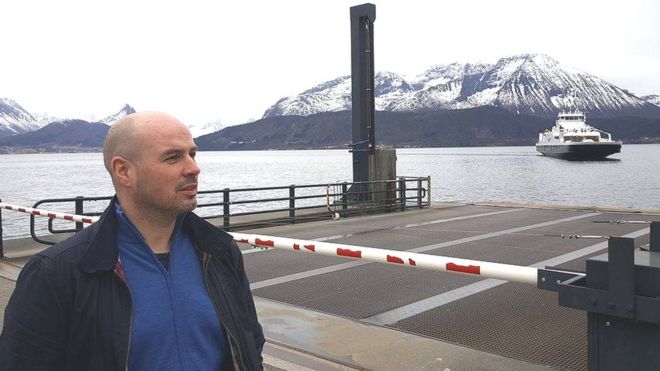

Image caption Trond Bonesmo welcomes Norway's new low-carbon electric ferries

It might be slow, but the romance of commuting by ferry is not lost on Trond Bonesmo as he boards MF Norangsfjord for the crossing from Magerholm to Sykkylven.

"It's a welcome break, and the view isn't too bad either," he says as he looks across the sea towards the Sunnmoere Alps' snow-covered peaks.

"A bridge across the fjord would obviously make the crossing faster, but Storfjorden is two or three kilometres wide and 700 metres deep, which makes it very expensive to build one," says Mr Bonesmo, IT and operations manager for a consumer goods company.

Many Norwegian fjords present similar difficulties to bridge builders, so instead the country's coastal population relies on ferries that link their often remote communities.

Each year, some 20 million cars, vans and trucks cross the country's many fjords on roughly 130 ferry routes.

Most of Norway's ferries run on diesel, spewing out noxious fumes and CO2.

But this is about to change.


Image copyright Getty Images Image caption Building bridges across Norway's mountain-flanked fjords would be difficult and costly

Following two years of trials of the world's first electric car ferry, named Ampere, ferry operators are busy making the transition from diesel to comply with new government requirements for all new ferry licensees to deliver zero- or low-emission alternatives.

"We continue the work with low-emission ferries because we believe it will benefit the climate, Norwegian industry and Norwegian jobs," Prime Minister Erna Solberg said in a speech in April 2016, in which she vowed to help fund required quayside infrastructure.

Ferry company Fjord1, which operates the MF Norangsfjord, has ordered three fully electric ferries that are scheduled to enter active service on some of its routes in January 2018.

Multi Maritime, which designed the ferries, welcomes the growth in demand.

"Several years of investment in sustainable technologies have resulted in us having more than 10 fully electric and plug-in hybrid ferries under construction by several yards," says Gjermund Johannessen, managing director.
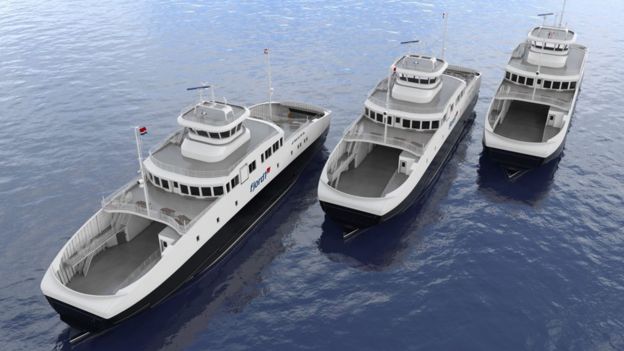


Image copyright Multi Maritime Image caption Multi Maritime has designed three electric ferries for Fjord1

In addition to new-builds, the marine division of Siemens, which developed the technology for Ampere, believes 84 ferries are ripe for conversion to electric power. And 43 ferries on longer routes would benefit from conversion to hybrids that use diesel engines to charge their batteries.

If this were done, nitrogen oxide (NOx) emissions would be cut by 8,000 tonnes per year and CO2 emissions by 300,000 tonnes per year, equivalent to the annual emissions from 150,000 cars, according to a report penned jointly by Siemens and the environmental campaign group, Bellona.

Click here for more Technology of Business features

Long-distance ferries are not well suited to electrification, but about 70% of Norway's ferries cover relatively short crossings, so switching to electric power would pay for itself in a few years, according to the report.

Each ferry would save about a million litres of diesel per year, helping to reduce energy costs by 60% or more, says Odd Moen, head of sales at Siemens' marine division.

"The electricity to power Ampere, with its 360 passengers and 120 cars, across a six kilometre-wide fjord costs about 50 kroner (£4.65; $5.80)," he says.

"In Norway, that won't even pay for a cup of coffee and a waffle."
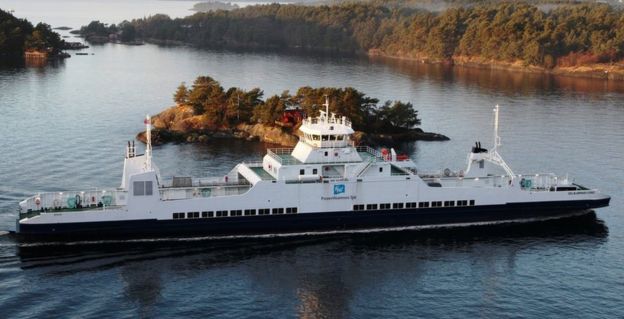


Image copyright Fosen Namsos Image caption Norway's older ferries are also being converted from diesel to electric

Ampere's electric powertrain, which was designed by Fjellstrand shipyard using Siemens technology, includes an 800kWh battery pack weighing in at a hefty 11 tonnes, which powers two electric motors, one either side of the vessel.

The batteries are fully charged overnight, but as each of the 34 daily 20-minute crossings of the Sognefjorden requires 150kWh, the battery must be topped up during loading and unloading as well.

During initial trials, the fast charging placed excessive strain on the local grid, designed as it was to service a relatively small population.

To lighten the load, high-capacity batteries were put on constant charge on either side of the fjord, ready to transfer the electricity quickly to the ferry's batteries whilst docked.

The charging added an extra burden to the Ampere crew's busy schedules. But this challenge is being dealt with by the latest electric ferry designs, which incorporate fully automatic charging systems.

Emissions from diesel-powered ferries have always been a problem.

"When they're docked, their engines are idling - that's when you see those black fumes coming out of their chimneys - and then they're accelerating hard away from land, so their engines are never operating with maximum efficiency," explains Mr Moen.


Image copyright Getty Images Image caption Ferry pollution is an issue for most busy city ports; Hong Kong is no exception

Mr Moen says he has registered much interest in the technology from overseas, and urges other governments to require and support a switch from diesel to electric ferries where appropriate.

Indeed, emissions from ferries is a problem not just in Norway, but in coastal communities and cities all over the world.

This is why Scotland has been moving to lower-carbon hybrid ferries - combining diesel and lithium-ion batteries - with three ferries now in operation.

In Hong Kong, the Environmental Protection Department has long been waging a war on emissions from ferries that are responsible for much of Victoria Harbour's poor air quality.

Similarly, in New Zealand a single ferry visit to Wellington used to pollute the air as much as all Wellington's cars did in a month, according to National Institute of Water and Atmospheric Research figures.

Back in rural Sykkylven, where the air is relatively fresh, NOx emissions pose less of a problem than in a congested city.

But CO2 emissions from ferries should be curbed nevertheless to help combat climate change, Mr Bonesmo says, as he steers his electric car off the ferry.

By 2020, an all-electric solution will have replaced the current diesel-electric ferry on the Magerholm-Sykkylven crossing.

"And then my entire commute will be emissions free," Mr Bonesmo grins.

bbc.com


To: Brumar89 who wrote (76131)4/13/2017 1:59:58 PM
From: Eric  Read Replies (1) | Respond to of 86355
 
Cruel Intentions — Opposition to Climate Change Response is Swiftly Becoming Illegal

“From 1957 onward, there is no doubt that Humble Oil, which is now Exxon, was clearly on notice” about rising CO2 in the atmosphere and the prospect that it was likely to cause global warming… — Environmental Law Center’s Director Carroll Muffett in The New York Times

*****

We’ve known for some time that failing to respond to climate change is a callous cruelty of the worst kind imaginable. That continuing to burn fossil fuels and to delay a necessary transition to renewable energy will not only melt ice caps, provoke extreme weather the likes of which none of us have seen, flood coastlines and island nations, and threaten global food production, but it will also ultimately set off a hothouse mass extinction that is likely to be as bad or worse than the Permian.

We’ve known for decades now that the best, most moral, choice for human civilization is to keep those harmful fuels in the ground. To find a better way for conducting our national and global affairs and not to continue along the catastrophic business as usual emissions path. To listen to the increasingly urgent warnings posed by scientists — not the all-too-harmful dissembling of climate change deniers.

Follow


Hardeep ???? @hardeepkrai

We are the biggest disappointment of all species so justice says we get the worst.. #climatechange #environment t.co

7:35 PM - 11 Apr 2017


Earth is at risk of high having Triassic period-like CO2 levels

A new study found that the increasing CO2 levels in the Earth's atmosphere could result in a climatic condition resembling the Triassic period. And this could happen over the next century! Also Read:...

flip.it

55 Retweets


22 likes


(Nature will surely grant no quarter if we do not hold the climate bad actors to account.)

And because continuing to burn fossil fuels commits so many harms on individuals, on nations, on the world, on children who are now growing up or who have yet to be born, and on the vital skein of nature itself, this activity is increasingly being viewed in the context of liability and criminality.

Corporate Support of Climate Change Denial Invites Accusations of Fraud, Consumer Protection, Environmental Law, and Securities Violations

For its actions as a leader in misinforming the public and promoting climate change denial, Exxon Mobil has found itself at the center of a maelstrom of lawsuits and investigations. The oil and gas company opposed regulations to curtail global warming. It funded organizations critical of global climate treaties and actively sought to undermine public opinion about the scientific consensus that global warming is caused by burning fossil fuels. And, in a move reminiscent of the Orwellian nightmare, the company helped to found and lead a misinformation engine called the Global Climate Coalition of businesses opposed to regulating greenhouse gas emissions. All this despite the fact that Exxon’s own scientists had previously confirmed that fossil fuel burning was indeed the cause of the warming.

By 2015, after numerous failures to respond to letters by Congressional Lawmakers and concerned citizens, Exxon was the subject of increasing scrutiny. In October of the same year, the company became the focus of a formal request from more than 40 social justice and environmental organizations to the United States Attorney General that an investigation be opened into its public deception and climate change denial campaigns. Vice President Al Gore, among other national leaders, then called for the revocation of Exxon’s articles of incorporation.


(Exxon’s own scientists told the corporation that human-caused climate change was a threat as early as the late 1950s. Exxon then spent millions of dollars to misinform the public. Image source: The Guardian.)

The outcry built as New York Attorney General Eric Schneiderman opened an investigation into Exxon’s activities. At issue was whether or not Exxon committed fraud or violated consumer protection and securities laws. Subsequently, the California Attorney General opened his own investigation into whether Exxon misinformed its shareholders, committed securities fraud, or violated environmental laws. And by mid summer of 2016, seventeen state attorney generals were involved in the growing legal action.

After various Congressional wranglings and court hearings, the case against Exxon is now headed for a New York state trial. It now appears that Exxon is likely to be found guilty of some or all of these charges. A decision that the company is likely to attempt to appeal.

Children Sue National Governments Over Human Rights and Welfare

Also in August of 2015, a group of children in Juliana vs the United States sued the federal government — arguing that its actions have endangered future generations’ rights to the degree that it threatened their survival. The government is argued to have endangered these children and to have failed in its duty to protect their access to crucial natural resources — to include a stable atmosphere and a natural world capable of sustaining the people of the United States.


(In the U.S., a variety of climate impacts ranging from sea level rise devouring coastlines, to worsening droughts, heatwaves, fires, and floods, to increasingly intense storms, to declining ocean health, air and water quality, to harm to the U.S. food and water security all threaten our children’s future well-being and survival. Their lawsuit — compelling the federal government to act decisively on climate change — continues to move forward in federal court. Image source: Common Dreams.)

The lawsuit has named President Donald Trump as a party to be held accountable. But the legal action’s overall aim is to compel the U.S. federal government to act in a decisive manner to respond to climate change in order to protect the survival and well being of future generations. The lawsuit continues to advance in federal court despite numerous calls by the fossil fuel industry and by the Trump Administration to have the case thrown out or delayed ( you can read the legal argument of the plaintiffs here). At this point, the case appears likely to receive a hearing this year.

On April 1 of 2017, a similar lawsuit was also filed by 9 year old Ridhima Pandey against the government of India. Ridhima’s lawsuit argues that India, which is also the world’s third largest carbon emitter, has failed to put into action the promises it made by signing the Paris Agreement on climate change. The case also alleges that India has violated its public trust doctrine, its implied promise to provide inter-generational equality, and a number of national environmental laws. Ridhima’s lawsuit comes as India has increasingly succumbed to dangerous heatwaves, droughts, and floods which have harmed food production, provoked mass suicides by farmers, and put the water security of a number of provinces into increasing jeopardy.

UK Government Faces Lawsuit in 21 Days if it Fails to Act on Carbon Budget

In the UK, promises to cut carbon emissions are now legally binding. Britain’s Climate Change Act required the government to find a way to reduce the amount of carbon hitting the atmosphere by 57 per cent through 2032. And considerable progress has been made toward this goal as a shift away from coal precipitated a 33 percent drop from 1992 through 2014. However, the government’s reliance on fracking, its sand-bagging of renewable energy adoption policies, and its failure to more fully incentivize electric vehicles has now put it in a position where the 57 percent goal is falling out of reach.

In response, environmental law firm ClientEarth is giving the UK government 21 days to make good by producing a policy that puts emissions reductions back on track to meet 2032 goals. Failure to do so, says the firm, will result in a lawsuit against the government for not meeting its legal obligations to the public.

youtube.com

(Climate change denial may make you want to laugh or cry. But it’s a deadly serious matter.)

James Thornton, chief executive at ClientEarth, noted:

“We want to work with the government on a strong, effective emissions reduction plan, but all we get is never-ending delays. Government must publish the plan, and must consult with industry and civil society. If it continues to kick this can down the road, we will have no option but to consider legal action.”

Paradigm Shift Running Throughout Civil Society

Legal actions holding powerful corporations accountable for climate harms, holding governments to account for failing to provide for the welfare of future generations, and legally compelling governments to adhere to climate policy obligations represents a pivotal shift in the rules and standards governing western civil societies. It provides an institution that enables citizens and environmental watch-dogs to shape climate policy while holding bad climate actors to account. And this critical social advancement in the presently perilous age when climate impacts are now starting to be realized could not have come soon enough.

robertscribbler.com

