“‘The permafrost is dying’: Bethel sees increased shifting of roads and buildings”… Now they just need some warming.
David Middleton / 3 hours ago July 10, 2017
Guest post by David Middleton
Rural Alaska
‘The permafrost is dying’: Bethel sees increased shifting of roads and buildingsAuthor: Lisa Demer
Updated: 1 day ago calendar Published 2 days ago
 Chief Eddie Hoffman Highway, seen on June 28, is the main thoroughfare in Bethel, and one of few paved roads. It has become a roller coaster of a ride over the past couple of years. The state Department of Transportation is studying whether heaving from the thaw-freeze of permafrost is a factor. (Lisa Demer / Alaska Dispatch News) Chief Eddie Hoffman Highway, seen on June 28, is the main thoroughfare in Bethel, and one of few paved roads. It has become a roller coaster of a ride over the past couple of years. The state Department of Transportation is studying whether heaving from the thaw-freeze of permafrost is a factor. (Lisa Demer / Alaska Dispatch News)
BETHEL — Along the main thoroughfare here, drivers brake for warped asphalt. Houses sink unevenly into the ground. Walls crack and doors stick. Utility poles tilt, sometimes at alarming angles.
Permafrost in and around Bethel is deteriorating and shrinking, even more quickly than most places in Alaska.
Since the first buildings out here, people have struggled with the freeze and thaw of the soils above the permafrost. Now those challenges are amplified.
“What they are saying is the permafrost is dying,” said Eric Whitney, a home inspector and energy auditor in Bethel who has noticed newly eroding river banks, slanting spruce trees and homes shifting anew just weeks after being made level. “I’m just assuming it is not coming back while we’re around here.”
[…]
Above the permafrost in Southwest Alaska, an active layer of soil, often peat, freezes and thaws each year. With air temperatures warming too, the active layer is growing bigger, consuming what had been thought of as permanently frozen.
Thirty years ago, crews would hit permafrost within 4 to 6 feet of the surface, Salzburn said. Now they typically find it 8 to 12 feet down. To install piling deep enough into permafrost to support a house, they used to drill down about 18 feet.
“Now we are going to depths of 35 feet,” Salzbrun said.
“There is a definite change,” said another Bethel contractor, Rick Hanson of T and H Leveling.
[…]
Alaska Dispatch News
“The permafrost is dying!”
“Thirty years ago, crews would hit permafrost within 4 to 6 feet of the surface, Salzburn said. Now they typically find it 8 to 12 feet down.”
Funny… Apart from this past year, Bethel AK is no warmer than it was in the 1930’s. However, thirty years ago, Bethel was definitely colder than it is now or was in the 1930’s…
 Figure 1. Bethel AK Annual Mean Temperature, GHCN v3 (adj) + SCAR data. ( NASA GISS) Figure 1. Bethel AK Annual Mean Temperature, GHCN v3 (adj) + SCAR data. ( NASA GISS)
There is no statistically meaningful trend in the annual, summer or winter temperatures at the Bethel AK station:
 Figure 2. Bethel AK. Annual (metANN), Summer (J-J-A) and Winter (D-J-F) temperatures. (NASA GISS) Figure 2. Bethel AK. Annual (metANN), Summer (J-J-A) and Winter (D-J-F) temperatures. (NASA GISS)
Bethel’s permafrost may be problematic due to the fact that the average annual temperature is just below freezing and gets well above 0°C in summer and it may thaw to a deeper depth than it did 30 years ago… However, there’s no evidence that the permafrost is dying any more than it would have been dying in the 1930’s.
Featured Image: USGS
https://wattsupwiththat.com/2017/07/10/the-permafrost-is-dying-bethel-sees-increased-shifting-of-roads-and-buildings-now-they-just-need-some-warming/
Alan Robertson
July 10, 2017 at 9:55 am
Any structure which is exposed to the Sun and sits atop, or penetrates the permafrost, would transfer heat into the permafrost.
What kind of thawing does the permafrost experience, 5 miles from town?
[ Ditto for a road surface exposed to the sun, it will warm up and hole warmth that has to impact the permafrost below it. ]
Tracy
July 10, 2017 at 11:41 am
As an Alaskan and a Engineer that has taken some Artic Engineering I know a little bit about both Bethel and permafrost. I was in Bethel in 1980 or 81 (a couple of days and I don’t remember a lot of it) it had some paved roads, it is a remote city only barge or plane access. I would say the pave roads were less than 10 years old then and the city was a lot smaller. I am assuming that the permafrost there is relic permafrost left over last ice age. The thing with relic PF is that it will stay frozen if left alone, but if disturbed by almost anything it will start to melt. If its frozen gravel no big deal but on the other hand if its frozen mud get out the snorkels.
uncan
July 10, 2017 at 10:12 am
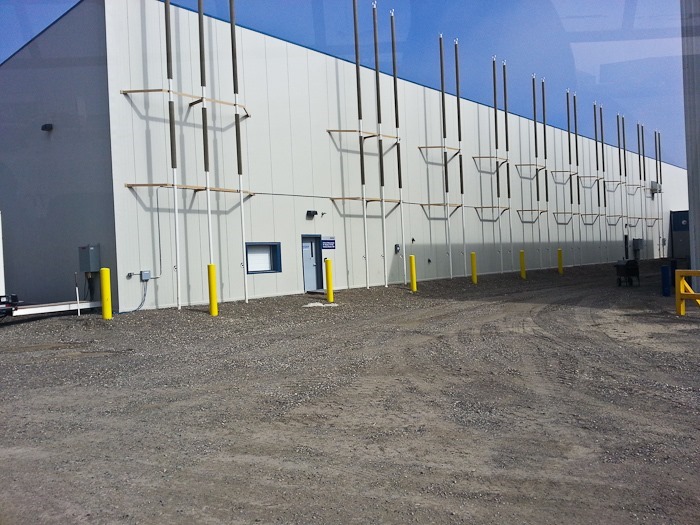
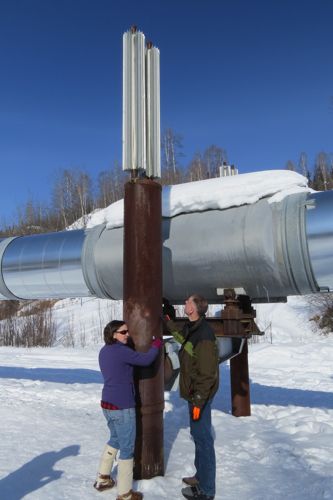
Asphalt paths and roads have been a poster child of thawing permafrost for some time. We all know road surfaces can be much hotter than surrounding grass/shrubs/tree’s. There is no evaporative cooling that foliage provides. If posts (telephone poles) are driven into permafrost the poll will transport heat below the surface more efficiently. This effect is a well known, permanent building installations often place “heat pipes” in around the building to keep the permafrost frozen. The problem is man-made, just not AGW induced.
Heat pipe on buildings
Heat pipe on pipeline support
Bill McCarter
July 10, 2017 at 11:16 am
I placer mined in permafrost in the Klondike for 10 years. The natural ground cover is moss. Where the moss is, there is permafrost at the surface, when the moss is removed the permafrost melts. If it is in a wet area the permafrost does not recede. The water refreezes every winter and protects the underlaying ice. If the ground is allowed to drain and dry the permafrost will slowly disappear ever summer. This has nothing to do with global warming.
richard
July 10, 2017 at 11:41 am
Melting permafrost has always been a problem where there are roads and buildings-
1946- “When the Russians build on frozen ground they sink piles deep into the “permafrost,” melting holes with steam jets. The piles are then wrapped in tar paper and greased so that the top soil freezing and thawing with the seasons cannot stick to them and heave them. But piles are scarce in much of Alaska and army engineers think they know something better – thick insulating mats to keep the “permafrost” always frozen.
Near Fairbanks the Army has laid down 20 runway sections insulated from “permafrost” by layers of cellular concrete, asphalt, foam glass,. gravel, moss, and spruce boughs. Under each runway are thermometers to measure the heat penetration for buildings. The trick is to rest the walls on thick mats
of insulating material or allow cold air to circulate freely under the heated floors”
ristvan
July 10, 2017 at 11:59 am
Went and researched Bethel permafrost. There is an old 1957 USGS report. Bethel lies at the extreme southern edge of the Alaska permafrost zone, so dicey. The permafrost across Bethel is quite variable in thickness based on several boreholes. The city has grown from a small Eskimo village/trading outpost in 1900 to the ninth largest in Alaska with about 6500 people in 1700 households. 91 taxies, per capita the taxi cab capital of the US. Got to be substantial UHI. There is a lot more to the Bethel story than AGW.
|
|



