Really?
So much FUD in that story of misinformation.
Bird kill: death from turbine blades If industrializing natural landscape were not bad enough, wind turbines are also a real hazard to migrating birds. Each year millions of birds are (unnaturally) killed by wind turbines worldwide. According to Nature, up to 440,000 birds are killed in the USA each year. Conventional power plants on the other hand, do not kill anywhere near as many birds. Wind turbines also kill many bats.
Effect of Wind Turbines on Bird Mortality
Maeve White
November 24, 2016
Submitted as coursework for PH240, Stanford University, Fall 2016
Introduction
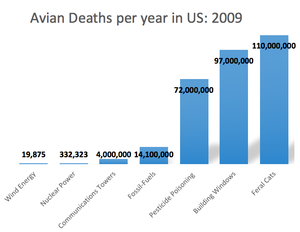 | | Fig. 1: Bird Deaths per year in the U.S. for 2009. [5] (Source: M. White) | Wind energy offers many advantages, which is why it is one of the fastest-growing energy sources. One of the major benefits of wind energy is that is very cost competitive - in 2014 the leveraged price of wind purchase agreements was about 2.35 cents per kilowatt-hour.
[1] Other benefits of wind energy include its ability to create jobs (more than 73,000 workers employed in 2014), the economic benefits for farmers, wind turbines have low operating costs, and most obviously, it is a clean and renewable source of energy. However, there are also challenges and disadvantages to wind power - one of which is that turbine blades kill birds. [1]
Reality of the Problem
Although it is widely understood that wind turbines do cause bird mortalities due to turbine collisions. Collision rates and impacts on bird populations are tentative and wide ranging since data is not subject to scientific review.
The study "Rates of bird collision mortality at wind facilities in contiguous United States" systematically derives an estimate of bird mortality due to wind turbines in the US. The study applies inclusion criteria compiled from multiple studies, and extracts information about the height of wind turbines. Turbine height and the radius of carcass search plots influence the defined proportion of total number of birds killed. Therefore, this study adjusts mortality for varying search radiuses for carcasses. Table 1 shows the results from their study, which includes estimates of bird mortality from wind turbine collisions, including US regional data. This study found an average total of 234,012 total bird mortality due in the US due to wind turbines. Most notably, this study includes the mortality per MW, which breaks down how many birds die per MW of energy gained from the wind turbine. The US total has a mean of 4.12 deaths per megawatt of energy, and a mean of 18.76 deaths per MW in California. [2]
Region Total # Turbines Total MW capacity Total Mortality Mortality per Turbine Mortality per MW
California 13,851 5,796 108,715 7.85 18.76
East 6,418 11,390 44,006 6.86 3.86
West 5,757 9,590 27,177 4.72 2.83
Great Plains 18,551 29,896 54,115 2.92 1.81
Total US 44,577 56,852 234,012 5.25 4.12 | | Table 1: Estimates of bird mortality due to wind turbines in the U.S. [2] | When analyzing the mortality of birds due to wind turbines, it is important to note that wind turbines have an apparent lower magnitude of bird mortality compared to other anthropogenic mortality sources (windows/buildings, communication powers, feral and pet cats). [3] It is estimated that a median of 599 million birds are killed by building collisions in the US. [3] It is also estimated that feral and free-ranging pet cats are estimated to kill four times as many birds as buildings do each year. [3]
Although wind turbines may not be the number one killer of birds, and only 4.12 birds are killed per MW, one major concern are the types of species killed by wind turbines. One highlighted example is at a single far near Altamont, CA where 75 golden eagles die each year due to the farm's 5000 turbines. [4]
Other Energy Sources
It is difficult to effectively interpret the impact of wind turbines on bird mortality without comparing it to other energy sources. As seen by Fig. 1, wind energy actually contributed to the least number of bird deaths per year in 2009. According to the study, "The avian benefits of wind energy," fossil fuels are 17 times more dangerous to birds than wind turbines, and killed nearly 14 million birds in 2009. [5] Fossil fuels contributed 5.18 bird fatalities per GWh, while nuclear energy causes 0.416 fatalities per GWh, and wind energy contributes the least with 0.269 fatalities per GWh. [5]
Conclusion
While wind turbines certainly contribute to bird mortality, they contribute to much less deaths than fossil fuels - a nonrenewable, unclean form of energy. Wind turbines also kill the least number of birds per unit of energy compared to other types of energy. Additionally, efforts are being made to decrease the negative impact wind turbines have on bird mortalities through technological development and properly siting wind plants. [1]
© Maeve White.
The author grants permission to copy, distribute and display this work in unaltered form, with attribution to the author, for noncommercial purposes only. All other rights, including commercial rights, are reserved to the author.
large.stanford.edu
References [1] "2014 Wind Technologies Market Report," U.S. Department of Energy, DOE/GO-102015-4702, August 2015.
[2] S. R. Loss, T. Will, and P. P. Marra, "Estimates of Bird Collision Mortality at Wind Facilities in the Contiguous United States," Biol. Conserv. 168, 201 (2013).
[3] S. R. Loss et al., "Bird-Building Collisions in the United States: Estimates of Annual Mortality and Species Vulnerability," Condor 116, 8 (2014).
[4] J. Warrick, " The Surprising Way That Birds and Wind Turbines Can Coexist," Washington Post, 31 Aug 15.
[5] B. K. Sovacool, "The Avian Benefits of Wind Energy: A 2009 Update," Renew. Energy 49, 19 (2013). |



