Paris 1.5-2°C target far from safe, say world-leading scientists
By David Spratt on 27 July 2017

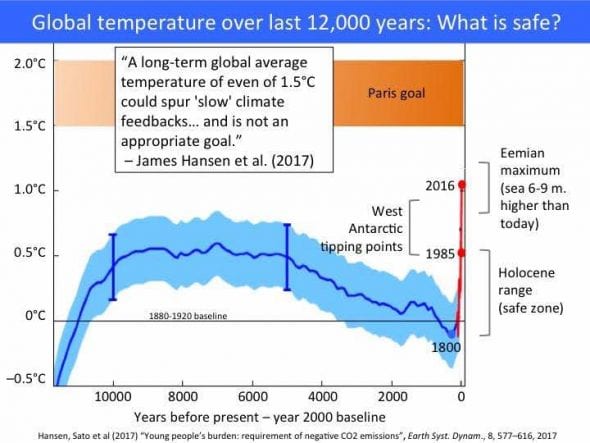
The Paris climate agreement goal of limiting global warming to 1.5 to 2 degrees Celsius (ºC) is well above temperatures experienced during the Holocene — period of human settlement over the last 11,700 years — and is far from safe because “if such temperature levels are allowed to long exist they will spur “slow” amplifying feedbacks… which have potential to run out of humanity’s control.”
That’s the message from some of the world best climate scientists, including former NASA climate chief, James Hansen, in a newly paper, “Young people’s burden: requirement of negative CO2 emissions”, published in Earth System Dynamics this month.

Co-authors include cryosphere expert Eric Rignot, paleo-climatologist Shaun Marcott, and oceanographer Eelco Rohling.
They conclude that “the world has overshot the appropriate target for global temperature” because there are big risks in “pushing the climate system far out of its Holocene range”.
The researchers say the current temperature of 1ºC warming (compared to the 1880-1920 baseline) is about half a degree water that the Holocene maximum, and about as hot as it got in a previous warm period, the Eemian (130,000 to 115,000 years ago) when the “sea level was 6-9 meters (20-30 feet) higher than today”.
This glimpse into past climates shows that the current level of climate warming, with temperatures similar to the Eemian maximum, are dangerous.
This is because “long-term” feedbacks would result in significant loss of polar ice sheets, raise the seal level by several metres, and may activate the permafrost layer in a nasty carbon-cycle feedback.
Such a feedback — in which climate warming triggers the release of stored carbon in polar regions, pushes more carbon into the atmosphere, and raises the temperature further — produces an escalating cycle of warming that may beyond the human capacity to reign it in.
In their research paper and an associated media release and brief, the authors lay out the evidence and need for drastic, immediate emission reductions, and the drawdown of atmospheric carbon to a safe level. Here are the main findings of the research (all figures are based on a 1880-1920 baseline).
Temperature: The observed warming trend shows we are now 1.05ºC above the 1880-1920 baseline. In addition, there was about 0.1ºC between the mid-18th century and the late-19th century.
Thus the total warming to date from “pre-industrial” conditions is about 1.15C. (This is similar to the newly-published “Importance of the pre-industrial baseline for likelihood of exceeding Paris goals” which says warming since “pre-industrial” has been around 1.2ºC.)
Holocene: During the Holocene, the period of human settlement starting 11,700 years ago, the temperature varied in a narrow band of 0.6ºC, with the early Holocene warmer than the more recent period.
The modern trend line of global temperature “crossed the early Holocene temperature maximum in about 1985”, and “the temperature trend today is now 0.5ºC above the Holocene maximum”.
So humans have created and are now experiencing a warm climate than at any time during the period of human civilisation (fixed settlement).
Eemian: The most recent warm-period analogous to today was the Eemian, 130,000 to 115,000 years ago. Today, global warming “has raised global temperature… to the level of the Eemian period”, so Eemian conditions give us an insight into what the current level of warming, of just over 1ºC, is likely to produce.
The picture is not pretty: during the Eemian, “sea level was 6-9 meters (20-30 feet) higher than today”.
Whilst “sea-level rise this century of say half a metre to a metre, which may be inevitable even if emissions decline, would have dire consequences… these are dwarfed by the humanitarian and economic disasters that would accompany sea-level rise of several metres”.
The reason is simple: human civilisation has been predominantly built around the coasts, and the world substantially relies on the rich alluvial deltas such as the Nile, the Ganges, the Brahmaputra and the Mekong for food.
A one-metre sea-level rise would inundate 20% of land area of Bangladesh, wipe out 40% of the Mekong Delta, flood one-fourth of the Nile Delta and depopulate some coral atoll small states.
1.5ºC target: If the current 1ºC of warming is likely to raise the sea-level by several, devastating, metres, then clearly 1.5ºC is not a suitable goal.
On this the researchers are very clear.
The big problem is that the Paris 1.5 and 2ºC goals “are far above the Holocene temperature range” and if “allowed to long exist they will spur “slow” amplifying feedbacks”.
The researchers say that:
“The most threatening slow feedback likely is ice sheet melt and consequent significant sea level rise, as occurred in the Eemian, but there are other risks in pushing the climate system far out of its Holocene range.
Methane release from thawing permafrost and methane hydrates is another potential feedback, for example, but the magnitude and timescale of this is unclear.”
Safe goal:
So what would be safe? The answer is that “limiting the period and magnitude of temperature excursion above the Holocene range is crucial to avoid strong stimulation of slow feedbacks”.
In other words, aim to get temperatures back under the Holocene maximum of 0.5ºC, which implies a level of greenhouse gases below 320 parts per million (ppm) of atmospheric carbon dioxide (CO2), compared to the current level of 405 ppm.
Target 350 ppm:
Whilst acknowledging that “an appropriate goal is to return global temperature to the Holocene range within a century” or under 0.5ºC, in the first instance Hansen et al. propose getting down below 350 ppm, which should keep temperatures from staying above 1ºC.
But this may not be enough. In a recent interview, Hansen acknowledges: “So what should humanity aim for? It’s not any larger than 350 ppm, and it might be less.”
Drawdown requirements:
The paper then explores at some length the actions required to get the level of atmospheric carbon dioxide back below 350 ppm.
The first conclusion is that this is only possible by actively drawing down carbon dioxide by reforestation, changed soils practices, or more technological methods; getting to zero emissions and relying on the carbon cycle by themselves will not get us there.
The second conclusion is that the drawdown task becomes more difficult the longer it takes to bend the emissions curve down.
For example, “if we start reducing CO2 emissions in 2021 at a rate of 6% a year, we’d need to also extract about 150 gigatonnes of carbon from the atmosphere by 2100.
Most of this, about 100 gigatonnes, could come from improved agricultural and forestry practices alone.”
However, if the emissions reduction rate after 2020 is only 3% a year, then the amount of drawdown required jumps to 230 gigatonnes of carbon and more of this would require expensive solutions: “continued high fossil fuel emissions would demand expensive technological solutions to extract CO2 and prevent dangerous warming.”
Changing goals:
We are also reminded that the goals of climate policy-making have shifted dramatically in three decades.
The 2°C “was more or less plucked out of thin air, in 1975, not by scientists, but by economist William Nordhaus as ‘a first intuition’ [and] subsequent analyses essentially defaulted to this figure in what amounts to the science being molded to fit the political and economic paradigm, as climate scientist Kevin Anderson puts it, rather than to what the data actually tells us.”
Whilst in 1992 the goal was “stabilization of GHG concentrations in the atmosphere at a level that would prevent dangerous anthropogenic interference with the climate system”, by 2009 the Copenhagen climate conference concluded that this objective required a goal to “reduce global emissions so as to hold the increase of global temperature below 2°C”.
By 2015, in Paris, the goal had become “[h]olding the increase in the global average temperature to well below 2°C above the pre-industrial levels and pursuing efforts to limit the temperature increase to 1.5°C above the pre-industrial levels”.
What we now know is that this political judgement was well wide of a scientifically-driven mark, which Hansen and his co-authors have firmly established as “return[ing] global temperature to the Holocene range within a century”.
reneweconomy.com.au
David Spratt is Research Director for Breakthrough National centre for Climate Restoration, www.breakthroughonline.org.au/ |



