watch & brief
wait & see
supposedly step by step
with overarching purpose
etc etc
ft.com
China seeks dominance of global AI industry
Beijing challenges US with plan to create $150bn artificial intelligence sector
10 hours ago

Big data: the race is on to develop artificial intelligenceIf the development of artificial intelligence is an arms race, then China wants to become the world’s unchallenged AI superpower. While the National Science Foundation in the US has no increase in funding this year, China has promised to “vigorously use governmental and social capital” to dominate the industry.
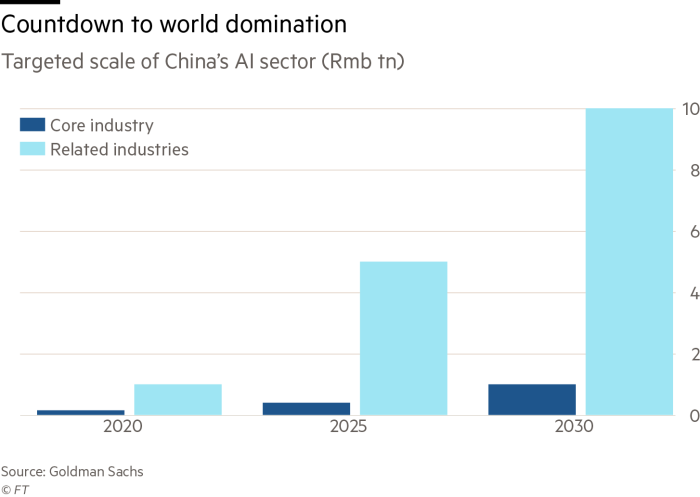
US and Chinese tech companies alike are ploughing money and talent into AI, but Beijing’s blueprint for investing in artificial intelligence — creating a $150bn industry by 2030 — underlines its desire to beat the US.
While industrial policy is no guarantee of success — contrary to aims, China has failed so far to create global champions in semiconductors or cars — few are dismissing Beijing’s clout in AI, the ability of machines to mimic human thinking and carry out tasks ranging from targeting advertisements to playing Go.
“2030 is too pessimistic,” says Kai-Fu Lee, a veteran of Microsoft Research and Google who now runs his own venture capital firm Sinovation Ventures in Beijing. He reels off China’s advantages: the sheer number of people; data; talent; even the superior number of lines of code being written.
At 730m, China’s online population alone is almost twice the size of America’s and more tech-savvy. “Mobile [use] in China is light years ahead of anywhere else,” says one tech player. “So you have a huge experimental lab for exciting AI applications. In China we see different consumer behaviours every day, in the US it’s a lot slower.”
Next, there is a huge supply of data, the lifeblood of AI applications from self-driving cars to ecommerce sites that throw up customised lists of products we are more likely to buy. Privacy laws are weak and China begins collecting information on its citizens from the moment they are born while tech giants Baidu, Alibaba and Tencent — collectively known as BAT — are privy to what they buy, where they travel and who they chat to.
“When it comes to government data, the US doesn’t match what China collects on its citizens at all,” says James Lewis, senior fellow at the Center for Strategic and International Studies. “They have a big sandbox to play in and a lot of toys and good people.”
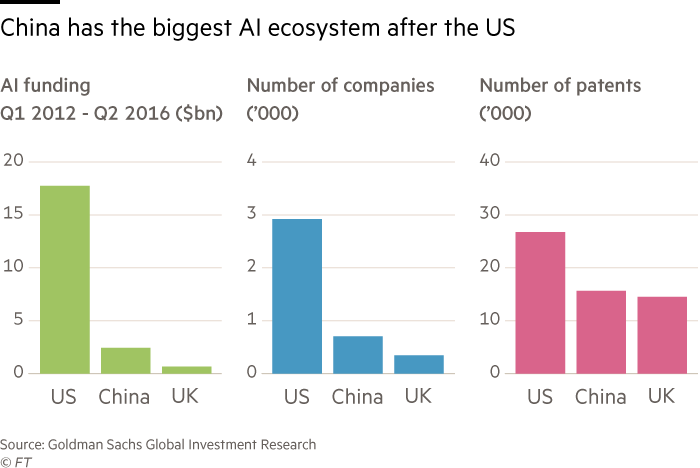
China’s cheque book is also unmatched in the US, where budgets are being cut. “The Chinese invest billions, we [the US] spend millions. It’s hard to see how you wing it when you are being outspent a thousand to one. We are not going to win when we are outgunned to that extent; even if they are half as efficient it’s still 500:1.”
Some say Chinese efficiency in the sector is improving anyway. “The way the government is putting money in is getting smarter and smarter,” says Ming Lei, one of the co-founders of Baidu and now co-director at Peking University’s AI Innovation Center.
“Before they just gave money to research projects or big SOEs or universities. But now they are more likely to give it to a private company, to one that is more active and can really produce the products and services.”
Americans, themselves facing cutbacks in research, are gently sweating at the prospect of China surging ahead in a technology that has strong military as well as civil applications — a point Beijing itself stressed in its paper outlining its AI goals.
“[China] must, looking at the world, take the development of AI to the national strategic level?.?.?.?firmly seize the strategic initiative in the new stage of international competition in AI development, to create new competitive advantage, opening up the development of new space, and effectively protecting national security.”
Adds Elsa Kania, an analyst focusing on the Chinese military and emerging technologies: “The People’s Liberation Army seeks to leverage private sector advances in AI, while actively pursuing AI-enabled capabilities within the defence industry and military research institutes.”
There are detractors who play down China’s strengths and say the country is too far behind in technology and lacks the talent to play catch-up. A recent LinkedIn survey showed that China had just 50,000 people working in tech-related roles in AI — ranking it well below the 850,000 of the US and just one-third the level of the UK and India.
One way China, both at government and private level, is seeking to catch up is by writing big cheques to woo overseas talent — particularly hai gui, sea turtles or returning Chinese who have gone overseas to study and stayed a year or two. The poster child for the turtles is Qi Lu, formerly of Microsoft and now running Baidu.
It remains to be seen whether the cross-pollination of talent will be matched with ideas: the extent to which China will join the global community in developing and advancing AI, rather than merely competing in an arms race between nations.
Chinese engineers are quick to point to the sharing nature of the research. Many work on open platforms — so much so that Baidu claims that its recently-released code base enables a single person to assemble a vehicle capable of (limited) autonomous driving in just three days.
But the risk remains that China, or indeed any of the tech titans — China’s three BAT companies, plus Google, Facebook, Microsoft and Amazon — control what stands to be the keys to the next industrial revolution.
“Will the seven giants of AI become secretive and create a virtuous circle [doing more and accumulating more data] leaving everyone else looking for crumbs?” asks Mr Lee. “I don’t agree with that, but I think it’s plausible at least.”
Either way, China is putting ample money and political capital into its relentless drive to reign supreme in AI.
China overtakes EU in AI papers
China’s output of academic papers on artificial intelligence overtook the 28 EU countries combined for the first time last year, a Financial Times analysis has found.
The result shows how seriously the country takes its target of becoming “world-leading” in artificial intelligence research and applications by 2030, as outlined in a government policy on AI development this summer.
China hopes to leapfrog the US and Europe in using the technology to improve economic efficiency — as well as national security.
FT analysis based on Elsevier’s SciVal and Scopus data, the world’s largest database of academic publications covering more than 5,000 publishers, shows that in 2016 China increased its output of AI-related papers by almost 20 per cent compared with the previous year, while EU and US output dropped. During the year China published 4,724 AI papers, while the EU published 3,932.
However, the quality of fundamental research remains a problem. Although China leads the world in quantity of AI research, it lags behind the EU in terms of number of AI papers in the top 5 per cent of most cited research — but still overtook the US in this metric last year.
Yuan Yang and Yingzhi Yang |



