keeping very busy and getting the world to get busy as well
busy is good, as long as the boyz are playing well together
time.com
China: New Silk Road Is a Challenge for Washington | Time
On China’s remote western frontier with Kazakhstan, yurts and camels are silhouetted against a piercing blue sky. Yet the most striking image rising from the desert is an entirely new city. Founded four years ago, Khorgos is poised to become the world’s busiest inland port, a vital link in China’s multi-billion dollar plan to re-create the Silk Road.
Some $8 billion of trade passes through each year, say Chinese officials. There’s a free-trade zone that welcomes 30,000 traders daily, and an industrial complex of factories where manufacturers enjoy perks such as two years of free rent courtesy of the Chinese government. At the customs gate, trucks line up stacked with agricultural equipment and huge cross sections of blue industrial piping, as blurry-eyed drivers chain-smoke out of their cab windows.
“Today, the ground of Khorgos is mud,” says Guo Jianbin, deputy director of the Khorgos Economic Development Zone administration committee, accenting his words with a booted stamp. “But soon it will be paved with gold.”
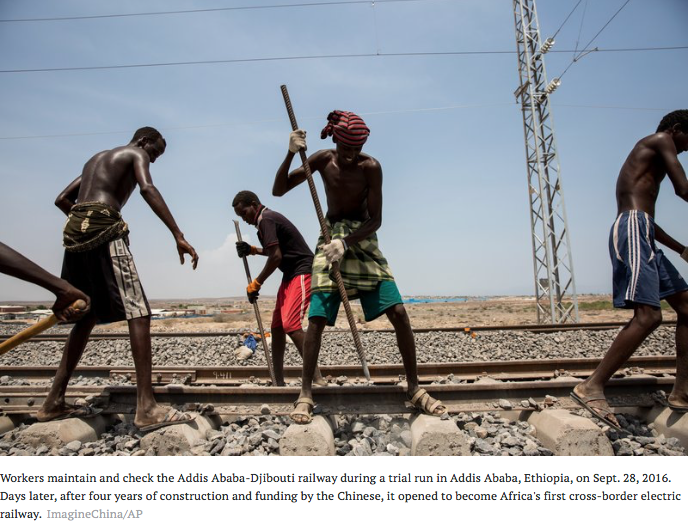
Khorgos is a linchpin in Chinese President Xi Jinping’s signature Belt and Road Initiative. Formerly known as One Belt One Road, it’s a rekindling of the ancient Silk Road through a staggeringly ambitious plan to build a network of highways, railways and pipelines linking Asia via the Middle East to Europe and south through Africa. The economic land “belt” takes cargo, in large part via Khorgos, through Eurasia. A maritime “road” links coastal Chinese cities via a series of ports to Africa and the Mediterranean. A total of 900 separate projects have been earmarked at a cost of $900 billion, according to the China Development Bank. There’s the $480 million Lamu deep-sea port in Kenya, which will eventually be connected via road, railway and pipeline to landlocked South Sudan and Ethiopia and right across Africa to Cameroon’s port of Douala. A new $7.3 billion pipeline from Turkmenistan will bring China an extra 15 billion cubic meters of gas annually. Not since the hordes of Genghis Khan galloped west in the 13th century have such sweeping transnational ambitions emanated from China, though instead of ashes and sun-bleached bones, this time the invaders plan to leave harbors, pipelines and high-speed rail in its wake.
“Exchange will replace estrangement, mutual learning will replace clashes, and coexistence will replace a sense of superiority,” Xi told the opening of the Belt and Road Forum in Beijing in May.
It’s a vision of inclusive globalization that bolsters Chinese leadership credentials at a time when the U.S. is wavering on its international commitments. Belt and Road spans some 65 countries, covering 70% of the planet’s population, three-quarters of its energy resources, a quarter of goods and services and 28% of global GDP—some $21 trillion. Beijing’s rationale is clear: these are large, resource-rich nations within its reach, with a severe infrastructure deficit, which China has the resources and expertise to correct. By boosting connectivity, China can spur growth in the short term, gain access to valuable natural resources in the mid term and create new booming markets for its goods long into the future.
In March, China’s Commerce Minister Zhong Shan said Chinese firms had already contributed 180,000 jobs and nearly $1.1 billion in tax revenue along the Belt and Road. Increasing numbers of Chinese engineers, crane operators and steel smelters stand to reap the benefits of maturing projects.
“You’ll have a China that really sits at the beating heart strategically and economically of this most important part of the world,” says professor Nick Bisley, an Asia expert at Australia’s La Trobe University.
For Xi, that’s the rightful position of the world’s most populous nation, boasting its second-biggest economy after that of the U.S. China’s recent history has lurched from colonization to devastating war and then collectivized economic turmoil, poverty and political strife. No longer. Today, Chinese companies own storied European soccer teams, a major Hollywood film studio and New York’s Waldorf Astoria hotel. China has the most solar panels, wind turbines, and high-speed rail in the world. When, in January, Xi became the first Chinese leader to address the World Economic Forum in Davos, he presented an image of a confident, globalist, responsible statesman, helping to set international rules of trade and environmental standards.
This vision contrasts starkly with U.S. President Donald Trump, who can’t pass his own $1 trillion plan to rebuild the nation’s crumbling roads, bridges and electricity grid, despite the vast majority of Americans recognizing the urgent need. Trump’s nixing of American involvement in the Trans-Pacific Partnership trade agreement, and open questioning of key Asian alliances, have weakened the U.S. as a Pacific power. Trump’s stalled attempts to renegotiate NAFTA have irked neighbors Canada and Mexico, while his announcement of America’s withdrawal from the Paris climate accord has left the world looking to China for leadership on this and other issues.
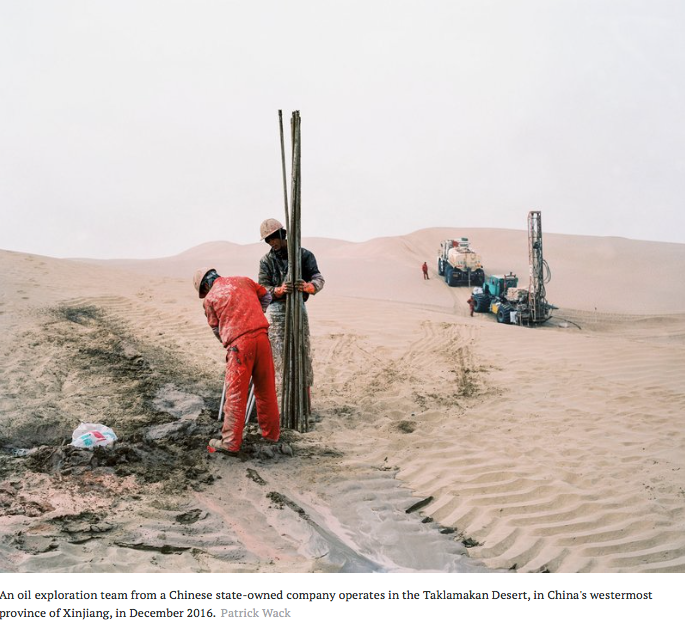
Restoring the lost grandeur of the Silk Road has myriad challenges, of course, chiefly the questionable economics of pouring millions of dollars into some of the world’s poorest and most unstable nations. Falling commodity prices have undermined some projects, while others are vulnerable to crises or shifting political winds in host countries.
The scale of the challenge is evident in Khorgos, through which trains now chug on a 7,000-mile journey from 27 Chinese manufacturing hubs to 11 cities in Europe. It’s the world’s longest international freight line, broadly following the path of the old Silk Road caravans that lugged pistachios, ivory and dates to eager markets in the West. Guo says 2,050 cargo trains passed by Khorgos last year, and the goal for 2017 is 5,000.
Khorgos sits on the edge of the Taklamakan Desert, nicknamed the “Sea of Death.” Herodotus wrote in his Histories of griffins guarding golden treasure at the desert’s craggy northern extreme, and of the North Wind gushing from a mountain cave here. Lying just 100 miles from the Eurasian pole of inaccessibility—the farthest point on earth from any ocean—Khorgos remains one of the most remote spots on earth
Today, the Taklamakan fills part of China’s westernmost autonomous region of Xinjiang, which borders seven Central and South Asian nations and is thus the central hub for Belt and Road’s land portion. A total of 3,500 miles of the ancient Silk Road passes through this Alaska-sized territory, where the Taklamakan’s dunes to the south are separated from a lush northern prairie by a central spine of meringue-peaked mountains.
But Xinjiang is also China’s most volatile region, prone to periodic convulsions of strife from a predominantly ethnic Uighur Muslim population that feels marginalized and even persecuted under Beijing’s rule. Riots in the provincial capital Urumqi in 2009 left 197 dead, according to official figures. Security is suffocating. To take a train at the Urumqi’s railway station requires negotiating four ranks of X-ray machines and metal detectors. At the city’s central bazaar, soldiers stand next to armored cars with bayonets affixed to assault rifles, as lambs are carried bleating and blinking past trays of mutton into butcher shops. It’s China’s only province without 4G cell-phone coverage—deliberately held back to impede the download of jihadi propaganda, say local officials.
In the especially restive south, Uighurs must secure official permission just to travel to neighboring villages. Many feel development isn’t inclusive. “Things were better before,” says a Uighur taxi driver in Khorgos, whose name TIME has withheld for his own security. “In the winter I would hunt wild turkey; in the summer I picked berries. We don’t need all this.”
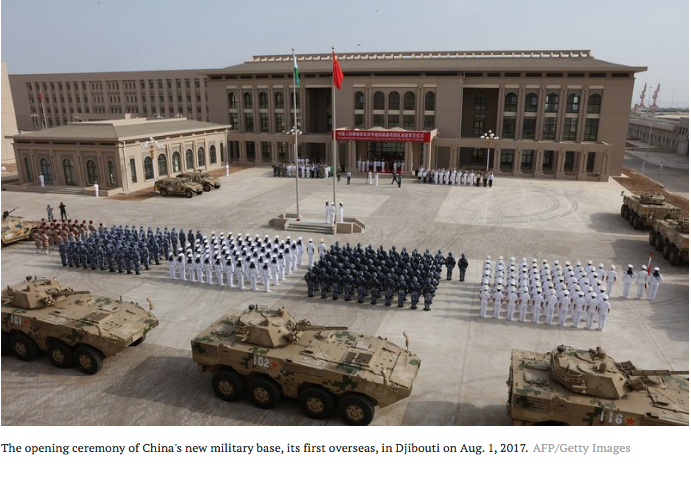
Security is not just a domestic issue. Pipelines and dams in Myanmar, ports in Western Africa, hydro-electricity plants and copper mines in Afghanistan could all be held ransom to strife. Last year, Chinese railway workers in Kenya were attacked by locals who said the new arrivals had been unfairly prioritized for jobs. China may feel compelled to expand its military presence in trouble spots, shifting the global security architecture away from the U.S. In August, China opened its first overseas military base in Djibouti, and it now contributes more U.N. peacekeepers than the other four permanent Security Council members combined.
“Security is the most important challenge facing Belt and Road,” says Zhu Feng, dean of the Institute of International Affairs at Nanjing University.
Economic questions also plague many aspects of the initiative. The ancient Silk Road faded in importance in the 1700s as more sophisticated ships began plying sea routes crammed with booty. Today, trains through Khorgos haul more than 80 standard shipping containers and stretching a half-mile long. But modern ships are powered by 110,000 horsepower engines and carry up to 20,000 containers.
The rail line via Khorgos to Europe is two to three times the cost of sea freight, with twice the carbon footprint, while only cutting transport times from eastern Chinese factories to Europe in half—18 days compared to 35 by sea. There are few goods that would benefit from this time-saving for the extra cost: perishable fruit or pharmaceuticals are flown by airplane to minimize spoilage; electronics or imperishable household wares are dispatched by the cheapest method possible to maximize profits. Compounding matters, while China sends clothes, electronics and building materials through Khorgos to the West, those same “cargo trains are coming back empty,” says the official Guo. Europe isn’t a cost-effective destination, and the economies of Central Asia are weak. At the Khorgos free-trade zone, only 10% of traders come from Kazakhstan. While the Chinese browse mink furs, Georgian red wine and Siberian honey, the Kazakhs queue for rust-bucket minibuses clutching plastic chairs, cheap bedding and counterfeit sneakers.
“Ninety-nine percent of our customers are Chinese,” says Lian Gang, the manager of a duty-free shop in the trade zone.
The marine “road” faces its own impediments. China’s ports had excess capacity of 50 million containers in 2013, according the think tank International Transport Forum, bigger than the combined volume handled by Japan, Russia, Taiwan and South Korea. But the current surge of new port construction, combined with slowing Chinese exports, means excess capacity will likely double by 2030.
Xi’s personal patronage of Belt and Road means many questionable projects are getting the green light due to political expedience rather than economic need. A new railway through landlocked Laos, for one, is set to cost $7 billion—about half of the country’s GDP. Some 70% is to be funded by Chinese investment with the rest paid for by the Laotian government, largely through loans provided by a consortium of Chinese state banks. The isolated nation of 7 million will never be a competitive manufacturing hub.
According to Erica Downs, a China specialist at nonprofit research and analysis organization CNA, who has spent four years researching the initiative, “If you can link whatever you are doing to Belt and Road, even if it’s a tenuous connection, there’s still a chance of securing financial support.” State Chinese banks are obliged to support government initiatives with low-interest loans. Wary bankers have started referring to “One Belt One Trap.”
When Xi first announced the initiative in Almaty in 2013, commodity prices were at historic highs. But they have now fallen precipitously. China is, of course, big enough to handle a few white elephants. Its meteoric rise over the last three decades was engineered on exactly this massive state-championed approach to financing, and it has the resources. Its GDP was $11.2 trillion last year, with growth at a slowing though healthy 6.7%, and a trade surplus of $48.5 billion in August 2017. In total, the Silk Road Fund—comprising injections Asian Infrastructure Investment Bank (AIIB), New Development Bank, China Development Bank, Export-Import Bank of China and the nation’s humanitarian aid coffers—adds up to $269 billion.
But the rest of the estimated $900 billion for the initiative must come via private Chinese banks and contributions by host countries. Beijing has enormous centralized power to get things done, including offering myriad incentives for business that embrace Belt and Road. Still, there is the danger that is has gone too far.
“The Chinese are very possibly taking on commitments that will exceed their ability to fund in a period of dramatically slowing growth,” says Scott W. Harold, a China expert for RAND Corp.
Of course, it might not matter whether most projects offer substantial returns. Infrastructure is inherently a positive, regardless of whether its financiers handsomely recoup their investment. Roads, bridges and tunnels link communities and boost commerce. The Asian Development Bank says Asia needs $26 trillion of infrastructure through 2030, or $1.7 billion per year. Try telling rural Indonesians that a new power plant, which will let their children study into the night, is a bad idea. Or Sudanese farmers that the road or railway that will take their crops to market is an expensive folly. Many Belt and Road countries are so poor that even a tiny injection of capital can make a massive difference to livelihoods.
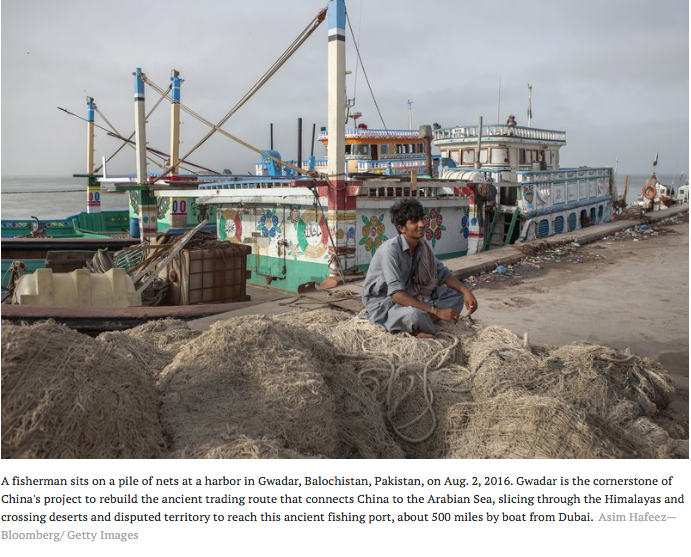
Above all, the new Silk Road is a geopolitical gambit.
The Chinese-financed Hambantota Port in southern Sri Lanka has been vastly underused since it opened in 2010, prompting the Colombo government in July to sell a 70% stake to state-run China Merchants Port Holdings for $1.1 billion. India is now worried that the port will be used to host Chinese naval vessels.
The China-Pakistan Economic Corridor is about befriending Pakistan so it stops extremists seeping over into Xinjiang.
Meanwhile, the AIIB, the new Beijing-headquartered multilateral development bank, was established in 2016 to fund Belt and Road projects but also to show the world that China can run a real, multilateral development bank according to international standards. Washington made fierce attempts to persuade nations not to join it, but few listened and 80 nations arenow members, including staunch U.S. allies Australia and Britain.
“When the Chinese government proposed the idea there was some misunderstanding, and some questions and even suspicions,” AIIB president Jin Liqun tells TIME in his Beijing office. “Misunderstanding is understandable. It takes time for people to appreciate the concept.”
America remains in denial about what Belt and Road really signifies. In a June report, the State Department commented that the Initiative’s free-trade zones “only offer a degree of [liberalization] comparable to other opportunities in other parts of China” and not much else. The U.S. sent a low-level delegation to the May forum in Beijing. Chinese state media reported in June that Trump told a senior Beijing official he was open to cooperating on the initiative, though the White House wouldn’t confirm those remarks. Then, on October 3, Defense Secretary Jim Mattis criticized the China-Pakistan Economic Corridor for passing through disputed Kashmir, parroting India’s objections and appearing to side with New Delhi on the intractable territorial wrangle.
“In a globalized world, there are many belts and many roads, and no one nation should put itself into a position of dictating ‘one belt, one road,’” Mattis told the Senate Armed Services Committee during a congressional hearing.
The new Silk Road is the purest illustration of Beijing’s budding influence as Washington is consumed with partisan bickering and fumbles for a coherent foreign policy. China has wrapped an amorphous group of projects in a tidy package that speaks to inclusiveness, cooperation and altruism. It speaks of China, as an environmental leader, despite being the planet’s worst polluter; as a champion of free trade and investment, despite wreathing its economy in protectionist red tape; as a good guy, despite acting as an authoritarian state that is a serial violator of human rights.
In Khorgos, this is no desert mirage, but a reality of steel and concrete, diesel fumes, and plastic sheeting.
“The next step is to diversify our capabilities: information, logistics, financial and an airport,” says the official Guo. “And also tourism.”
Big dreams for a small city that has its sights set on both East and West.
—With reporting by Zhang Chi/ Khorgos |



