Would Evangelicals Elect Lucifer? A thought experiment

Gustave Doré, Illustration for John Milton’s “Paradise Lost” (1866)
In 2016, Fox debuted a new police drama, “Lucifer,” whose title and basic premise, which are taken from a comic book series, were certain to be seen by network audiences as provocative?—?or would have been, had the show debuted three decades ago instead. The truth is that culturally, the Devil has lost a bit of his swagger. Yet Christians?—?especially those of the evangelical variety?—?still attribute much of the world’s misery to the operations of Satan.
Ordinarily, you couldn’t pay me to watch network crime dramas. I find them so artistically uninteresting that if I could strike a Faustian bargain to avoid hearing about them altogether, I’d probably take it. But given the fact that I identify as a Christian, and that one of my major interests is theology, a show entitled “Lucifer”?—?a reference to Christianity’s great antagonist?—?was always going to penetrate my defenses.
The basic idea is that Satan was starting to get bored of hell. In pursuit of more action, the Devil took human form and began spending his time in Los Angeles. (Imagine having such an unflattering view of L.A. that your show’s premise is that Satan finds the city more sinfully alluring, more pervasively decadent, than the Great Inferno itself.)
Now imagine the Devil decides to trade in his L.A. living for some southern charm. We know he eventually goes down to Georgia but let’s stay that along the way he settles for a while in Alabama. What would he find there?
Now that the Crimson Tide are safely, if not controversially, in the College Football Playoff, Alabama’s focus is back on the Senate race between a candidate whose views on abortion are utterly despicable to the majority of Alabamians and a candidate whose shopping mall dalliances are disgusting to the majority of well-adjusted humans.
Early on, it looked as if Doug Jones, the Democrat, would fall to Roy Moore, the Republican. Then word got out that Moore, while in his thirties, pursued sexual relationships with underage girls. In addition to tightening the race, this news has led to a moment of deep introspection?—?and sometimes not-so-deep introspection?—?about the propriety of voting for a despicable man promising to push ethically desirable policies.
The debate had a familiar feel to it. Our last presidential election furnished the right with a similar choice; in the end, the overwhelming majority of Republicans decided to support Trump, while a small contingent, largely made up of conservative intellectuals and principled dissenters, remained firmly NeverTrump.
Since the day he announced his candidacy until the present moment, I have not wavered in my belief that Trump is manifestly unfit for office. Yet I’m not of the belief that many of the evangelicals who did vote for him, the ones who did so reluctantly and on the basis of lesser-evil reasoning, were acting hypocritically in doing so.
After all, elections inherently require comparative judgments, not absolute ones. Evangelicals, like all voters, had to weigh the prospect of a Trump presidency not absolutely but relative to the alternative: Hillary Clinton.
It would have been hard for Democrats to nominate someone more loathed on the right than Hillary. For evangelicals, the 2016 election thus became, not a contest between a candidate they believed to be morally upstanding against a candidate they believed to be morally unworthy, but a contest between two morally compromised candidates.
This rationale, however, only gets you to a place of reluctant Trump support; it does not justify Trump enthusiasm. When I would speak to Trump supporters, the line I usually got was that Trump was a necessary evil?—?the only way to stop Hillary from getting to the White House. Yet over time, the inner logic of our political culture crowded out this principled approach. As the general election rolled on, and as Trump skepticism evaporated into the air, the right stopped merely tolerating Trump on strategic grounds and began making the affirmative case for him, embracing him wholesale while offering little to no public reservations about his candidacy.
The reason evangelical Trump enthusiasm did, in many cases, qualify as hypocrisy is because, in an earlier era, many of these same Trump enthusiasts ardently denied Bill Clinton’s fitness for office on purely moral grounds. But set that transparently hypocritical posture aside for the moment and once again consider the phenomenon of reluctant Trump support.
For many, the ethical considerations that have shaped evangelical deliberation in the Alabama Senate race are similar to the ones that were present during the 2016 presidential election. The moral dimensions are the same.
I disagree with this sentiment. From an evangelical vantage point, the two cases are meaningfully different. They share many similarities, sure, but one crucial difference is that Trump reluctance had a built-in appreciation for the fact that Trump could not plausibly be portrayed as a Christian. As the hilariously pathetic image of Jesus hovering behind Trump in the Oval suggested, nobody thought Trump was conscientiously guided by God, but that he was being used by God, unwittingly, to carry out God’s will on earth.
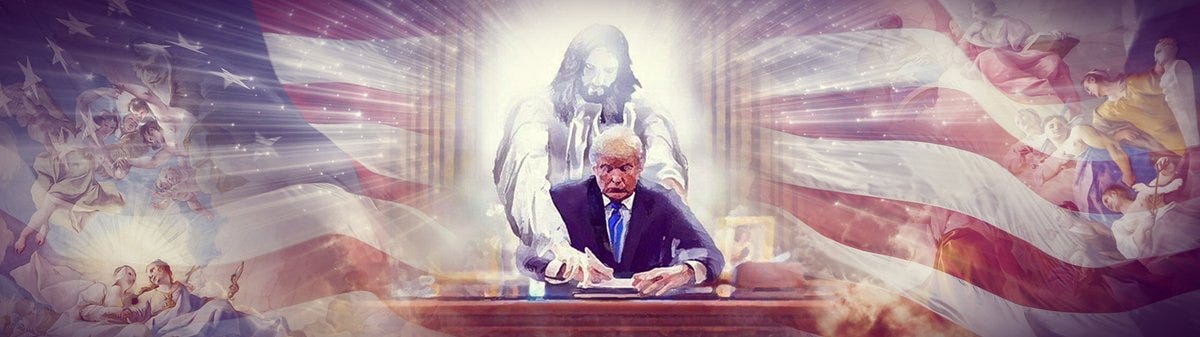
I BELIEVE!
Trump’s cluelessness to God’s designs gave him an instrumental quality; there was an obviousness to his lack of respect for, and interest in, evangelical Christianity. And this gave evangelicals the public cover they needed to justify voting for him.
If they could ward off the liberal enchroachments brought on by a Hillary presidency, while being able to publicly dissociate Trump’s personal behavior from what Christianity preaches?—?if they could straddle this fence politically, it would all work out: important components of their agenda would be advanced while the reputation of their faith would suffer but ultimately endure.
Roy Moore is a different beast altogether. Moore’s public image is suffused with the signs and features?—?but, crucially, not the norms?—?of bold, Bible-believin’ Christian witness. If we were redrawing the painting with Moore rather than Trump in it, it would mean showing Jesus and Moore shaking hands. Trump was being unwittingly used by God, but Moore was Jesus’ partner in this mission to advance the kingdom! There was no way to extract Moore, in the eyes of the public, from his persona as a committed Christian.
Let me reiterate that, in my judgment, both men are absurdly unqualified for public office and that, in a political culture that valued intelligence, integrity, and competence, neither would get a sniff at a position of political consequence. With that said, the above distinction between Trump and Moore is one that Christians should take seriously.
As I wrote in a previous piece:
Evangelicals give themselves wide latitude to have their causes advanced by ungodly men. They are perfectly willing to give political support to secular presidents, kings, and rulers who in return offer to promote their policies. That’s just it?—?evangelicals care more about a president’s policies than his piety. They would rather back an atheist who can be counted on to carry forward their agenda than a Christian who could not.The problem, though, is that when one of those “ungodly” men come from our own camp, the stakes suddenly become much higher. When that happens, there’s a discrediting effect that has an additional?—?and for many, an insuperable?—?aspect to it: the fallout is not just political, but spiritual. That’s because the candidate didn’t just represent our political interests but the faith as a whole. Christians are supposed to be above reproach; if we elevate a man who not only professes the faith but a projects a sense that he is fully driven by his faith-based convictions, yet it’s plain as day that he is a moral deviant, it’s not just the office that is desecrated but also the faith itself.
Ultimately, there’s a distinction between “we can make use of a secular candidate to further God’s ends” and “we can make use of a candidate claiming to be Christian, while being a really poor representative of Christianity, to further God’s ends.” Since the latter reasoning discredits the faith, and since it is subversive of the very aims it desires to achieve, it should be dropped.
Writing in The Federalist, D.C. McAllister makes a more generalized case for voting for ethically compromised individuals. She argues that it’s justified to vote for a morally questionable politician:
God forbade his people from forming unholy alliances and intermarrying with foreigners, because this was true spiritual corruption, but he used pagan authorities, armies, and even religious people from foreign lands to execute his will. …Today, God uses the “ungodly” as doctors, lawyers, teachers, and politicians. To vote for, associate with, or even advocate for a person working in the secular arena who will bring about the “greater good” despite being personally immoral, pagan, or the member of some “unapproved” Christian sect (as the Catholics once were in America) is justified.The idea is that there are some relationships?—?for example, choosing who to appoint as a church leader, or who to make your marriage partner?—?that are too spiritually significant to allow an “ungodly” or “deeply immoral” person to occupy. But when it comes to choosing who will govern us, exhibiting ungodliness or immorality shouldn’t necessarily rule someone out.
In a series of tweets, the New York Times columnist Ross Douthat responded to McAllister’s argument in the following way:
Ross Douthat
?@DouthatNYT
Replying to @DouthatNYT
It seems to me that this distinction, between forbidden "unholy alliances" and God *using* the irreligious for His ends, is crucial to understanding why Christians should NOT vote for sybarites and possible pederasts even when there seems to be a strong pragmatic case.
Ross Douthat
?@DouthatNYT
Replying to @DouthatNYT
The point being that of course God can, and does, use even wicked figures for His good ends. But to actively vote to place the wicked in power is dangerously presumptuous, and far too close for comfort to the "unholy alliances" that @McAllisterDenadmits are forbidden.
Ross Douthat
?@DouthatNYT
Replying to @DouthatNYT
Since all leaders are flawed and sinful in their ways, where to draw the line requires prudence; it's impossible to absolutely *prove* that Roy Moore is so personally ungodly as to trump (if you will) the general obligation to vote pro-life.
oss Douthat
?@DouthatNYT
Replying to @DouthatNYT
But with Trump's, well, everything and now Moore's mall problem we are clearly in territory that most evangelicals would have seen as a reductio ad absurdum just a short while ago.
In this last tweet, Douthat references the argumentative strategy known as the reductio ad absurdum. I like reductios?—?you often hear the cliche about missing the forest for the trees; an effective reductio can help a reader see that the reasoning employed toward a narrow aim would, if more systematically applied, require accepting some seriously undesirable conclusions.
I’d like to offer a reductio to show that evangelical support for Trump and Moore is morally problematic. My reductio is a thought experiment involving Lucifer in Alabama.
Remember, in my hypothetical above, the Devil got sick of all the California Love and felt like settling into a less dizzying environment. There is TV precedent for this: in a 1998 episode of “Touched By An Angel,” the Devil embeds himself inside a far more modest town.
Say Lucifer goes to Alabama and gets into Republican politics. He is straightforward about who he is?—?he’s Lucifer! And he’s asking for your vote!
Yet what’s surprising to many people is that his policy preferences line up with certain Republican priorities. The point isn’t?—?to the chagrin of liberal readers?—?that this is because Republican policies are Satanic or anti-Christian; on the contrary, Lucifer explains he prefers Christian policies because it is only when Christianity is vibrant that he can have his fun as a countervailing spiritual force.
In other words, he adopts a pro-life policy platform because, if he can enact these views politically, it means there will be more human beings on earth to influence for the worse. Imagine you could trust Lucifer, while in office, to be stridently anti-abortion. On the other side is a candidate who supports unrestricted access to abortion.
[ "Imagine you can trust Lucifer .." The problem is .... You can't. He's Lucifer. ]
Here’s the question: Why shouldn’t evangelicals who voted for Trump against Clinton, and are planning on voting for Moore against Jones, also vote for Lucifer over his opponent?
If the answer is: “they should,” then this should make clear, to the voters and their sympathizers, that something has gone deeply wrong. If one’s political philosophy doesn’t reliably disincline them toward casting a vote for the Prince of Darkness, it’s time to pack it up.
If the answer is: “they shouldn’t,” then they need to explain why they would vote Trump and Moore but not Lucifer. Where do they draw the line? How far are they willing to go to promote the right policies?
Roy Moore’s sexual attraction to teenagers was so intense he got barred from a shopping mall, where he would “badger” them. If this is someone on the acceptable side of the divide, who, if anyone, would populate the non-acceptable side?
When people point out that his romantic pursuit of teenage girls is disqualifying, Moore construes that as engaging in spiritual warfare against him, a shameless distortion of Christian theology and an easy way to open the faith up to mockery. If this is a man we’ll support, then who wouldn’t we support?
If your political framework is not able, under the same circumstances, to furnish you with a clear and forceful repudiation of Lucifer, then it’s time to seriously re-evaluate your approach.
The point isn’t that Moore is Satan; the point is that if your exclusive consideration is ideology, and if there is no set of moral failings that would override the value of a candidate’s support for good policies, then that should justify voting for Satan in an analogous electoral scenario. But that’s absurd.
arcdigital.media |



