Speed of Tesla big battery leaves rule-makers struggling to catch up
By Giles Parkinson on 21 December 2017

The Tesla big battery – the world’s largest lithium-ion battery installation – has only been in operation for three weeks, but already it has highlighted just how unprepared the National Electricity Market, and its rules and regulations, are for this new technology.
Most of what Tesla has done in its first few weeks has been for show: a test of its own capabilities for the satisfaction and curiosity of its owners and developers, and a demonstration to other market players of what is possible now, and what is to come.
In those first few weeks it has intervened to show how it can respond to demand peaks, ensuring supply and clipping prices; it has played in the FCAS market (frequency and ancillary services); it has discharged at full capacity (100MW); and displayed its rapid re-bidding and charging and discharging capabilities.
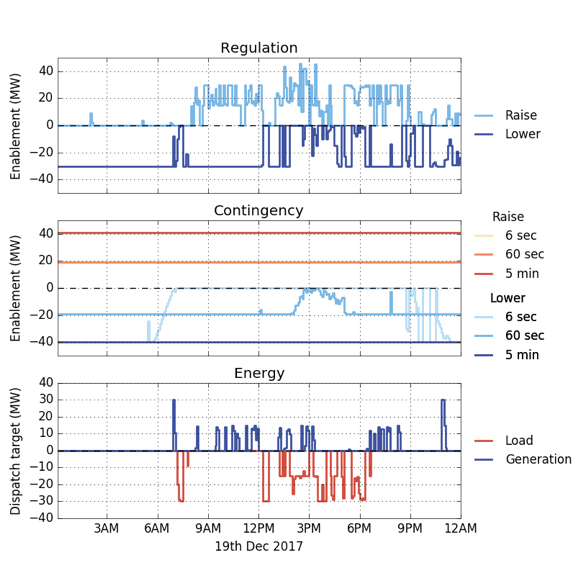
(Some recent events are illustrated in the graphs above from the ever-observant and data-rich Dylan McConnell from the Climate and Energy College).
Last week, in one of its most dramatic interventions, the Tesla big battery responded in an instant when a Loy Yang A unit tripped and sent frequency down below 49.8Hz, the normal trigger point for a reaction from contracted generators.
In what is known as the FCAS contingency market (designed to cater for such sudden outages), the Hornsdale Power Reserve, as the Tesla big battery is known, displayed its speed of response, helping arrest the fall in frequency before leaving and allowing the contracted generators to complete the job.
It was largely for show because the Tesla battery is not an official player in those markets.
It could have done more, as it has demonstrated in testing at other times, including ramping from 0 to 100MW in 140 milliseconds (but not, as some media reported, for the Loy Yang trip), but the fact is there is no market mechanism for batteries to be rewarded for such Fast Frequency Response.
We have to remember that the Tesla big battery exists only because it is contracted by the South Australian government to provide specific services to the local grid, and to allow its owners Neoen to play with some time shifting of wind energy.
But one suspects its remit allows for it to play elsewhere and emphasises the point to the owners of the 20th century machinery that the future is here. The S.A. government is effectively providing a service to the whole Australian energy market by paying the Hornsdale Battery to be available and on-line.
But as far as the NEM and its rule-maker are concerned, the future is not yet here. Or at least they are not ready for it.
Market rules have not yet been adjusted, they still favour the ageing incumbents, and the go-slow mentality on rule changes continues. And it’s a damning indictment on those who should have seen the future coming, because they have been told about it often enough.
This is as true for Tesla as it is for other battery storage developers. Indeed, it is true for the promoters and would-be providers of energy efficiency and demand management, and a whole range of smart technologies that could make this grid more efficient and reduce costs.
The 5-minute settlement rule, designed to favour fast-responding technologies like batteries, has been approved, but will not replace the existing 30 minute settlement rule, designed for slow-moving machinery like coal and gas, until mid 2021.
In the meantime, the rorting of bidding practices will continue, delivering windfall profits to generators who – according to the pricing regulators – are doing nothing illegal but merely exercising their “market power.”
The market for what batteries can also provide, as demonstrated in the Loy Yang A trip, is for fast frequency response. But the market rule-maker, the Australian Energy Market Commission, is still wrestling with these rules.
One could forgive the AEMC had this technology appeared out of the blue, but batteries have been operating and demonstrating their capabilities for several years in other markets in the US and Europe. In Australia, it’s as though they’ve suddenly sighted an alien spaceship.
Many readers of our story on the Tesla battery’s response to the Loy Yang A trip complained that its intervention was minor (only 7MW), brief (a few seconds), and didn’t exactly save the grid.

The point is however, that the battery demonstrated what could be done. As Simon Hackett, from Tesla rival Redflow, tweeted in response to Elon Musk’s tweet of our story, the battery is designed to provide fast response, to stop the sticks falling out of the “Jenga pile” before other generators can catch up.
The problem is that market rules and pricing mechanisms are not designed around technologies like batteries that can go from 0 per cent to 100 per cent full power in a fraction of a second.
It is understood that the Tesla control system automatically sensed that system frequency dropped when Loy Yang tripped.
Frequency instantaneously changes across the National Electricity Market when an event happens and while synchronous generation provides mechanical inertia which helps moderate frequency changes, other technologies are required to provide fast follow-up, to inject power into the network to stabilise frequency.
This is what batteries are really good at: injecting power fast. In the same way that, if you are riding a bike up a hill and start to wobble, you need to pedal a little harder, the battery kicked in.
In these situations it is not so much about how hard you pedal but making sure you stay balanced by responding quickly to changes.
South Australia and Tesla are not alone in pioneering the deployment of batteries to deliver grid security and reliability alongside increased renewable energy deployment.
A recent report by Everoze titled “Batteries Beyond the Spin – The dawning era of digital inertia on the Island of Ireland” summarises a Queens University Belfast study commissioned by AES, another global leader in energy storage.
The report is based on experience with a 10MW battery energy storage system at the Kilroot Power Station in Northern Ireland. A key observation of the report is batteries provide 100 per cent of their output as digital inertia, vs synchronous generators which are limited to 7-14 per cent of total capacity.
This would mean the 100MW Tesla Big battery could provide the equivalent inertial response to 700-1400MW of traditional generation.
The Everoze report concludes “adopting digital inertia can slash the cost of delivering inertial response as well as improving the quality of power response following events”.
The battery industry insists that we can address system security, reliability, affordability and lower emissions while accepting the digital era has spread to the energy system, and that we are moving beyond the steam age.
The AEMC know that times are changing and have a process underway to review Frequency Control Frameworks.
As its November 2017 issues paper states:
“Sometimes, large generating units and transmission lines may trip unexpectedly and stop producing or transmitting electricity. These events tend to result in larger changes in system frequency and more significant impacts on the safety and reliability of the power system. Controlling frequency is therefore critically important”.
The problem with the AEMC and its application to public policy is that it seeks to attributes blame for frequency stability on new variable technologies like wind and solar (the AEMC likes to call them intermittent), and not the old clunkers that seem to trip on a very frequent basis.
( Four times in the last week, with another 1,500MW out of action – the equivalent of another Hazelwood generator).
However, progress in being made. The forward thinking discussion paper released by the Australian Energy Market Operator recognises the need to act, and quickly. “NEM planners must prepare for and manage a rapid transformation of the power system,” it wrote.
It at least is looking at how it can change market rules to encourage the anticipated huge resource in household battery storage, and how that can help the grid. It also wants to recognise the importance of large scale storage, be it battery, pumped hydro or solar thermal.
In a submission to the AEMC, Tesla goes through all the different hurdles that make it hard for battery storage. “The current structure of the NEM was not set up to fully cater for the incorporation of non-synchronous technologies and battery energy storage,” it says.
It suggests that the AEMC should consider a 2 second market or even a 1 second market, but also warns against mandating each and every wind and solar generator to have storage, as it will result in higher costs and wasted capacity.
Tesla is not the only one to make the complaint. Batteries can provide any number of services (up to 20, according to some estimates), but on the NEM can basically only get paid for one: time-shifting the output of wind and solar.
That was the complaint of the builders of Lincoln Gap wind farm, who are going ahead with battery storage anyway, to test the waters.
Interestingly, the Hornsdale wind farm, adjacent to the Tesla battery, this week began playing in the frequency control market, finally doing the tests with the Australian Energy Market Operator. It is the first wind farm to offer this service in Australia.

As ever, these graphs – which show the energy and FCAS offerings from Hornsdale 2 wind farm, as opposed to the battery – are from the ever vigilant McConnell.
The next big storage installation, next to the Wattle Point wind farm, will rely on contacts from the transmission provider, and a grant from ARENA, to provide frequency response and micro-grid and islanding services on the Yorke Peninsula.
Even the Victorian government is struggling to make enough funding available to the two preferred winners of its tender for two battery storage installations providing at least 100MWh of storage.
That result was supposed to be announced in late August, and installed by January 1. But negotiations are continuing, and are now expected to go through summer before an announcement is made.
The Lakeland solar and storage facility – supposed to the first combined large-scale solar and storage installation on the grid – is also facing numerous delays as AEMO, the local grid people, and the project’s own engineers get their minds around various issues.
The ARENA-sponsored project was supposed to connect in July, but now looks set for a late January start-up at the earliest, a delay of six months, if not more.
reneweconomy.com.au |



