SI
SI
discoversearch

We've detected that you're using an ad content blocking browser plug-in or feature. Ads provide a critical source of revenue to the continued operation of Silicon Investor.  We ask that you disable ad blocking while on Silicon Investor in the best interests of our community.  If you are not using an ad blocker but are still receiving this message, make sure your browser's tracking protection is set to the 'standard' level.
Strategies & Market Trends : 2026 TeoTwawKi ... 2032 Darkest Interregnum -- Ignore unavailable to you. Want to Upgrade?


To: Maurice Winn who wrote (138425)1/21/2018 11:54:25 PM
From: elmatador1 Recommendation

Recommended By
pak73

  Read Replies (1) | Respond to of 220217
 
If Food was a problem. If feeding the world was a what it matters, everybody would be investing in Brazil.

No less astonishingly, Brazil has done all this without much government subsidy. According to the Organisation for Economic Co-operation and Development (OECD), state support accounted for 5.7% of total farm income in Brazil during 2005-07. That compares with 12% in America, 26% for the OECD average and 29% in the European Union. And Brazil has done it without deforesting the Amazon (though that has happened for other reasons). The great expansion of farmland has taken place 1,000km from the jungle.
http://www.economist.com/node/16886442?fsrc=scn/ln_ec/the_miracle_of_the_cerrado


To: Maurice Winn who wrote (138425)1/22/2018 12:08:52 AM
From: elmatador  Respond to of 220217
 
It is not cassava only MQ!
With over 90 million social media users in the country, (yes 90 million arms and legs plus wallets) there is a lot of opportunity for well-placed digital marketing to grab consumers’ attention.

the only Latin American country to crack the top ten retail e-commerce markets in the world.

Despite Brazil’s recent economic slowdown, e-commerce grew by 11.5% in 2017 and is predicted to chart 10% growth in 2018.

While these statistics show a significant drop from the 28% growth Brazil’s e-commerce market experienced in 2013, it is safe to say that Latin America’s e-commerce powerhouse will continue to dominate the region for the foreseeable future.

Message 31446823


To: Maurice Winn who wrote (138425)1/22/2018 6:14:53 PM
From: TobagoJack1 Recommendation

Recommended By
Arran Yuan

  Read Replies (1) | Respond to of 220217
 
progression of a very clever move by tencent, inside out

scmp.com

China's biggest internet firm finds a way to bypass Google, Apple apps
22 Jan 2018 - 4:43pm
Tencent Holdings, China’s biggest internet company by market value, is on a collision course with Apple and Alphabet with its aggressive push into mini mobile applications, which allow users to bypass traditional app stores and run programs directly within its WeChat application.

Tencent has re-engineered the WeChat messaging app in a way that applications smaller than 10 megabytes can run instantly on WeChat’s interface. It is now offering 580,000 mini programs after just one year of development, compared to the 500,000 mobile apps that Apple’s App Store published from 2008 to 2012, according to Hu Renjie, WeChat’s mini program director.

“The mini program is a brand new product model which can seamlessly link the offline and the online together,” said Hu, adding that the mini program scheme has attracted 1 million developers.

As well as bypassing the need for app stores, mini programs offer speed of access to users because they can be loaded instantly from within WeChat on any operating system.

Tencent’s move to bundle apps within WeChat could hurt Apple and Alphabet as the two US tech giants rely on their own universe of apps to enrich the use of their respective iOS and Android systems.

In a measure of the size of the threat that mini programs present, WeChat already has a user base of 980 million globally, which is larger than the population of the European Union and Russia combined.

One mini program, the Jump Jump mobile game, attracted 400 million players in China in less than three days after becoming available on WeChat’s homepage, making it the most popular mobile game in the country.


Tencent recently announced that it had more than 170 million monthly users of its mini programs since their launch in January 2017. A number of international brands, including McDonald’s, KFC, Coach and carmaker Tesla, released mini programs for WeChat in the past year, with a Tesla one allowing users to monitor the acceleration rate of their vehicle.

WeChat poised to become China’s official electronic ID system

Tencent’s strategy to transform WeChat into “an app that runs apps” is in juxtaposition to Apple and Google, who have built their own ecosystems.

The Chinese firm has already had a run-in with Apple, with the US firm updating its App Store review guidelines in April to emphasise that apps cannot offer programs in a “store or store-like interface” and asking Tencent to remove a function that allowed WeChat users to pay tips to content and app publishers.

Normally, in-app purchases would have to go through Apple’s payment platform, with Apple taking 30 per cent of the revenue generated. But WeChat’s tipping feature used architecture that was not designed to include Apple.

But last week, The Wall Street Journal reported that Apple and WeChat had reached a deal which would allow WeChat to resume its tipping feature, while Apple would enjoy part of the profit.

Thomas Graziani, co-founder of a WeChat marketing agency start-up called WalktheChat, said the tipping feature gave WeChat “an edge over Apple”. App developers and content generators would be incentivised to launch products on WeChat more so than on the App Store because of the tipping feature.

The mini program feature could also give WeChat an advantage over Google. With the Google Play app store blocked in China, there is a need for a centralised app market for Android users, which WeChat could meet.

But Graziani said there was still room for both platforms to exist.

“Mini programs will not replace the mobile app as you know it,” he said. “But they are very effective in helping apps like games to acquire new users.”

Graziani said mini games launched on WeChat were often simplified or shortened. Companies often released mini games as teasers for regular games in the hope that users would download the original games from the App Store.

China’s bankers and traders turn to WeChat to make deals

Tencent’s domestic rivals, Baidu and Alibaba Group Holding – owner of the South China Morning Post – have similar mini program features with their products, while Facebook Messenger has included instant games on its platform.

As to how much a 10-megabyte app could accomplish, Phillip Pun, founder of social networking app Plando, said: “10 megabytes can make for good-sized software and it can be very sophisticated.”

“The app I used to develop was just about 20 megabytes. but it was a full chat app and social network with photo sharing capability,” he said.


To: Maurice Winn who wrote (138425)1/22/2018 6:24:45 PM
From: TobagoJack  Respond to of 220217
 
hello maurice,

it appears Message 31448070 that there are some on the thread behaving inconsistently to the ideal of for the greater good, treating all courteously, as equals, without derision, minus the denigration, and not treating the cafe as a cesspool of olives or of some kenyan slum, and

some even compare themselves to ... well, skip it, as such individuals are simply deplorable, perhaps they cannot stomach other folks enjoying themselves

oh well, really quite sad, and pitiable

let us watch & brief to see the progression of possible illness


To: Maurice Winn who wrote (138425)1/22/2018 8:46:10 PM
From: TobagoJack  Read Replies (1) | Respond to of 220217
 
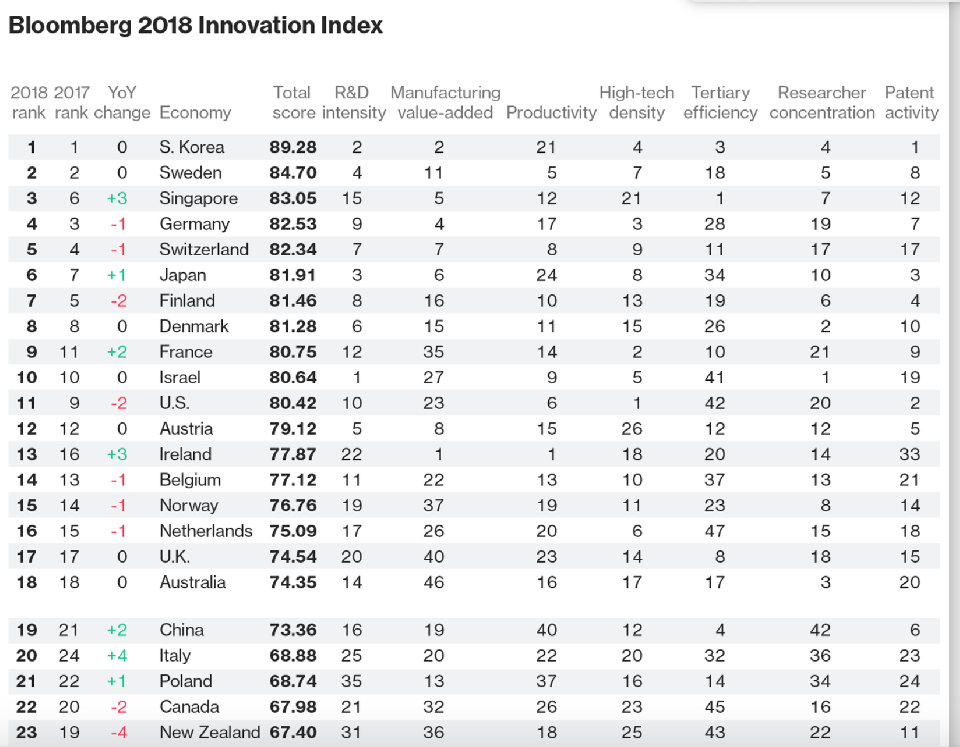
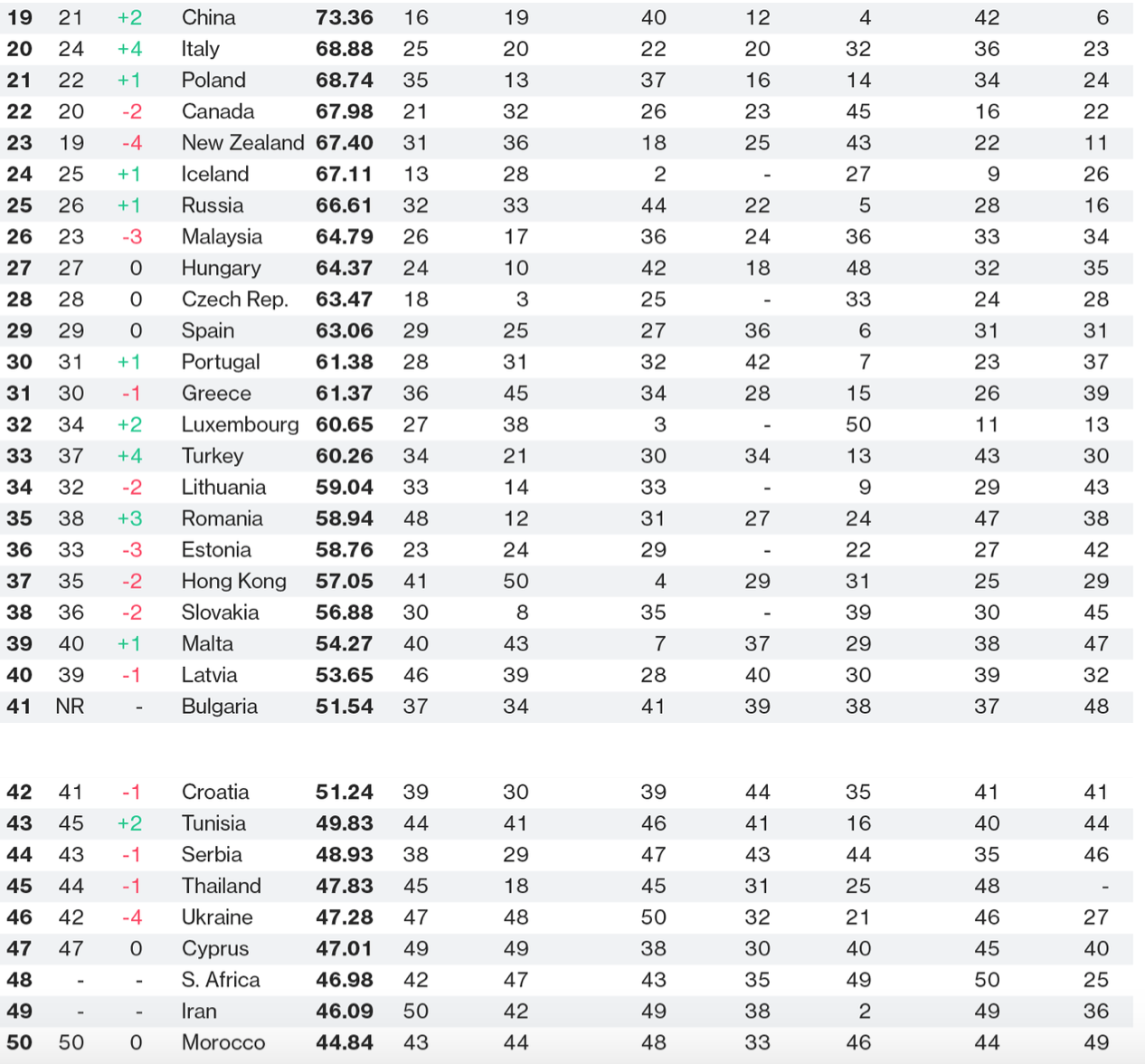
hello mq, per suspect media, either nz is #23, and / or china is misplaced, and / or korea doesn't actually belong, and am certainly unsure about singapore

and of course the score ought to be multiplied by the folks it does good for, etc etc per weighted measure

have no idea what portugal is doing on the list, but not surprised by missing brazil

because obviously morocco is of more merit, and suspect tunisia of same

but, ... hey ... watch & brief

bloomberg.com

Singapore Soars Up Innovation Rankings, U.S. Falls Out of Top 10
More stories by Michelle Jamrisko
January 23, 2018, 7:06 AM GMT+8
Score another one for Seoul while Silicon Valley slides.

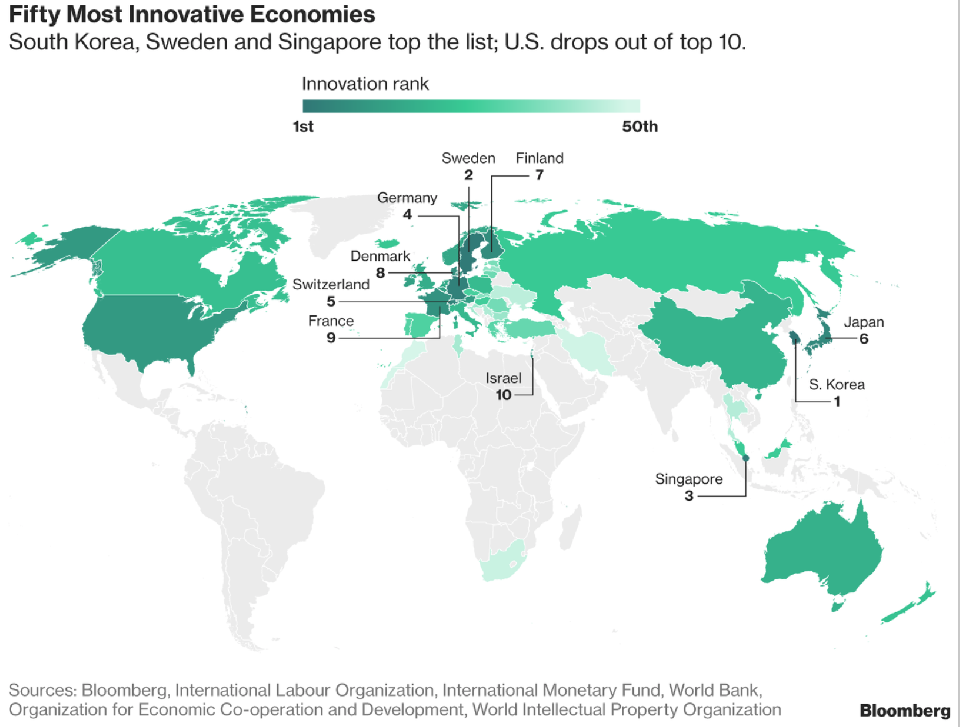
The U.S. dropped out of the top 10 in the 2018 Bloomberg Innovation Index for the first time in the six years the gauge has been compiled. South Korea and Sweden retained their No. 1 and No. 2 rankings.

The index scores countries using seven criteria, including research and development spending and concentration of high-tech public companies.


The U.S. fell to 11th place from ninth mainly because of an eight-spot slump in the post-secondary, or tertiary, education-efficiency category, which includes the share of new science and engineering graduates in the labor force. Value-added manufacturing also declined. Improvement in the productivity score couldn’t make up for the lost ground.

“I see no evidence to suggest that this trend will not continue,” said Robert D. Atkinson, president of the Information Technology & Innovation Foundation in Washington, D.C. “Other nations have responded with smart, well-funded innovation policies like better R&D tax incentives, more government funding for research, more funding for technology commercialization initiatives.”

Singapore jumped ahead of European economies Germany, Switzerland and Finland into third place on the strength of its top ranking in the tertiary-efficiency category.

“Singapore has always placed strong focus on educating her populace, especially in STEM disciplines,” said Yeo Kiat Seng, professor and associate provost at the Singapore University of Technology and Design, referring to science, technology, engineering and mathematics. It also has a “steadfast commitment to funding R&D and innovation,” added Yeo, who holds 38 patents.

Supplier EcosystemSouth Korea remained the global-innovation gold medalist for the fifth consecutive year. Samsung Electronics Co., the nation’s most-valuable company by market capitalization, has received more U.S. patents in the 2000s than any firm except International Business Machines Corp. And its semiconductors, smartphones and digital-media equipment spawned an ecosystem of Korean suppliers and partners similar to what Japan developed around Sony Corp. and Toyota Motor Corp.

China moved up two spots to 19th, buoyed by its high proportion of new science and engineering graduates in the labor force and increasing number of patents by innovators such as Huawei Technologies Co.

“One common trait of the U.S., Korea and China is that people accept failure as part of the process,” said Prinn Panitchpakdi, country head of CLSA Thailand, an Asian brokerage and investment group. “Innovation lags in countries where the culture emphasizes risk avoidance and where R&D is seen purely an expense, not an investment. That’s the mindset in Thailand.” It dropped one spot from a year earlier, to 45th.

Top-Tier CountriesJapan, one of three Asian nations in the top 10, rose one slot to No. 6. France moved up to ninth from 11th, joining five other European economies in the top tier. Israel rounded out this group and was the only country to beat South Korea in the R&D category.

South Africa and Iran moved back into the top 50; the last time both were included was 2014. Turkey was one of the biggest gainers, jumping four spots to 33rd because of improvements in tertiary efficiency, productivity and two other categories.

The biggest losers were New Zealand and Ukraine, which each dropped four places. The productivity measure influenced New Zealand’s shift, while Ukraine was hurt by a lower tertiary-efficiency ranking.

Movements in this year’s list were generally less dramatic than last year, when Russia took a 14-spot tumble following sanctions related to Ukraine and the plunge in energy prices. In the current index, it moved up one spot to 25th.

The 2018 ranking process began with more than 200 economies. Each was scored on a 0-100 scale based on seven equally weighted categories. Nations that didn’t report data for at least six categories were eliminated, trimming the list to 80. Bloomberg released the top 50 and category scores within this cohort. For additional data, click here.