BIS Puts the HAMMER ON -- Bitcoin Could Break the Internet, Central Bank Overseer Says
(So the BIS is lowering the boom on Bitcoin and many of the cryptocurrencies.... I like it when I can get
back in the mode of front running the market by coming up with market analysis that then is given teeth by
the Gravitas of MacroFundamental developments.... such as "the Regulators" --- BIS getting definitely
negative on Bitcoin.... maybe they just needed a push that the Crash is coming.....
etc editorial note by JJP)
Message 31657722
(Big Bear warning from June 14th)
By Edward Robinson
June 17, 2018, 12:00 PM EDT Updated on June 18, 2018, 11:20 AM EDT
The Bank for International Settlements just told the cryptocurrency world it’s not ready for prime time -- and as far as mainstream financial services go, may never be.
in a withering 24-page article released Sunday as part of its annual economic report, the BIS said Bitcoin and its ilk suffered from “a range of shortcomings” that would prevent cryptocurrencies from ever fulfilling the lofty expectations that prompted an explosion of interest -- and investment -- in the would-be asset class.
The BIS, an 88-year-old institution in Basel, Switzerland, that serves as a central bank for other central banks, said cryptocurrencies are too unstable, consume too much electricity, and are subject to too much manipulation and fraud to ever serve as bona fide mediums of exchange in the global economy. It cited the decentralized nature of cryptocurrencies -- Bitcoin and its imitators are created, transacted, and accounted for on a distributed network of computers -- as a fundamental flaw rather than a key strength.
In one of its most poignant findings, the BIS analyzed what it would take for the blockchain software underpinning Bitcoin to process the digital retail transactions currently handled by national payment systems. As the size of so many ledgers swell, the researchers found, it would eventually overwhelm everything from individual smartphones to servers.
“The associated communication volumes could bring the Internet to a halt,” the report said.
‘Disaster’Researchers also said that the race by so-called Bitcoin miners to be the first to process transactions eats about the same amount of electricity as Switzerland does. “Put in the simplest terms, the quest for decentralized trust has quickly become an environmental disaster,” they said.
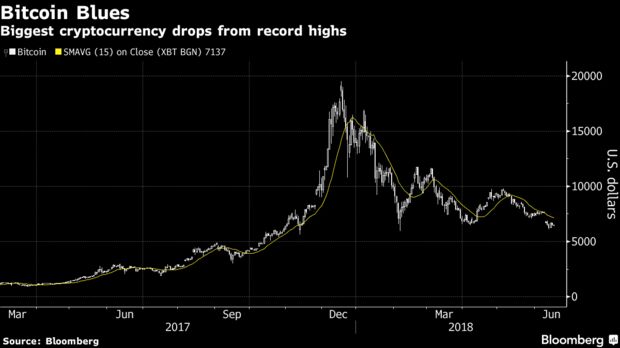
The BIS is weighing in at pivotal moment in the cryptocurrency story. Even as Goldman Sachs Group Inc., the New York Stock Exchange, and other institutions take steps to offer clients access to the new marketplace, the U.S. Securities and Exchange Commission is cracking down on the offerings of new digital tokens, which it has found are rife with ripoffs. At the same time, cyber-attackers are hitting crypto exchanges regularly -- just last week, Bitcoin nosedived after a South Korean exchange reported it was hacked. It fell 0.8 percent to $6,449 as of 11:19 a.m. in New York on Monday.

The report may also revive concerns that for all its ingenuity, blockchain transactions will get harder and harder to protect as it scales up. When this decentralized anonymous system was introduced in 2009, it quickly proved it could secure purchases by computer enthusiasts, networks of friends, as well as criminals in the digital black market, says a working paper published by the National Bureau of Economic Research, a non-profit organization in Cambridge, Massachusetts. Yet with supporters pushing to make it a mass market platform utilized by companies and governments, it may become too expensive to secure, concludes Eric Budish, the paper’s author and an economics professor at the University of Chicago Booth School of Business.
The value of the cryptocurrency market has plunged 53 percent this year to $280 billion, according to CoinMarketCap.
Some Benefits
The BIS did say that blockchain and its so-called distributed ledger technology did provide some benefits for the global financial system. The software can make sending cross-border payments more efficient, for example. And trade finance, the business of exports and imports that still relies on faxes and letters of credit, was indeed ripe for the improvements offered by Blockchain-related programs.
LISTEN TO ARTICLE
4:01
In one of its most poignant findings, the BIS analyzed what it would take for the blockchain software underpinning Bitcoin to process the digital retail transactions currently handled by national payment systems. As the size of so many ledgers swell, the researchers found, it would eventually overwhelm everything from individual smartphones to servers.
“The associated communication volumes could bring the Internet to a halt,” the report said.
The BIS is weighing in at pivotal moment in the cryptocurrency story. Even as Goldman Sachs Group Inc., the New York Stock Exchange, and other institutions take steps to offer clients access to the new marketplace, the U.S. Securities and Exchange Commission is cracking down on the offerings of new digital tokens, which it has found are rife with ripoffs. At the same time, cyber-attackers are hitting crypto exchanges regularly -- just last week, Bitcoin nosedived after a South Korean exchange reported it was hacked. It fell 0.8 percent to $6,449 as of 11:19 a.m. in New York on Monday.
The report may also revive concerns that for all its ingenuity, blockchain transactions will get harder and harder to protect as it scales up. When this decentralized anonymous system was introduced in 2009, it quickly proved it could secure purchases by computer enthusiasts, networks of friends, as well as criminals in the digital black market, says a working paper published by the National Bureau of Economic Research, a non-profit organization in Cambridge, Massachusetts. Yet with supporters pushing to make it a mass market platform utilized by companies and governments, it may become too expensive to secure, concludes Eric Budish, the paper’s author and an economics professor at the University of Chicago Booth School of Business.
The value of the cryptocurrency market has plunged 53 percent this year to $280 billion, according to CoinMarketCap.
Some Benefits
The BIS did say that blockchain and its so-called distributed ledger technology did provide some benefits for the global financial system. The software can make sending cross-border payments more efficient, for example. And trade finance, the business of exports and imports that still relies on faxes and letters of credit, was indeed ripe for the improvements offered by Blockchain-related programs.
Still, the institution concluded that Bitcoin’s great breakthrough, the ability of one person to send something of value to someone else with the ease of an email, is also its Achilles heel. It’s simply too risky on a number of levels to try and run the global economy on a network with no center.
“Trust can evaporate at any time because of the fragility of the decentralized consensus through which transactions are recorded,” the report concluded. “Not only does this call into question the finality of individual payments, it also means that a cryptocurrency can simply stop functioning, resulting in a complete loss of value.”
bloomberg.com
( editorial notes by JJP.... with both the BIS, the Central Bank to the world's central banks,
and the US regulators clamping down...... the great cryptocurrency mania continues to winddown.... I am doubling down on my call for $800..... this may work out the way Ampex ,worked out when it was a nifty fifty stock.. in the early 1970's.....
Be sure to have a quick review of the technical outlook for BTC........
Message 31657722
JJP |



