Nope; just the opposite.
Newly Disclosed FISA Applications Disprove 'Witch Hunt' Claims From Trump, Nunes
By Chas Danner
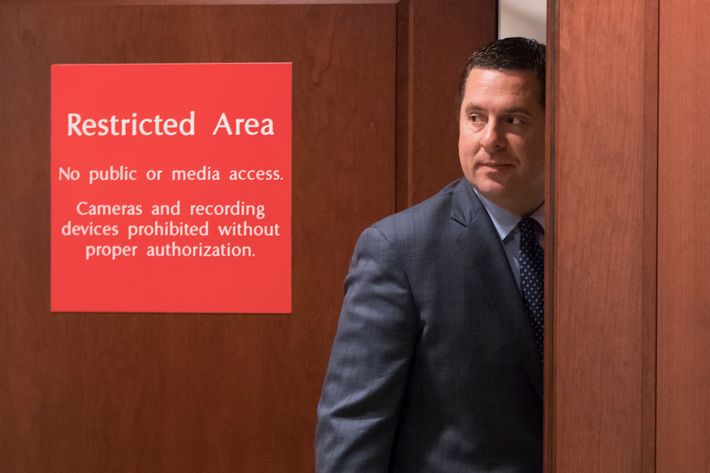
Assembling credible evidence is also restricted in Devin Nunes’s committee, apparently. Photo: J. Scott Applewhite/AP
The controversial FISA applications to wiretap former Trump campaign adviser Carter Page have been made public, and from what details remain in the heavily redacted documents, they contradict one of the Trump camp’s central “witch hunt” theories regarding the Russia investigation. On Saturday, the Justice Department released the original October 2016 FISA warrant to tap Page, who federal investigators suspected of working with Russia, as well as subsequent applications to renew that warrant. The documents were put out in response to Freedom of Information Act requests, but it was the first time the government has ever released such information to the public.
Back in February, Devin Nunes, the Republican chairman of the House intelligence committee, published an overhyped memo alleging misconduct from federal investigators in their pursuit of a warrant to monitor Page. Nunes’s allegations, which focused primarily on the idea that the FBI had misled the FISA court, have been held up by the president and his allies as evidence that the Trump campaign was unfairly and unlawfully targeted by the Obama administration and intelligence community. The GOP-orchestrated memo, which was opposed by Democrats on the House intelligence committee as well as the Trump-appointed director of the FBI, armed the president with a powerful weapon in his efforts to discredit special counsel Robert Mueller’s investigation into Russia’s pro-Trump election interference. More broadly, the allegations conveniently provided much needed fuel to the right-wing conspiracy theory, heavily supported and promoted by the president, that “deep state” elements of the U.S. government have been working against Trump from the start.
Democratic lawmakers later published their own memo rebutting Nunes’s allegations point by point, arguing that Nunes had omitted or mischaracterized essential details contained in the warrant applications in an attempt to defend Trump. The newly released FISA applications support that conclusion.
President Trump, meanwhile, claimed the exact opposite on Sunday morning in a series of tweets about the “FISA scam which led to the rigged Mueller Witch Hunt!” To Trump, who issued another attack on his own Justice Department and implied that its redactions had some nefarious purpose, the Page documents proved Nunes right. Trump is unlikely to have actually read or attempted to understand the FISA applications then or now. But no matter — everything is a smoking gun to the president when it comes to his obsession with discrediting the Russia investigation.
Carter Page, or repeatedly referred to as a Russian agent in the warrant applications, agrees with the president. During a CNN interview on Sunday, the former Trump adviser dismissed the allegations in the FISA warrants and reasserted his innocence — though he did also acknowledge that he was once an “informal adviser” to the Kremlin.
The most notorious claim of the Nunes memo was that the FBI failed to properly disclose that one of the sources cited in the original warrant application, former British spy Christopher Steele, was hired by Trump’s political opponents. According to the Nunes memo, the FBI didn’t “disclose or reference the role of the DNC, Clinton campaign, or any party/campaign in funding Steele’s efforts, even though the political origins of the Steele dossier were then known to senior and FBI officials.”
Democrats had later said that the FBI did acknowledge that the source’s employers were working against Trump, and sure enough, it seems Nunes left that detail out:
In his write-up of the applications for the New York Times, Savage also explains that, looking at the document, it’s clear that the government worked to hide any Americans’ names in the application, including Trump’s, who is referred to as “Candidate #1.” That appears to counteract one of Nunes’s other complaints — that the FBI should have specifically disclosed who hired the source, as if that would make more of a difference to the court than acknowledging that Steele’s employers were “likely looking for information that could be used to discredit [the Trump] campaign.”
The documents also refute another erroneous point often made by Trump’s allies — that the Steele dossier formed the sole basis of the application to put a tap on Page. It didn’t. The applications also weaken their claims of partisan bias, since the documents confirm that all four judges who signed off on the Page warrants were not only appointed by Republican presidents, but named to the FISA court by the GOP-nominated chief justice of the Supreme Court, John Roberts.
At Lawfare, FISA expert David Kris has offered his own interpretation of the applications, including some emphasis on how unprecedented it was that the Department of Justice had released them at all. Kris explains that making the documents available was a “monumental disclosure,” adding that “the government considers FISA applications to be very sensitive — and their disclosure, even heavily redacted, may have long-term, programmatic consequences long after we’re finished with President Trump.”
Kris has previously argued that the purpose of the Nunes memo was to deceive the American public, and he says the memo looks even worse once you go through the unredacted parts of the FISA applications. But anyone hoping for more detail about what Mueller and his investigators know, he adds, will probably be disappointed:
While I am sure people will try, my initial impression is that with all the redactions it is going to be very tough to figure out the full scope of information supporting the Court’s repeated finding of probable cause to believe that Carter Page was an agent of Russia. There is a mention of two Russians, one of whom pleaded guilty to being an unregistered agent of a foreign government and was sentenced to 30 months, but even that is disconnected from the redacted discussion that precedes it. Substantively, the government seems to have hewed as closely to the prior disclosures as it could in applying FOIA.
The redactions also appear to indicate that the government was able to obtain useful evidence using its wiretaps of Page, as that information seems to have been referenced in the successful applications to renew the FISA warrant.
Trumpworld vastly oversold the Nunes memo as definitive proof of a significant plot against the president, then underdelivered, yet the allegations became part of the canon of misinformation that’s been used to attack the Justice Department, the Mueller investigation, and Democrats ever since.
Analysts like Kris warn of “significant collateral damage to essential elements of our democracy” on account of the fiasco, but neither the Nunes memo nor its debunking is likely to move opinion polls or result in meaningful pressure on the GOP. The president, along with most of his supporters and allies, surely believed the memo’s claims sight unseen, and efforts — like Trump’s Sunday tweets — to falsely reframe the FISA applications will probably be repeated and accepted in that crowd.
The real proof offered by the FISA applications is that key Republican lawmakers like Devin Nunes are willing to blatantly abuse their power to protect the president. Nunes’s trumped-up allegations, like his absurd attempt to clear the president of wrongdoing afterward, demonstrates not just sycophancy, but culpability. The Nunes memo isn’t the cudgel or ladder Trump’s allies think it is — it’s a mirror. |



