BOMBSHELL: Current heat waves are linked to climate change, scientists confirm; Climate change has made the extremely high temperatures in Europe more than twice as likely to occur, a new analysis has revealed.
dw.com

Record-breaking temperatures of up to 39 degrees Celcius (102.2 degrees Fahrenheit) in Germany; out-of-control wildfires in Sweden and other typically cool northerly regions; and a toxic algae outbreak in the warmer than usual Baltic Sea in Poland — Europe is sweltering in the current heat wave.
With the extreme high temperatures continuing in most parts of Europe, people are asking: Is climate change to blame?
Scientists say yes.
"Climate change has generally increased the odds of the current heat wave more than two-fold," said Geert Jan van Oldenborgh, a researcher at the Royal Netherlands Meteorological Institute.
He is part of World Weather Attribution (WWA), a network of scientists in six institutions established to provide near-real-time analysis of possible links between climate change and extreme weather events.
A WWA team has analyzed the current heat wave in northern Europe and presented preliminary results on Friday.
 To stay cool in record-high temperatures, you can follow the example of this little boy: play at a fountain To stay cool in record-high temperatures, you can follow the example of this little boy: play at a fountain
How do scientists connect specific weather events to climate change?
Pinning down blame for complex weather events isn't straightforward, due to the numerous variables involved, from water temperature to air pressure.
But thanks to state-of-the-art climate models, scientists can now calculate the likelihood of individual extreme weather events having happened due to climate change.
Read more: Climate change and extreme weather: Science is proving the link
Like how epidemiologists link smoking to cancer, climate scientists work with statistical probability.
"Smoking is never the only reason — but it increases the likelihood to develop cancer," Friederike Otto, researcher at the Oxford University's Environmental Change Institute and member of the WWA, told DW.
To determine the likelihood that an individual extreme weather event is caused by climate change, scientists estimate what the probability of a particular extreme event would be in the climate of today, versus in the climate of a world free of human-caused greenhouse gas emissions.
We've already warmed the globe by about 1 degree Celsius, compared to pre-industrial times.
By comparing the results of these two scenarios, scientists can attribute any differences in probability of the extreme event to human-caused climate change.
With this method, the WWA network has already shown that climate change made Hurricane Harvey in 2017 three times as likely to happen, the Lucifer heat wave that swept southern Europe in 2017 four times as likely to happen, and did not change the likelihood of the 2014 Sao Paolo drought taking place.
 The banks of the river Rhine in Düsseldorf have cracked due to dryness The banks of the river Rhine in Düsseldorf have cracked due to dryness
How did they calculate the probability of climate change causing the current heat wave?
The WWA researchers compared the currently high temperatures with historical records at seven weather stations in northern Europe — two in Finland and one each in Denmark, the Irish Republic, the Netherlands, Norway and Sweden.
The weather stations were selected for practical reasons. Current temperature data could be accessed in real time, and all of them had digitalized records extending back to the early 1900s.
For each year in the historical record, the scientists looked at the hottest consecutive three days. For 2018, they took the hottest three days of the year so far.
They then fed their the datainto climate models, and compared the results of the world today with the world from the past when greenhouse gas emissions were much lower.
In the case of Copenhagen, the group found that a heat wave like the current one occurs every seven years in our current world. But in a world without manmade climate change, such a heat wave as this one occurs only every 35 years.
 Even dogs seek refreshment during the current heat wave Even dogs seek refreshment during the current heat wave
"We can thus say climate change increased the likelihood of the event to occur by a factor of ten [in the case of Copenhagen]," Otto told DW.
Compiling all the results from the seven analyzed weather stations across Europe, the scientists found that the probability of such heat waves is overall twice as probable today than if human activities had not altered the climate.
The results are not yet peer-reviewed, because the WWA scientists are aiming to provide a quick analysis of current extreme weather events since public interest is high. They do plan to publish the results formally in a scientific journal, as they have done with previous analyses.
Why is it important to attribute specific extreme weather events to climate change?
Climate change is an abstract topic with abstract measures, for example the increase of the average global temperature on Earth.
But people don't experience average temperatures; they experience heavy rainfall (including flooding), heat waves, severe storms and droughts, researchers point out.
Listen to audio05:33
What climate change means for agriculture
"It's very important to provide illustrations of the effects of climate change," Robert Vautard, a senior scientist with France's Laboratory for Climate and Environment Sciences, told DW.
Only when we undestand what climate change looks like can we can prepare for it, he thinks.
After the deadly heat wave in 2003, which resulted in the death of 15,000 people in France alone, the French government created an emergency plan to deal with future heat-related health problems.
But experts believes their plan might already be outdated.
"Our infrastructure and healthcare plans are based on heat waves and rainfall we have witnessed in the past. But we have to realize that the climate today is not the same it used to be, and it will be very different in the future," Vautard added.
Lawmakers in the United Kingdom, where unusual high temperatures of more than 30 degrees Celsius were recorded last week, face a similar fear.
They have warned that premature deaths from heat waves could triple by 2050, and call upon the government to develop a strategy to protect the health of the public.
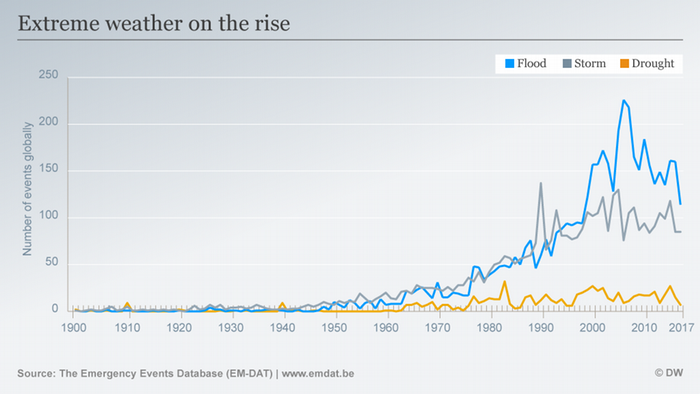
Will we see more extreme weather events in the future?
Climate scientists almost universally agree: Yes.
"Extreme heat events like this one will become more frequent and more intense as the globe continues to warm," Andrew King, a researcher at the ARC Centre of Excellence for Climate Extremes at the University of Melbourne, told DW.
"We know that heat waves and hot summers, like the infamous hot summer of 2003 in Europe, will very likely occur in most years, even under only 2 degrees Celsius of global warming," he added.
The Paris Climate Agreement seeks to limit global warming between 1.5 and 2 degrees Celsius but on our current track, we are moving towards 3 degrees warming.
The climate is not just getting hotter — it's getting less predictable.
Variability of extreme weather events will increase, confirmed climate scientist Otto. While we may one year see heat waves, the next year we could experience extreme rainfall. And the picture can look very different from location to location.
"The dangerous thing about climate change is that what we are not adapted to the changes," said Otto.
Beyond the urgent current need to limit global warming to under 2 degrees Celsius, learning to adapt quickly to extreme weather events will be a great challenge for the future.

SOARING TEMPERATURES, WILDFIRES SCORCH EUROPEEurope strips offSummer 2018 began as a welcome break from Europe's often-unpredictable weather, and people took advantage of the constantly warm temperatures to spend more time outside. The heat was especially a boon for pubs and bars where fans congregated to watch the soccer World Cup. But as temperatures climbed to up to 39 Celsius, the heat wave's negative effects began to be felt across the continent.
1 2 3 4 5 6 7 8 9
DW RECOMMENDS
Germany swelters under heat waveHigh temperatures and a prolonged drought are disrupting daily life in Germany. Ship cargo on the River Rhine has been reduced by half and fish populations have been threatened by high water temperatures. (26.07.2018)
Swimmers warned against Baltic Sea as German heat wave approachesThe Baltic Sea's warmer waters have brought an increased risk from the vibrio bacteria. Health officials in the northeast of Germany have warned vulnerable people against bathing in coastal waters. (24.07.2018)
Sweden now fighting 50 wildfires as EU nations rush water bombersAfter Italy and Norway sent helicopters and planes, other neighbors have pledged help to douse dozens of forest fires across Sweden. Authorities have said some of the blazes are "impossible to extinguish." (20.07.2018)
The global heat wave that's been killing usA heat wave is ravaging countries around the world. Although many celebrate sunny days, wildfires, wasted crops and health problems are some of the many disastrous consequences hot weather can have. (18.07.2018)
How can cities adapt to a hotter climate?As the world is battling with extreme heat, researchers from the United Nations University in Bonn are going from door to door to find out what it will take for societies to adapt to a hotter climate. (25.07.2018)
Will extreme weather become even deadlier?Flooding in Japan and a heat wave in Canada have killed hundreds. With extreme weather causing unimaginable disasters, and extreme weather events on the rise, some experts believe many more could die if nothing is done. (12.07.2018)
Climate change and extreme weather: Science is proving the linkPinning down blame for complex weather events isn't straightforward. But cutting-edge science is rapidly shrinking the space to argue that the crazy weather we're experiencing isn't due to greenhouse gas emissions. (11.04.2018)
1.5C degree goal 'extremely unlikely' – IPCCA draft report from the IPCC says only huge and rapid change in the way we live can keep global warming below 1.5 degrees Celsius, the lower limit set out by the Paris Agreement. Reactions to the leaked paper vary. (15.01.2018)
You won't stop climate change on your own — demand action!Most of us do things every day that contribute to climate change, and changing our behavior is vital. But we won't get anywhere acting alone. And that's where you come in. (22.12.2017)
More storms and flooding: How we'll need to adapt to extreme weatherCurrent storms and flooding in Germany and France are a glimpse of what's to come as climate change sets in and extreme weather becomes the norm. It's too late to stop, so we'll have to live with it - but how? (03.06.2016)
Soaring temperatures, wildfires scorch EuropeRecord-breaking temperatures of up to 38 Celcius have caused deadly wildfires, water shortages and damaged crops. Initially seen as a refreshing change, many Europeans now say the heat wave can't end soon enough. (28.07.2018)
WWW LINKS
Study: Climate change and Hurricane Harvey
Study: Climate Change and Drought in Sao Paolo
World Weather Attribution analysis: Heat wave in Europe linked to climate change
AUDIOS AND VIDEOS ON THE TOPIC
Living Planet: Drought puts German farmers under pressure
What climate change means for agriculture
Date 30.07.2018Author Katharina WeckerRelated Subjects Climate Change, Environment, Extreme weather, COP23, Data journalismKeywords environment, heat wave, climate change, global warming, extreme weatherFeedback: Send us your feedback.Print Print this pagePermalink p.dw.com
RELATED CONTENT

Great southern drought: Australian farmers crippled, climate action stalled 09.08.2018Amidst the worst drought in living memory, the world's driest continent is also heating up due to climate change. Critics say too little is being done to prevent increasing temperatures and decreasing rainfall.

Dying fish and drying rivers — consequences of Europe's summer heat wave 10.08.2018Over the past week, dead fish have been pulled out of Germany's rivers and lakes by the ton — the extreme heat and a lack of rain have proven too much for them. Global warming is among factors altering fish habitat.

Portugal breaks temperature records as European heat wave sizzles on 03.08.2018Eight locations in Portugal have hit their highest-ever temperatures amid a heat wave across Europe. Two people are reported to have died in neighboring Spain of heat-related causes.
Date 30.07.2018Author Katharina WeckerRelated Subjects Climate Change, Environment, Extreme weather, COP23, Data journalismKeywords environment, heat wave, climate change, global warming, extreme weather Send us your feedback.Print Print this pagePermalink p.dw.com
AUDIO

Subscribe to DW's environment podcastDW's half-hour radio show and podcast Living Planet makes the environment matter to you.
MORE ENVIRONMENT
Welcome to eco@africa
On this week's eco@africa, we check out an innovative net that harvests water from fog, visit one of the largest ape conservation projects in Africa, and meet an eco hero trying to save Nigeria's wildlife.
Counting critters: Germans invited to join first insect census
Welcome to the latest edition of eco@africa
Can businesses learn from forests?
GLOBAL IDEAS

Forest-saving honeyClear and farm, that's what living in the Selva Maya used to be about. But now there is an alternative.
ECO@AFRICA

Fishing for cloudsWater is precious in one of Morocco’s driest regions. But a innovative net harvesting fog helps boost its water supply.
SCIENCE AND TECHNOLOGY
DW's Health News: weekend sleep-ins could prolong your life
Left-handed, left-footed, left-kissing?
Is your mobile phone damaging your brain?
Parker Solar Probe: Diving into the solar atmosphere
BUSINESS
Turkish economic shadow looms over Europe and beyond
Musk reveals one driver behind taking-Tesla-private plan
Opinion: The Turkey crisis: A threat to Europe's economy?
Bayer shares plunge on M |



