If Trump’s Voters Turn Out This Fall, They’ll Give Republicans A Big Senate Majority
In the small-town and rural Midwest, the Republican margin of victory over the Democratic presidential candidate increased to 28.8 percent in 2016 from 12.4 percent in 2012.
By Thomas Mitchell
AUGUST 13, 2018
thefederalist.com
Hillary Clinton ruled the big Midwestern cities and suburbs in 2016, often surpassing Barack Obama’s 2012 margins of victory in places like Hamilton County, Ohio (Cincinnati) and Hennepin County, Minnesota (Minneapolis.) But in every Midwestern state, the small towns and countryside gave Donald Trump much higher victory margins than they gave Mitt Romney in 2012.
The small-town and rural Midwest gave Hillary 20 percent fewer votes than Obama received in 2012, and gave Trump 13 percent more votes than they did Romney. The GOP smaller-town victory margin increased an astonishing 130 percent for the nine Midwestern states in aggregate. The “Small–Town and Rural” vote is defined as all voters not in major cities, suburbs, or established “blue collar” industrial counties, not places where media heavies or the donor class live.
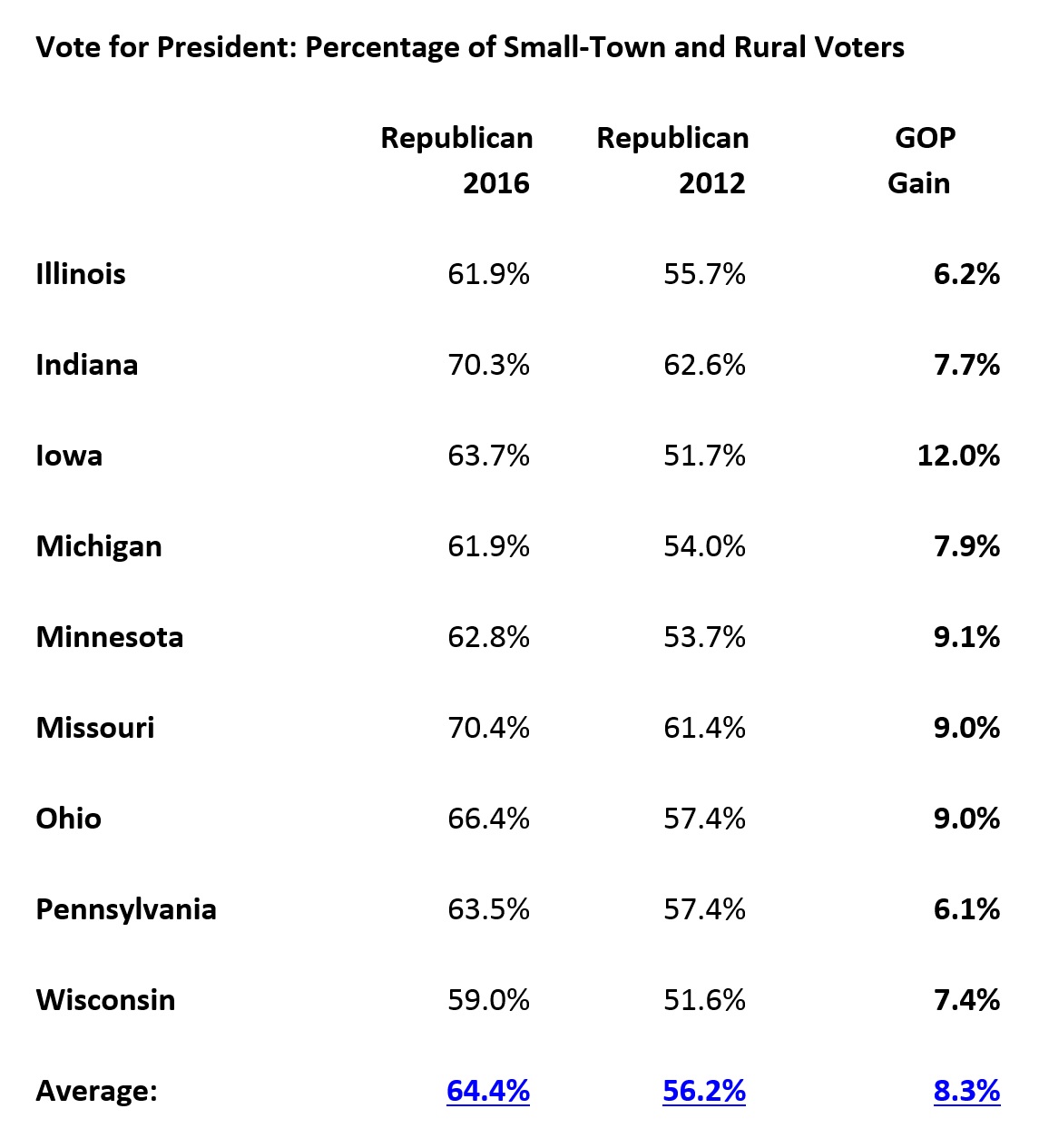
In the small-town and rural Midwest, the Republican margin of victory over the Democratic presidential candidate increased to 28.8 percent in 2016 from 12.4 percent in 2012. Trump won seven of the nine Midwestern states, and was very competitive in Minnesota. Only Illinois, with a heavy 70 percent weighting in the total vote from the city of Chicago and from the Chicago and St. Louis suburbs, was a smooth win for Hillary Clinton. (All percentages are shown as between the two top candidates. 64.4% – 35.6% = 28.8%; 56.2% – 43.8% = 12.4%.)
Here’s the popular and electoral vote “small town and rural” voter impact in 2016, with the “switch states” from 2012 separated.
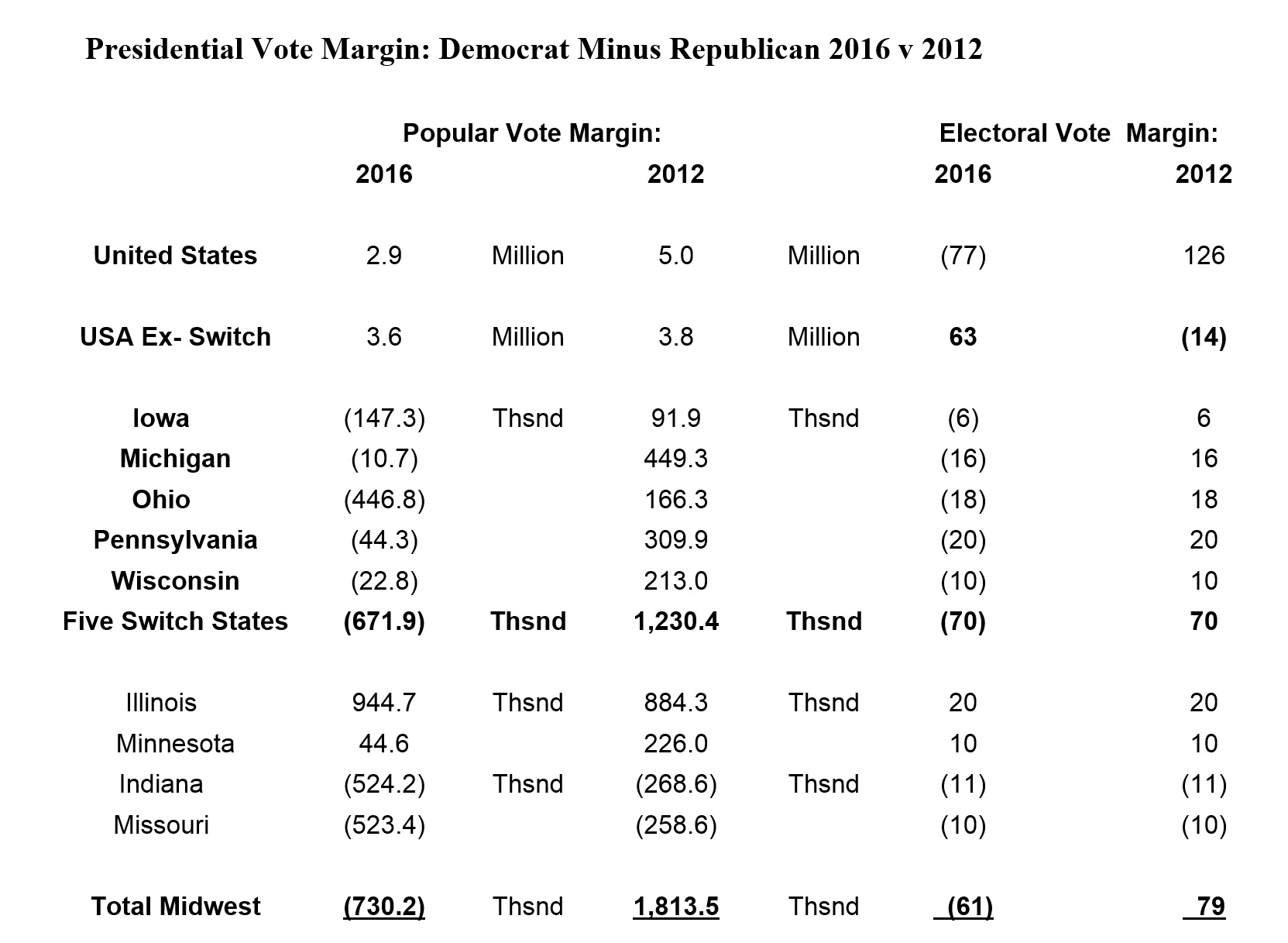
The 70 Midwest electoral votes Obama won in 2012 and Clinton lost in 2016 sum up the entire presidential election. That swing of 140 electoral votes — 70 lost for Democrats plus 70 won by Republicans — destroyed Clinton’s chances of becoming president. For the nine Midwestern states, in 2016 more than 2.5 million votes effectively switched from Democrat to Republican (730.2 + 1813.5 = 2,543.7.)
Eight Midwestern Democratic Senate seats are on the ballot in 2018. There’s no guarantee that the small-town and rural shift will extend into 2018, but if it does, at least five Midwestern Democrat senators look very vulnerable. Tactically, both Democratic and GOP Senate campaign managers need to allocate significant time and resources to reaching these voters this November.
By definition, small-town and rural voters need to be reached using old-fashioned “retail politics” — barbecues, state fairs, local volunteers enthusiastically recruiting other locals, going on the 5:30 a.m. crop and commodities report radio programs, getting ink in the sub-regional weeklies and holding big parties and other events in county seats. While presidential campaigns may think they can afford to bypass these “old-hat” methods, Senate candidates do not have the same luxury. Clinton recognized this very clearly when she ran for the Senate in New York in 2000, in her first bid for elective office.
There Are Plenty of Obstacles to This Outcome
All the early readings so far — special elections, voter participation in primaries — have signaled that 2018 will be a typical midterm election, with the out-of-power party gaining seats in Congress. Furthermore, centrist Democrats have generally been primary winners so far, while non-establishment Trump loyalists have won in the GOP primaries, raising the threshold of difficulty for Republican success in the mid-terms.
There is also the question of the “Hillary Effect” in the 2016 vote. No one can say with confidence how many small-town and rural Midwest voters positively preferred Trump, and how many Democrats and Independents felt the Hillary Aversion Syndrome. Sen. Bernie Sanders won the 2016 Wisconsin primary and Minnesota caucus with outsized majorities, and small-town and rural voters in both states showed very strong shifts away from the Democrat at the top of the ticket in November.
So did Iowa, where Hillary and Bernie ended in a dead heat in the nation’s first caucus vote, despite Hillary’s overwhelming support from the established machinery of the Democratic Party, including near-total control of the finances of the Democratic National Committee starting in the summer of 2015.
The smaller-town and rural voter is a “wild card” in this year’s midterm elections. Neither party can be sure exactly who the 2016 switch voters are, or even what they want today. If they were “change” voters in 2016, are they ready to go to the sidelines and see how Trump does in the next two years, with or without a Congress loyal to him? How many are eager to give him what he’s asking for?
None of the by-elections or primaries so far has directed any light onto smaller-town and rural voters’ preferences this year. The dead heat in the Aug. 7 vote in Ohio’s 12th Congressional District, which includes parts of Columbus, is not even a leading indicator. Columbus’ Franklin County gave Clinton a 152,000-vote margin over Trump, versus Obama’s 130,000-vote margin over Romney.
Urban and suburban voters in Minnesota, Ohio, Pennsylvania, and Wisconsin gave Hillary more than 60 percent of their votes versus Trump. Only one — Minnesota — gave her its electoral votes. It was the “downstate” or “upstate” voters who won the other three for Trump. If these voters come back to the polls in a similar frame of mind in 2018, Midwest Democrats are in trouble.
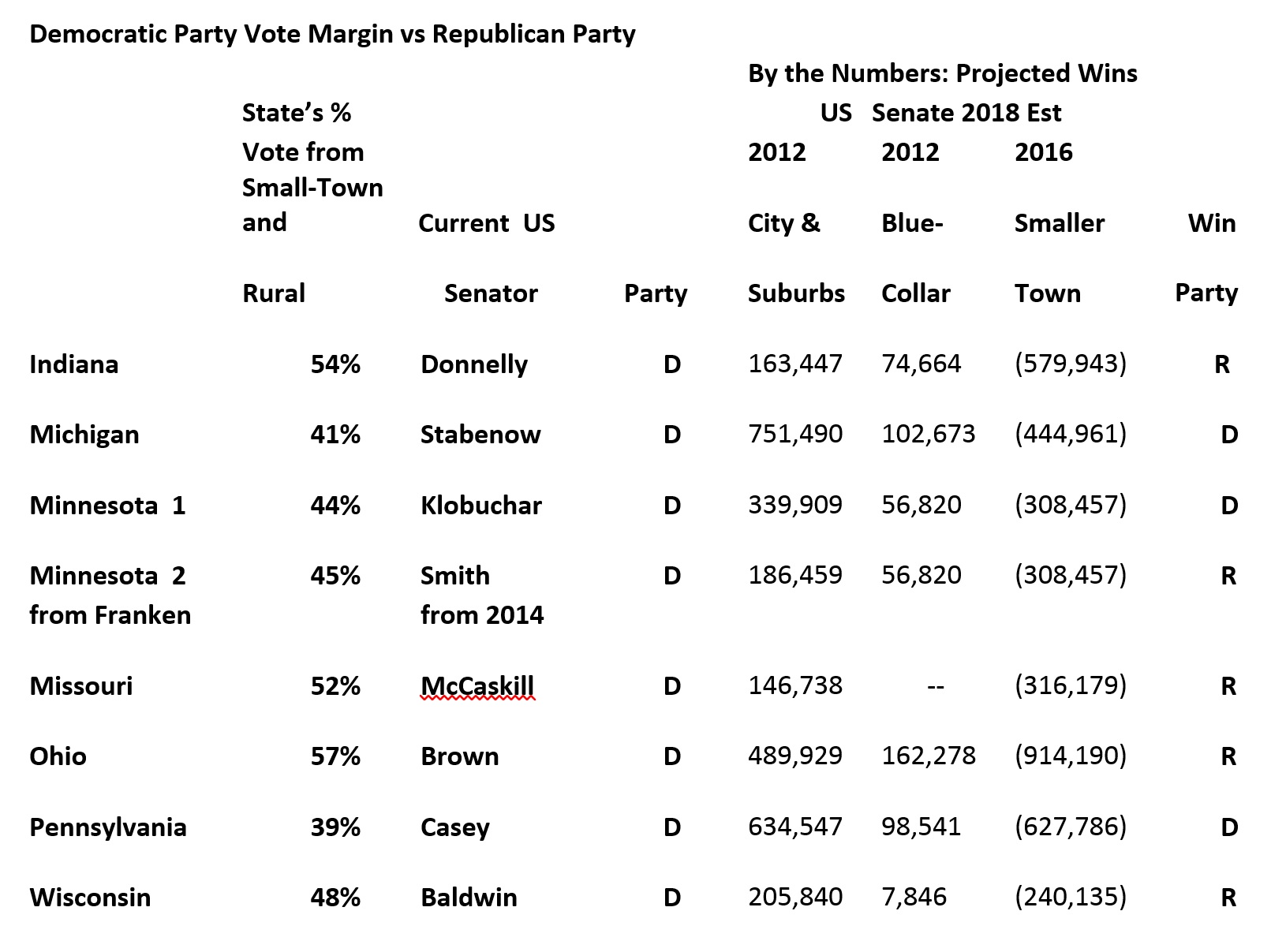
Only Debbie Stabenow in Michigan looks like a landslide winner based on this analysis. She ran more than 200,000 votes ahead of President Obama in 2012, and nearly 300,000 ahead of Obama in smaller-town and rural Michigan.
In Minnesota, where two Senate seats are in play, both Amy Klobuchar and Tina Smith, who replaced Al Franken, would face close votes if Minnesota’s smaller-town voters continue as they voted in 2016. Similarly, Sherrod Brown in Ohio, Tammy Baldwin in Wisconsin, and Claire McCaskill in Missouri would likely lose if those voters come back this year.
Joe Donnelly looks almost certain to lose in Indiana at this point. Bob Casey’s continued career in the Senate appears to depend on his winning back the blue-collar voters who deserted Hillary Clinton in 2016.
Not every election goes by the numbers: incumbency, a willingness to chase after every voter in every village, hamlet, and farm community, and likable personalities can often give a popular incumbent a significant edge in a statewide race. The Midwestern voter shift that was so dramatic in 2016 may prove to be sharply watered-down in the 2018 midterms. However, this is not an excuse for Democrats’ campaigns to relax or become complacent.
Focusing the 2018 statewide elections on Trump may not succeed for Democrats. It certainly killed Hillary’s momentum to devote so much time to her opponent’s weaknesses, because it left so little time to emphasize her own strengths. Democrat campaign managers need to overcome the backlash Hillary encouraged.
Whatever they do, incumbent Midwest Democrats cannot afford to believe their press clippings. My estimates of probabilities diverge significantly from those of leading pundits, as shown below.
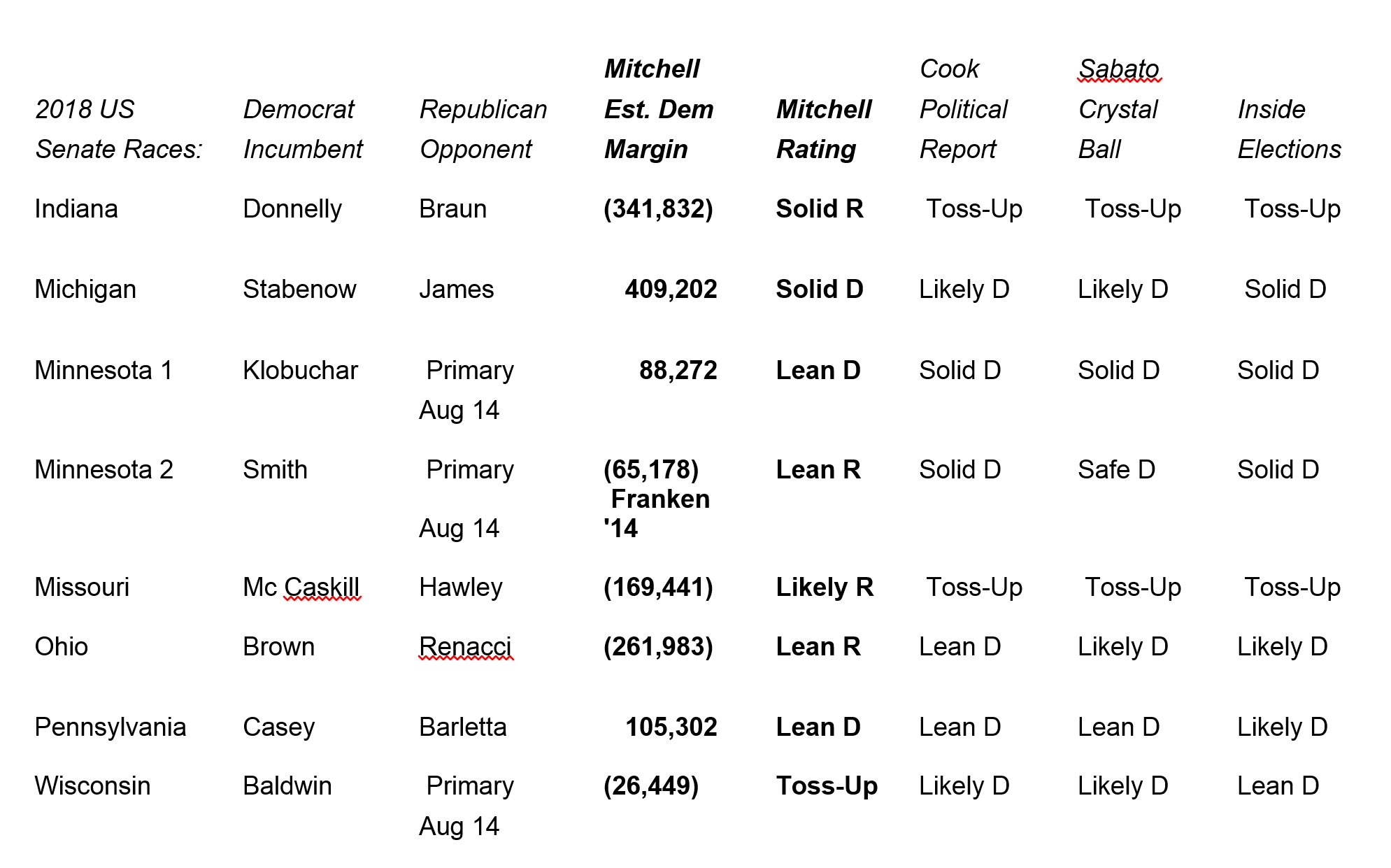
Mainstream analysts see six Midwestern Democrats leading and two in toss-ups. I see only three Democrats leading if the small-town and rural vote goes as it did in 2016, with four Republicans leading, and one toss-up.
This is what makes horse races, commodity markets, and sudden-death overtimes. Someone has to win. Midwest Democrats, hit the state fairs. Midwest Republicans, you better get your new majority back into the polling booths.
A top financial-industry investment research analyst from 1973 to 2015, Tom Mitchell published highly regarded “action recommendation” research. In the 2004-15 period, Mitchell was named the number one stock-picker for two different financial industries. |



