re gold ... and silver ... a hint of a glimmer of positive, and hopefully, not-fake news
i admit i have not a clue of what below is all about, but suspect the key idea is the last bits <<The ability to arbitrarily tune their optoelectronic properties would have a significant impact on their performance," he said.
This work also has broader economic implications due to the possibility of replacing high-cost metals with low-cost and earth-abundant ones. Though gold is immediately recognizable as a precious and expensive metal, copper and aluminum are much more readily available. Leite and her colleagues are now looking into how they can incorporate alloys using these metals into high-performance optical devices>>
other than 1/2 of world aboveground gold permanently tainted w/ radiation, nothing better than weaponising gold to defend the peace
i hope the boyz can find enough gold to get the job done, for i understand 2 olympic regulation size swimming pools of volume in gold is not a lot even nano-tech bits, and i am guessing paper gold would not allot well :0)
phys.org
Army research lights the way for new materials
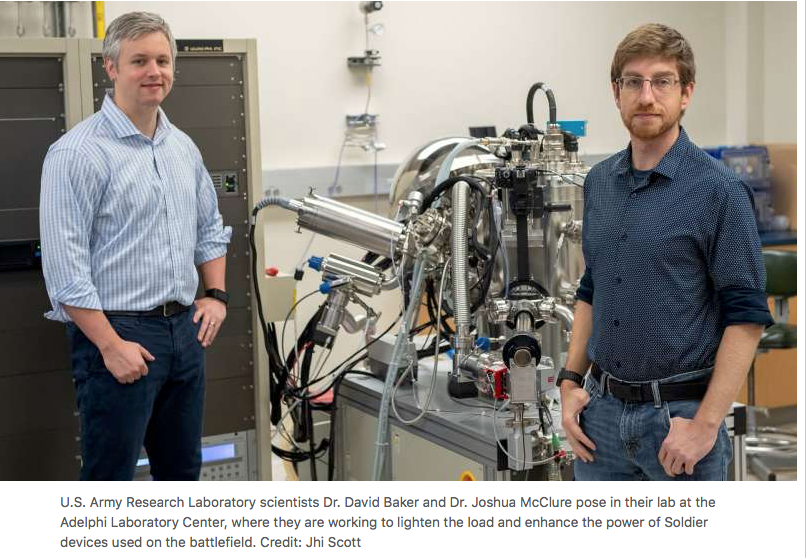
What happens when gold and silver just don't cut it anymore? You turn to metallic alloys, which are what Army researchers are using to develop new designer materials with a broad range of capabilities for our Soldiers.
This is exactly what scientists Dr. David Baker and Dr. Joshua McClure from the U.S. Army Research Laboratory are doing to lighten the load and enhance the power of Soldier devices used on the battlefield.
Their research, conducted in collaboration with Prof. Marina Leite and Dr. Chen Gong at the University of Maryland and Prof. Alexandre Rocha at the Universidade Estadual Paulista in Brazil, was recently featured on the cover of the Sept. 4 issue of Advanced Optical Materials.
The research paper, "Band Structure Engineering by Alloying for Photonics," focuses on control of the optical and plasmonic properties of gold and silver alloys by changing alloy chemical composition.
"We demonstrated and characterized gold/silver alloys with tuned optical properties, known as surface plasmon polaritons, which can be used in a wide array of photonic applications," Baker said. "The fundamental effort combined experiment and theory to explain the origin of the alloys' optical behavior. The work highlights that the electronic structure of the metallic surface may be engineered upon changing the alloy's chemical composition, paving the way for integration into many different applications where individual metals otherwise fail to have the right characteristics."
The research focused on combining experimental and theoretical efforts to elucidate the alloyed material's electronic structure with direct implications for the optical behavior.
According to the researchers, the insights gained enable one to tune the optical dispersion and light-harvesting capability of these materials, which can outperform systems made of individual elements like gold.
"The insights of the paper are useful to Soldiers because they can be applied to a variety of applications including, but not limited to: photocatalytic reactions, sensing/detection and nanoscale laser applications," McClure said. "When tuned properly, the integrated alloyed materials can lead to reductions in the weight of energy harvesting devices, lower power requirements for electronics and even more powerful optical sensors."
The researchers are currently looking at other metallic alloys and anticipate that their combined experimental and computational approach may be extended to other materials, including nonmetallic systems.
"The field of plasmonics enables potentially paradigm shifting characteristics with applications to the warfighter; this includes everything from computation, to energy harvesting, to communication, and even directed energy," Baker said. "However, researchers in these fields are limited to a handful of elements on the periodic table; gold and silver are two of the most commonly studied. This lack of options limits the available properties for technology development. By knowing the fundamental optical and electronic properties of alloys, we can develop new designer materials with a broader range of capabilities."
For the researchers, having their work selected to be on the cover of the journal is very exciting personally and professionally, and brings to light what they are developing for the success of the future Soldier.
They noted that this acknowledgement highlights that the broader scientific community recognizes the value of their contributions and research direction, and it is clear that their methods and alloyed materials are becoming increasingly more important and relevant for a variety of photonic applications.
Explore further: Scientists blend coinage metals to obtain alloys better than gold
More information: Chen Gong et al, Band Structure Engineering: Band Structure Engineering by Alloying for Photonics, Advanced Optical Materials (2018). DOI: 10.1002/adom.201870066
phys.org
Scientists blend coinage metals to obtain alloys better than gold
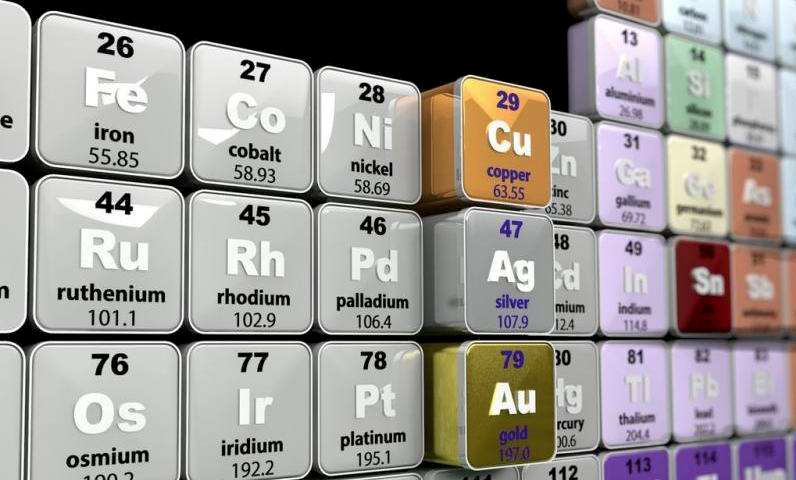
A peer-reviewed paper based on the study was published recently on the cover of the journal ACS Photonics.
Previous work on tuning the amount of light materials absorb has been constrained by the inherent properties of pure metals.
"Think about sunlight catching the silver of your wristwatch and projecting those little dancing dots on the wall next to your desk. The wavelengths of light needed to produce that effect are always within the same range. This is called a pre-determined optical response, and it has limited researchers' ability to change how much light is absorbed in a device made of pure metals such as gold, silver, and copper," explained Marina Leite, assistant professor of materials science and engineering at UMD and corresponding author of the paper.
To overcome this limitation, Leite and Chen Gong, a graduate student at UMD and co-author of the paper, investigated how the alloying processes of these noble metals affect their optical response to identify combinations that enhance or inhibit the absorption of light.
"This work is a perfect example of the power of materials science and engineering: we discovered a way to control and change metals' optical properties by mixing them. These alloys obtain a unique functionality that is not achievable using their pure counterparts—making them a better, more powerful tool for tunable optical response than gold, silver, or copper alone," said Leite.
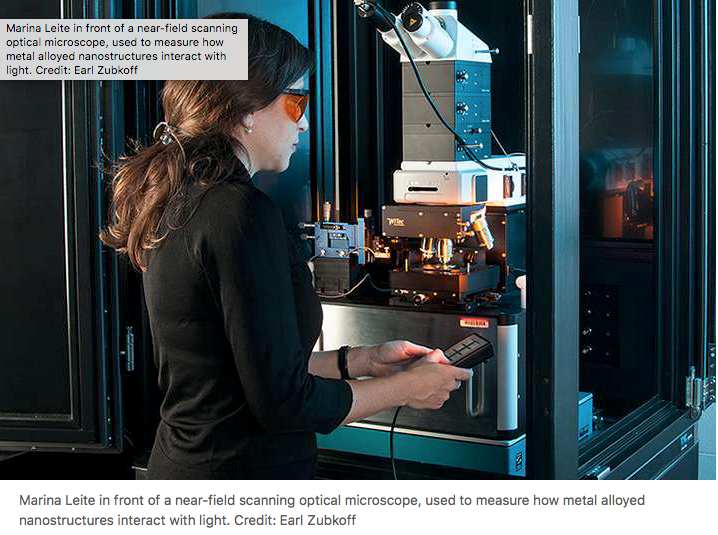
"Our results are relevant to my colleagues working on photonic devices—components for creating, manipulating, or detecting light—as these devices are highly dependent on the tunability of the optical response of their building blocks," Leite added.Jeremy Munday, assistant professor of electrical and computer engineering at UMD, agrees. "My colleagues and I have been working to increase the efficiency of solar cells, specifically by exploring the use of all- metal energy harvesting devices. The ability to arbitrarily tune their optoelectronic properties would have a significant impact on their performance," he said.
This work also has broader economic implications due to the possibility of replacing high-cost metals with low-cost and earth-abundant ones. Though gold is immediately recognizable as a precious and expensive metal, copper and aluminum are much more readily available. Leite and her colleagues are now looking into how they can incorporate alloys using these metals into high-performance optical devices.
Explore further: Physicists promise a copper revolution in nanophotonics
More information: Chen Gong et al. Noble Metal Alloys for Plasmonics, ACS Photonics (2016). DOI: 10.1021/acsphotonics.5b00586 |



