hmmmmnn, should be interesting, thucydides ( en.wikipedia.org ) and luo guanzhong en.wikipedia.org ( Romance of the Three Kingdoms en.wikipedia.org )
must watch & brief :0)
thinking of thigh bones and collar bones, chickens and roosts, etc etc, all very exciting
bloomberg.com
Trump Is Risking an Even Greater Chicken WarA trade spat over poultry between the U.S. and European nations in the 1960s left lasting damage. The fight with China could do greater harm.
Stephen MihmOctober 14, 2018, 10:00 PM GMT+8
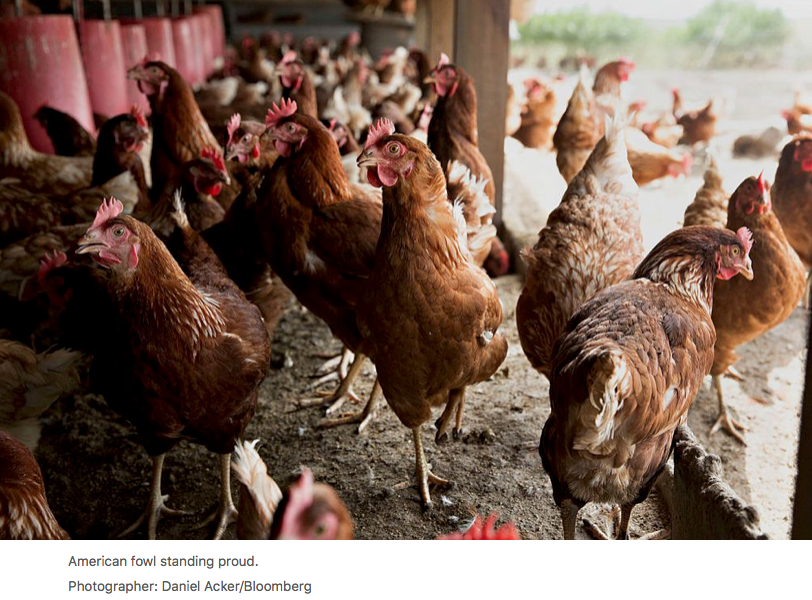
The staggering tariffs being levied on China will almost certainly test President Donald Trump’s claim that “trade wars are easy to win.” He might be right, but the president doesn't seem to have contemplated a different question: What happens when trade wars come to an end?
When one country imposes tariffs on another, the eventual resolution of the conflict does not necessarily mean a return to the status quo. Instead, the penalties levied in the heat of a trade war can have destructive ripple effects long after the dispute is settled.
The textbook example of these unintended consequences was the so-called Chicken War between the U.S. and the European Economic Community, the precursor to the European Union, almost six decades ago. Although the clash lasted little more than a year, we still live with the repercussions today.
In the 1950s, U.S. poultry farmers pioneered factory farming, yielding a surplus of cheap broiler chickens. Eager to find new outlets for the birds, they turned to Europe, and in particular, Germany. That country had lifted quotas governing dollar exchanges in 1958, which meant that American poultry producers could now sell their goods in one of Europe’s largest markets.
The inexpensive U.S. fowl quickly supplanted the more expensive chickens raised by conventional farms in Germany. In 1963, the six member nations of the European Common Market -- France, West Germany, Italy, Belgium, the Netherlands and Luxembourg -- raised tariffs on imports of frozen broilers by 278 percent, though only the Americans were affected.
The Europeans had imported 224.3 million pounds of frozen chicken from the U.S. before the tariff. Afterward, that plummeted to 70 million pounds. It would decline still further in subsequent years.
In response, the Americans threatened tariffs on a wide range of European imports. In Germany, the Munich Merkur sardonically observed: “American chickens apparently are endowed with an inalienable right to emigrate to the EEC markets, above all into the Federal Republic of Germany.”
The conflict was not a “tempest in a stewpot,” as the New York Times described it in 1963. At the time, the U.S. sent a quarter of its farm exports to Europe. Europeans paid for these with dollars, which helped stave off a balance-of-payments crisis that many American policy makers began to fear in the postwar era.
European leaders had made clear that they wished to end their dependency on American food. The chicken tariff was intended to help the continent's farmers get their own factory farms off the ground by giving them some breathing room. The Americans knew this, and recognized that more was at stake here than chickens: the outcome might determine the fate of American agricultural exports more generally.
The U.S. demanded justice, and had its case heard before a five-member panel representing the General Agreement on Tariffs and Trade. The arbiters concurred that the U.S. had sustained a loss, but pegged the amount at $26 million, rather than $46 million as the Americans claimed. This meant the U.S. could impose retaliatory tariffs up to that amount and the conflict would end there.
That's not what happened. Under GATT, tariffs would apply to all nations that shared the Europeans’ Most Favored Nation status. To spare other nations the pain, the U.S. selected four items it imported almost exclusively from countries that belonged to the EEC: potato starch and dextrin (Netherlands); brandy (France); and trucks (Germany).
This tariff on trucks, which raised duties from 8.5 percent to 25 percent, fell entirely on one company: Volkswagen. Its leader, Heinz Hordhoff, expressed outrage. “Why should we be the scapegoats in the chicken war?”
But the Americans refused to back down, though they dropped plans to tax the company’s popular bus at the last minute. (And good thing, too: imagine the 1960s counterculture without the VW Bus. Unthinkable.)
Some of these tariffs, particularly the one on brandy, got rolled back a decade later. But what the architects of the retaliatory tariff could not imagine was the perverse consequences of the tax on trucks. As Detroit automakers stumbled in the 1970s and beyond, they could not compete with foreign manufacturers when it came to producing small, fuel-efficient vehicles. But the 25 percent tariff on any foreign trucks effectively shut out not only the Germans, but eventually, the Japanese, too.
Moreover, in the 1980s, automakers managed to get two-door sport-utility vehicles classified as light trucks, which meant that foreign manufacturers couldn’t compete with Detroit here, either. While this classification would eventually be rescinded, the damage was done.
In 2008, for example, light trucks accounted for a wildly disproportionate share of Detroit’s profits: 57 percent of sales at General Motors; 62 percent at Ford; and 72 percent at Chrysler. When gas prices went through the roof in 2008, the Big Three stumbled again. The chickens had come home to roost.
This all began as a single, tiny trade dispute, with tariffs amounting to about $200 million in today’s dollars. Trump’s tariffs on China, by contrast, are 1,000 times larger and cover a far greater number of products.
The president is now playing chicken on an unimaginable scale. Perhaps he’ll win. Perhaps it will even be “easy.” But history suggests that the resolution of this conflict -- if there is a resolution -- may have profound, enduring consequences for both countries.
This column does not necessarily reflect the opinion of the editorial board or Bloomberg LP and its owners.
To contact the author of this story:
Stephen Mihm at smihm1@bloomberg.net
To contact the editor responsible for this story:
Max Berley at mberley@bloomberg.net
|



