Here's three - liquid and compressed air storage and this... some losses but scalable with no exotic materials - solar power we have take off line is 100% inefficient. Would you rather have 50-80% efficiency instead of 0%? - I'll take it.
energypost.eu Pumped Thermal Electricity Storage: grid-scale, cheap materials, known tech, compact, install anywhere - Energy Post
About Antoine Koen
7-9 minutes
 We need to store the huge quantities of excess electricity generated by variable renewables. But what’s the best way? Currently, over 99% of large-scale electricity storage uses pumped hydro dams. But geography severely limits where you can build one. And the growth of grid-scale batteries is limited by raw material costs and short lifecycles. Antoine Koen and Pau Farres Antunez at Cambridge University review an important alternative, Pumped Thermal Electricity Storage. It’s still in the development stage, but the technologies it uses – heat exchangers, compressors, turbines, electrical generators – are commonplace and proven in the power and processing industries. Units can be installed anywhere. They are compact: 1kg of water stored at 100°C can release ten times more electricity than 1kg stored at a height of 500 metres by a pumped hydro plant. The components last for decades, unlike batteries. The heat is stored in cheap and plentiful materials: gravel, molten salt, water. The downside is their energy conversion efficiency. At 50-70%, its well below 80-90% for lithium-ion batteries or 70-85% for pumped hydro storage. But who cares if, as expected, costs decline as the prototypes move to commercialisation, and costs continue to decline for variable wind and solar. We need to store the huge quantities of excess electricity generated by variable renewables. But what’s the best way? Currently, over 99% of large-scale electricity storage uses pumped hydro dams. But geography severely limits where you can build one. And the growth of grid-scale batteries is limited by raw material costs and short lifecycles. Antoine Koen and Pau Farres Antunez at Cambridge University review an important alternative, Pumped Thermal Electricity Storage. It’s still in the development stage, but the technologies it uses – heat exchangers, compressors, turbines, electrical generators – are commonplace and proven in the power and processing industries. Units can be installed anywhere. They are compact: 1kg of water stored at 100°C can release ten times more electricity than 1kg stored at a height of 500 metres by a pumped hydro plant. The components last for decades, unlike batteries. The heat is stored in cheap and plentiful materials: gravel, molten salt, water. The downside is their energy conversion efficiency. At 50-70%, its well below 80-90% for lithium-ion batteries or 70-85% for pumped hydro storage. But who cares if, as expected, costs decline as the prototypes move to commercialisation, and costs continue to decline for variable wind and solar.
The effect that fossil fuels are having on the climate emergency is driving an international push to use low-carbon sources of energy. At the moment, the best options for producing low-carbon energy on a large scale are wind and solar power. But despite improvements over the last few years to both their performance and cost, a significant problem remains: the wind doesn’t always blow, and the sun doesn’t always shine. A power grid that relies on these fluctuating sources struggles to constantly match supply and demand, and so renewable energy sometimes goes to waste because it’s not produced when needed.
One of the main solutions to this problem is large-scale electricity storage technologies. These work by accumulating electricity when supply exceeds demand, then releasing it when the opposite happens. However, one issue with this method is that it involves enormous quantities of electricity.
Cost limits batteries. Geography limits pumped hydro Existing storage technologies like batteries wouldn’t be good for this kind of process, due to their high cost per unit energy. Currently, over 99% of large-scale electricity storage is handled by pumped hydro dams, which move water between two reservoirs through a pump or turbine to store or produce power. However, there are limits to how much more pumped hydro can be built due to its geographical requirements.
One promising storage option is pumped thermal electricity storage. This relatively new technology has been around for about ten years, and is currently being tested in pilot plants.

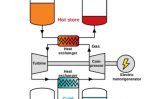
The conversion of electricity to heat happens in the central circuit, then stored in hot and cold tanks. / image by Pau Farres Antunez
Pumped thermal electricity storage works by turning electricity into heat using a large-scale heat pump. This heat is then stored in a hot material, such as water or gravel, inside an insulated tank. When needed, the heat is then turned back into electricity using a heat engine. These energy conversions are done with thermodynamic cycles, the same physical principles used to run refrigerators, car engines or thermal power plants.
Known technology Pumped thermal electricity storage has many advantages. The conversion processes mostly rely on conventional technology and components (such as heat exchangers, compressors, turbines, and electrical generators) that are already widely used in the power and processing industries. This will shorten the time required to design and build pumped thermal electricity storage, even on a large scale.
Cheap, clean materials: gravel, molten salt, water The storage tanks can be filled with abundant and inexpensive materials such as gravel, molten salts or water. And, unlike batteries, these materials pose no threat to the environment.
Large molten salt tanks have been successfully used for many years in concentrated solar power plants, which is a renewable energy technology that has seen rapid growth during the last decade. Concentrated solar power and pumped thermal electricity storage share many similarities, but while concentrated solar power plants produce energy by storing sunlight as heat (and then converting it to electricity), pumped thermal electricity storage plants store electricity that may come from any source – solar, wind or even nuclear energy, among others.
Easy to deploy, compact Pumped thermal electricity storage plants can be installed anywhere, regardless of geography. They can also easily be scaled up to meet the grid’s storage needs. Other forms of bulk energy storage are limited by where they can be installed. For example, pumped hydro storage requires mountains and valleys where substantial water reservoirs can be built. Compressed air energy storage relies on large subterranean caverns.
Pumped thermal electricity storage has a higher energy density than pumped hydro dams (it can store more energy in a given volume). For example, ten times more electricity can be recovered from 1kg of water stored at 100°C, compared to 1kg of water stored at a height of 500 metres in a pumped hydro plant. This means that less space is required for a given amount of energy stored, so the environmental footprint of the plant is smaller.
Molten salt tanks for thermal energy storage in a concentrate solar power plant. / Abengoa
Long life, decades The components of pumped thermal electricity storage typically last for decades. Batteries, on the other hand, degrade over time and need to be replaced every few years – most electric car batteries are typically only guaranteed for about five to eight years.
Conversion efficiency is lower than batteries, pumped hydro However, even though there are many things that make pumped thermal electricity storage well-suited for large-scale storage of renewable energy, it does have its downsides. Possibly the biggest disadvantage is its relatively modest efficiency – meaning how much electricity is returned during discharge, compared to how much was put in during charge. Most pumped thermal electricity storage systems aim for 50-70% efficiency, compared to 80-90% for lithium-ion batteries or 70-85% for pumped hydro storage.
…but who cares, if costs decline enough But what arguably matters most is cost: the lower it is, the faster society can move towards a low carbon future. Pumped thermal electricity storage is expected to be competitive with other storage technologies – though this won’t be known for certain until the technology matures and is fully commercialised. As it stands, several organisations already have working, real-world prototypes. The sooner we test and start deploying pumped thermal electricity storage, the sooner we can use it to help transition to a low-carbon energy system.
***
Antoine Koen is a PhD Candidate in Pumped Thermal Energy Storage, University of Cambridge
Pau Farres Antunez is a postdoctoral researcher in Energy Storage, University of Cambridge
This article is republished from The Conversation under a Creative Commons license. Read the original article.
|



