SI
SI
discoversearch

We've detected that you're using an ad content blocking browser plug-in or feature. Ads provide a critical source of revenue to the continued operation of Silicon Investor.  We ask that you disable ad blocking while on Silicon Investor in the best interests of our community.  If you are not using an ad blocker but are still receiving this message, make sure your browser's tracking protection is set to the 'standard' level.
Politics : Formerly About Advanced Micro Devices -- Ignore unavailable to you. Want to Upgrade?


To: FJB who wrote (1119515)2/22/2019 7:29:48 AM
From: sylvester80  Respond to of 1585085
 
OOPS! Law Expert Mocks Donald Trump For Inadvertently Making A Case Against Himself
Harvard constitutional law professor Laurence Tribe said he’d honestly “never had an opponent who was quite as helpful” as Trump.
02/22/2019 04:58 am ET
By Lee Moran
huffpost.com
A top Harvard constitutional law professor involved in a lawsuit seeking an injunction against Donald Trump’s declaration of a national emergency to fund a U.S.-Mexico border wall has thanked the president for helping to make the case.

On Thursday’s broadcast of “The Last Word with Lawrence O’Donnell,” the host asked Laurence Tribe if he’d “ever been on the opposite side of a litigant who was so helpful to your case in public comments that you could then simply type right into your brief to support your position?”

“Honestly, I have never had an opponent who was quite as helpful,” Tribe, who is representing the Texas county of El Paso in the case, said.

Tribe also thanked Trump “for being as obvious as he is about the absence of any emergency and about the fact that he is simply trying to do what emperors and kings do, not what a president of the United States should do.”

Check out the clip above.


To: FJB who wrote (1119515)2/22/2019 7:38:01 AM
From: sylvester80  Respond to of 1585085
 
OOPS! ‘Moment Of Reckoning’: U.S. Cities Burn Recyclables Spewing Toxic Pollution To Black & Latino communities After China Bans U.S. Imports
This new reality risks an increase of plumes of toxic pollution that threaten many black and Latino communities.
Oliver Milman The Guardian U.S.
02/21/2019 02:56 pm ET
huffpost.com


PHOTOGRAPH: HANNAH YOON/THE GUARDIANActivists Mike Ewall, left, and Zulene Mayfield stand in front of the Covanta incinerator in Chester, Pennsylvania. The incinerator brings in garbage from New York, Ohio and other states.

This story was produced and originally published by The Guardian U.S. and is reproduced here as part of the Climate Desk collaboration.

The conscientious citizens of Philadelphia continue to put their pizza boxes, plastic bottles, yoghurt containers and other items into recycling bins.

But in the past three months, half of these recyclables have been loaded on to trucks, taken to a hulking incineration facility and burned, according to the city’s government.

It’s a situation being replicated across the U.S. as cities struggle to adapt to a recent ban by China on the import of items intended for reuse.

The loss of this overseas dumping ground means that plastics, paper and glass set aside for recycling by Americans is being stuffed into domestic landfills or is simply burned in vast volumes. This new reality risks an increase of plumes of toxic pollution that threaten the largely black and Latino communities who live near heavy industry and dumping sites in the U.S.

The huge Covanta incinerator just outside Philadelphia, located in Chester City, Pennsylvania, is sent about 200 tons of recycling material every day since China’s import ban came into practice last year, the company says.

“People want to do the right thing by recycling but they have no idea where it goes and who it impacts,” said Zulene Mayfield, who was born and raised in Chester and now spearheads a community group against the incinerator, called Chester Residents Concerned for Quality Living.

“People in Chester feel hopeless — all they want is for their kids to get out, escape. Why should we be expendable? Why should this place have to be burdened by people’s trash and shit?”

Some experts worry that burning plastic recycling will create a new fog of dioxins that will worsen an already alarming health situation in Chester. Nearly four in 10 children in the city have asthma, while the rate of ovarian cancer is 64% higher than the rest of Pennsylvania and lung cancer rates are 24% higher, according to state health statistics.

The dilemma with what to do with items earmarked for recycling is playing out across the U.S. The country generates more than 250m tons of waste a year, according to the Environmental Protection Agency (EPA), with about a third of this recycled and composted.


HANNAH YOON/THE GUARDIANAshley Melecio, center, sits with her daughter Da’miaa Morales, left, and her son Da’ahmeer Melecio-Martinez at her home in Chester, Pennsylvania. She says she doesn’t let her kids play outside because of all the traffic and because of how bad it smells.

Until recently, China had been taking about 40% of U.S. paper, plastics and other recyclables but this trans-Pacific waste route has now ground to a halt. In July 2017, China told the World Trade Organization it no longer wanted to be the end point for yang laji, or foreign garbage, with the country keen to grapple with its own mountains of waste.

This New World
The current capitalist system is broken. Get updates on our progress toward building a fairer world.

Since January 2018, China hasn’t accepted two dozen different recycling materials, such as plastic and mixed paper, unless they meet strict rules around contamination. The imported recycling has to be clean and unmixed — a standard too hard to meet for most American cities.

It is “virtually impossible to meet the stringent contamination standards established in China”, said a spokeswoman for the city of Philadelphia, who added that the cost of recycling has become a “major impact on the city’s budget”, at around $78 a ton. Half of the city’s recycling is now going to the Covanta plant, the spokeswoman said.

There isn’t much of a domestic market for U.S. recyclables — materials such as steel or high-density plastics can be sold on but much of the rest holds little more value than rubbish — meaning that local authorities are hurling it into landfills or burning it in huge incinerators like the one in Chester, which already torches around 3,510 tons of trash, the weight equivalent of more than 17 blue whales, every day.


HANNAH YOON/THE GUARDIANTrucks full of garbage used to drive down Thurlow street in Chester to get to the Covanta incinerator.

“This is a real moment of reckoning for the U.S. because of a lot of these incinerators are aging, on their last legs, without the latest pollution controls,” said Claire Arkin, campaign associate at Global Alliance for Incinerator Alternatives. “You may think burning plastic means ‘poof, it’s gone’ but it puts some very nasty pollution into the air for communities that are already dealing with high rates of asthma and cancers.”

Hugging the western bank of the Delaware River, which separates Pennsylvania and New Jersey, Chester City was once a humming industrial outpost, hosting Ford and General Motors plants. Since the war, however, Chester has been hollowed out, with an exodus of jobs ushering in an era where a third of people live in poverty.

The industry that remains emits a cocktail of soot and chemicals upon a population of 34,000 residents, 70% of them black. There’s a waste water treatment plant, a nearby Kimberly-Clark paper mill and a medical waste facility. And then there’s Covanta’s incinerator, one of the largest of its kind in the U.S.

Just a tiny fraction of the trash burned at the plant is from Chester — the rest is funneled in via truck and train from as far as New York City and North Carolina. The burning of trash releases a host of pollutants, such as nitrogen oxides, sulfur dioxides and particulate matter, which are tiny fragments of debris that, once inhaled, cause an array of health problems.

Covanta say that pollution controls, such as scrubbers in smokestacks, will negate toxins emitted by recyclables. After passing through the emissions control system, the plant’s eventual output is comfortably below limits set by state and federal regulators, the company says, with emissions of dioxins far better than the expected standard.

The company also argues that incineration is a better option than simply heaping plastic and cardboard in landfills.

“In terms of greenhouse gases, it’s better sending recyclables to an energy recovery facility because of the methane that comes from a landfill,” said Paul Gilman, Covanta’s chief sustainability officer. “Fingers crossed Philadelphia can get their recycling program going again because these facilities aren’t designed for recyclables, they are designed for solid waste.”

Covanta and its critics agree that the whole recycling system in the U.S. will need to be overhauled to avoid further environmental damage. Just 9% of plastic is recycled in the US, with campaigns to push up recycling rates obscuring broader concerns about the environmental impact of mass consumption, whether derived from recycled materials or not.

“The unfortunate thing in the United States is that when people recycle they think it’s taken care of, when it was largely taken care of by China,” said Gilman. “When that stopped, it became clear we just aren’t able to deal with it.”


To: FJB who wrote (1119515)2/22/2019 7:38:22 AM
From: sylvester80  Respond to of 1585085
 
OOPS! USDA: Trump Trade War Triggering $1.9 Billion Plunge In Farm Exports; Soybean exports to China have fallen more than 90 percent.
02/22/2019 05:13 am ET
By Mary Papenfuss
huffpost.com

MYCOLA VIA GETTY IMAGES

American farm exports are expected to plunge $1.9 billion in fiscal 2019, compared to the previous year, largely due to President Donald Trump’s trade war with China, according to the U.S. Department of Agriculture.

Soybean exports have been hit particularly hard, the agency’s chief economist, Robert Johansson, told the USDA Outlook Forum in Washington on Thursday, Reuters reported. Because of the trade dispute, soybean exports to China will have “plummeted by 22 million [metric] tons, or over 90 percent” through this month, Johansson said.

China has dropped to the fifth largest market for American farm exports, Johansson noted. It was the top foreign purchaser in 2017. China is buying only about 6 percent of total U.S. exports, compared with nearly 18 percent in 2014.

View image on Twitter


Dept. of Agriculture

?@USDA


#AgOutlook: USDA Chief Economist Johansson, “the share of total U.S. agricultural exports to China is projected to be 6 percent, down sharply from recent years” #OATT


13

6:31 AM - Feb 21, 2019


See Dept. of Agriculture's other Tweets


Twitter Ads info and privacy

The USDA estimates a net farm income of $66 billion for 2018, compared with $134 billion in 2013.

Early last year Trump admitted farmers would take a hit in the trade war, but he insisted that they would “understand.” These are “great patriots,” he added, referring to the farmers. “They understand that they’re doing this for the country.” The Farm Bureau, which represents the nation’s farmers, has spoken out against tariffs and the trade war. The administration has set aside $12 billion to bail out farmers hurt by the president’s trade war.

Russian farmers are one of the beneficiaries of the trade war. Their soybean exports to China more than doubled last year, according to The Wall Street Journal. Russia’s overall trade with China rose more than 27 percent to over $100 billion last year, according to the Journal. The increase in trade between the nations has been reportedly nurtured by an increasingly powerful relationship between Chinese President Xi Jinping and Russian President Vladimir Putin, who are taking advantage of an America that is on the trade sidelines.

The trade war has also been linked to the highest number of Midwestern farm bankruptcies in a decade, according to an analysis of court records by the Journal.

Farmers’ fortunes could change if the United States and China work out their trade differences in talks that are underway. But even in the event of a trade deal, China’s recently developed commercial relationships with farmers in other countries could continue for years. Johansson also warned that unsold American soybeans now stored could take years to “unwind.”

As for the near future, the South American soy harvest “would make exports more competitive in the rest of the marketing year, dimming the prospects for an export recovery,” Johansson warned, according to Reuters.

Johansson’s discussion of exports begins at 18:15 in the video below:

Do you have information you want to share with HuffPost? Here’s how.


To: FJB who wrote (1119515)2/22/2019 7:50:30 AM
From: sylvester80  Respond to of 1585085
 
OOPS! FACTCHECK: LYING LIAR POS tRump LIES & Disinformation on Deficits
By Robert Farley
Posted on February 21, 2019
factcheck.org

President Donald Trump misleadingly claimed that “deficits seem to be coming down,” when in fact deficits are rising, largely because of the tax cuts he enacted.

In fact, the deficit in the first three months of fiscal year 2019 was 42 percent higher than it was for the same period last year.

Trump’s comment came as the president boasted about the country’s strong economy during a signing ceremony for a space policy directive.

Trump, Feb. 19: I don’t know if you noticed, but deficits seem to be coming down. And last month it was reported, and everybody was surprised, but I wasn’t surprised. We’re taking in a lot of money coming into our Treasury from tariffs and various things, including the steel dumping. And our steel companies are doing really well. Aluminum companies also. So we’re very happy about that.

The White House press office did not respond to our request for clarification or backup data, but the president appeared to be referring to the latest monthly deficit tabulation released by the Treasury Department. In December, the U.S. government ran a relatively low deficit of $13.5 billion, Treasury announced this month. That’s nearly $10 billion less than the previous December.

But the total deficit for the first three months of the fiscal year, ending in December, was $319 billion. ( See Table 1.) That’s 42 percent higher than in the first three months of FY 2018. ( See Table 2.)

Even so, experts told us it is unwise to cherry-pick a single month or even several months, as federal revenue and spending often fluctuate cyclically at different times of the year. It is better to look at the longer-term, yearly deficits, and the trend line there is clear: Deficits have increased under Trump, and they are forecast to continue to go up, according to projections by the nonpartisan Congressional Budget Office.

“December is almost always a relatively good month for the federal government,” Shai Akabas, director of economic policy at the Bipartisan Policy Center, told us in a phone interview. Fewer federal payments go out the door, and so historically deficits in Decembers are usually relatively low. The federal government shutdown also skewed the government’s bottom line that month. The deficit for January, which Treasury has not yet released, is also likely to be relatively low, and may even be a surplus, he said. Quarterly tax payments due in January typically give revenues that month a large bump.

“Looking at one month and saying deficits are getting better is like looking at the weather in November and December and saying the climate is getting colder,” Akabas said.

December’s figure is not indicative of the long-term trend, he said. “Deficits are rising significantly.”
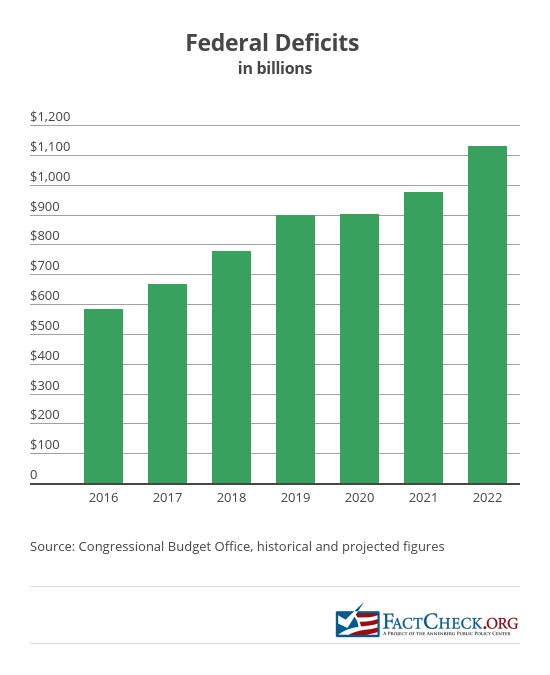


The federal deficit in FY 2018, which ended Sept. 30, was $779 billion — a nearly 17 percent increase from FY 2017. According to the Congressional Budget Office, about $164 billion of the 2018 deficit resulted from the Tax Cuts and Jobs Act — a Republican-crafted bill that the president signed into law on Dec. 22, 2017.

Revenue loss from the tax bill is expected to have an even larger impact on the deficit this year. According to the latest economic forecast from the Congressional Budget Office, released in January, the federal budget deficit is expected to reach nearly $900 billion this fiscal year (a 15 percent increase from 2018) and exceed “$1 trillion each year beginning in 2022.”

The White House, in its mid-session review of the fiscal year 2019 budget, estimates even larger short-term deficits than CBO. That document projects annual deficits will top $1 trillion in fiscal years 2019, 2020 and 2021.

“You can’t look at a single month to tell you much of anything” Marc Goldwein, senior vice president and senior policy director at the Committee for a Responsible Federal Budget, told us via email. “Overall, deficits are way up since the President took office.”

CRFB says the tax bill is the largest driver of increasing deficits, but increased spending, particularly on defense, also has played a role.

“The deficit is not going down,” Steve Ellis of the budget watchdog group Taxpayers for Common Sense told us via email. “It’s not very useful to look at the deficit from month to month or even the same month year to year. The last month had some saving because of the government shutdown, but that is going to be more than made up going forward.”

The timing of payments and even variables such as the number of weekends in a month has an effect on monthly deficits, Ellis said.

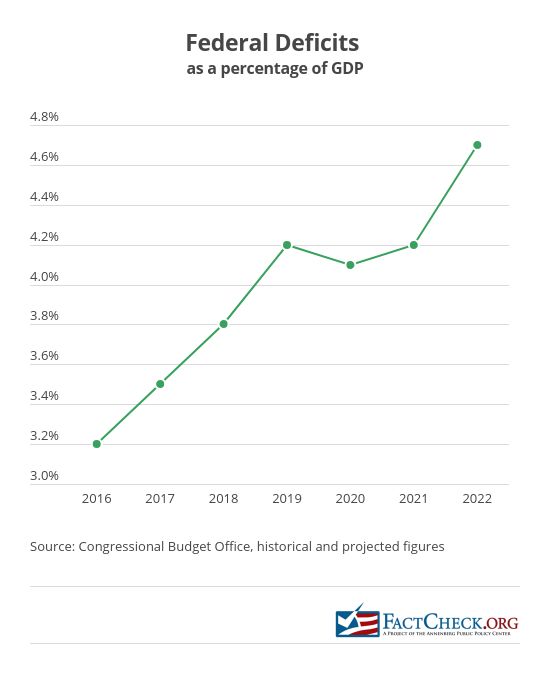
“The real measure of the deficit is as a percentage of GDP,” Ellis said. “Bottom line, since WWII the only other times the deficit has been this high was immediately after WWII and immediately after the Great Recession. But we have this level of deficits during an economic expansion, that’s unconscionable.”

According to the latest economic forecast from the Congressional Budget Office, “Over the coming decade, deficits … [will] fluctuate between 4.1 percent and 4.7 percent of gross domestic product (GDP), well above the average over the past 50 years,” and will average 4.4 percent a year from 2020 to 2029.

By comparison, CBO said: “Over the past 50 years, the annual deficit has averaged 2.9 percent of GDP.


The Trump administration contests the CBO projection. In a press briefing on Jan. 28, Larry Kudlow, director of the White House National Economic Council, said the White House simply disagrees with CBO about projected economic growth and, in turn, its deficit projections.

Kudlow, Jan. 28: So they [CBO] have had a very low growth estimate in response to Trump policies on taxes and deregulation, and we’ve had a much higher one — about a 1-percentage point differential, more or less. We’re at 3; they’re at 2, more or less.

The White House budget for fiscal year 2019 assumed “real Gross Domestic Product (GDP) growth averaging 3.0 percent during the 11-year forecast interval,” from 2018 to 2028.

But few outside the White House share such a rosy view. The most recent median forecast of the Federal Reserve Board members and Federal Reserve Bank presidents issued on Dec. 19 projected 3.0 percent growth for all of 2018, 2.3 percent in 2019 and 2.0 percent in 2020. Similarly, among the business and university economists who offered an annual GDP forecast to the Wall Street Journal’s monthly economic survey in January, the average prediction was for 3.0 percent growth for all of 2018, falling to 2.2 percent this year and 1.7 percent next year.

Trump asserted that increased revenues from “tariffs and various things” are bringing down the deficit, but increased revenues from tariffs are dwarfed by revenue losses from the tax cuts.

In the first three months of this fiscal year, the federal government took in about $17.8 billion in “customs duties” — about $8.4 billion more than during the same three months last year, according to the Treasury (Table 7). CBO says that increase in customs duties was “largely because of new tariffs imposed by the Administration during the past year.” By contrast, however, the CBO forecasts revenue losses from the tax cuts of $228 billion this year, and $272 billion in FY 2020.

“Tariffs definitely bring in some revenue,” Akabas said. “But in the scheme of things, they are quite small, several billion dollars as opposed to deficits of several hundred billion dollars.”

The long-term, big picture on deficits is clear, Akabas said. Deficits are rising under Trump, and in the years ahead, “The CBO projects rising deficits with no end in sight.”

Share The Facts

Donald Trump
President of the United States


"I don’t know if you noticed, but deficits seem to be coming down."
White House – Tuesday, February 19, 2019
SHARE READ MORE


To: FJB who wrote (1119515)2/22/2019 7:54:50 AM
From: sylvester80  Respond to of 1585085
 
OOPS! It’s clearer than ever that the US’s North Korea policy is in total chaos
“I don’t know if North Korea has made the choice to denuclearize,” a top Trump official shockingly told reporters.
By Alex Ward @AlexWardVox alex.ward@vox.com Feb 21, 2019, 12:10pm EST
vox.com
North Korean leader Kim Jong Un and President Donald Trump. KOREA SUMMIT PRESS POOL,MANDEL NGAN/AFP/Getty Images
The Trump administration just walked back its approach to North Korea — less than a week before the president is set to meet with North Korean leader Kim Jong Un in Vietnam.

During a background call with reporters about the upcoming meeting, a senior administration official with knowledge of the negotiation’s status made two statements that contradict Washington’s previous stances on its effort to rid Pyongyang of its nuclear arsenal.

First, the official said, “I don’t know if North Korea has made the choice to denuclearize.” That’s a major statement, as the administration has consistently claimed that Kim agreed to dismantle his nuclear program when he met with President Donald Trump last year in Singapore.

Last December, for example, Secretary of State Mike Pompeo repeated one of the administration’s common refrains, which is that Washington is “working towards the final, fully verified denuclearization of North Korea as agreed to by Chairman Kim Jong Un.” Pompeoreiterated the sentiment in an interview with Fox Business Network on Thursday: “I hope we can make real progress, that Chairman Kim will begin to fulfill the commitment he made in June in Singapore of last year to denuclearize his own country.”

And in January, Trump’s top envoy for North Korea talks, Stephen Biegun, told an audience at Stanford University that Kim had committed to “the dismantlement and destruction of North Korea’s plutonium and uranium enrichment facilities” which “represents the totality of North Korea’s plutonium reprocessing and uranium enrichment programs.”

So, for a top US official to basically walk that back implies that either the administration was lying before, or it’s unclear where North Korea talks really stand.

But that’s not all. The American official also noted that “we actually need to move very quickly in this process” — referring to North Korea’s denuclearization — “and I think we need to move in very big bites.”

That also goes against what Biegun said at Stanford last month:

From our side, we are prepared to discuss many actions that could help build trust between our two countries and advance further progress in parallel on the Singapore summit objectives of transforming relations, establishing a permanent peace regime on the peninsula, and complete denuclearization.

The implication, then, is that the US and North Korea would take smaller, corresponding measures to meet all of the points of disagreement. But that’s not what the official said — in fact, it’s the reverse. And that’s a problem, as past Trump administration attempts to extract major concessions from North Korea quickly have failed spectacularly.

“The ‘big bold move’ approach allows success to be defined as a photo op and a vague promise of something happening sometime between now and the sun going supernova,” Jonathan Cristol, a North Korea expert at Bard College, told me.

Perhaps the message was domestic posturing. As the Washington Post reported on Wednesday, National Security Adviser John Bolton and others in the administration oppose the step-by-step approach toward North Korea and believe the talks will ultimately fail. The senior administration official, then, may have simply been trying to reinforce that the plan is to have Pyongyang end its nuclear program soon and not over an extended period of time.

But taken together, those comments imply that the administration doesn’t know how it will deal with the upcoming, incredibly critical negotiations.

“We are nowhere,” says MIT nuclear expert Vipin Narang. “Which is probably exactly where the North Koreans want us to be.”

IN THIS STORYSTREAM North Korean nuclear program causes new tensions with US It’s clearer than ever that the US’s North Korea policy is in total chaos Why Trump is lowering expectations for next week’s Kim Jong Un summit


To: FJB who wrote (1119515)2/22/2019 8:36:39 AM
From: Sdgla1 Recommendation

Recommended By
FJB

  Read Replies (1) | Respond to of 1585085
 
This is the Dem party.

