SI
SI
discoversearch

We've detected that you're using an ad content blocking browser plug-in or feature. Ads provide a critical source of revenue to the continued operation of Silicon Investor.  We ask that you disable ad blocking while on Silicon Investor in the best interests of our community.  If you are not using an ad blocker but are still receiving this message, make sure your browser's tracking protection is set to the 'standard' level.
Non-Tech : The Brazil Board -- Ignore unavailable to you. Want to Upgrade?


To: kidl who wrote (1897)3/5/2019 12:25:56 PM
From: elmatador  Respond to of 2508
 
Emerging markets cut reliance on foreign bank credit

Trend should help developing countries withstand global shocks

Major emerging markets have become less reliant on foreign bank capital since the global financial crisis, reducing the risk of contagion from credit crises elsewhere.

However the remaining foreign bank credit tends to be sourced from a narrower range of countries, raising a red flag for some economies, particularly in Latin America, according to new research from the Bank for International Settlements.

The findings are important given the role foreign banks played in helping to power the pre-financial crisis credit booms and post-crisis busts seen in some emerging economies.

Academic work has also pointed to the role that foreign banks, particularly Japanese ones, played in spreading the 1997 Asian financial crisis from Thailand to Indonesia, Malaysia and South Korea by “drastically” curtailing their lending. This and other EM crises have been exacerbated as foreign banks withdraw their capital in times of distress.

“Unexpected losses in one country may induce banks to withdraw from other borrower countries as banks restructure their asset portfolio in an attempt to rebalance overall risks and satisfy regulatory constraints,” the BIS, commonly known as the central bankers’ central bank, said last year.
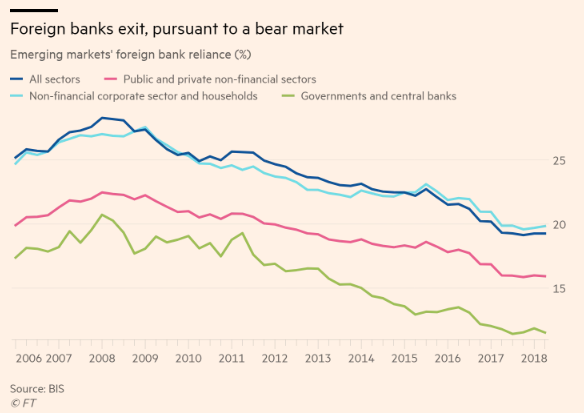

“Local funding has proven to be more stable through financial crises, while cross-border and foreign currency funding has been less so,” said Bryan Hardy, a BIS economist and author of the new research.

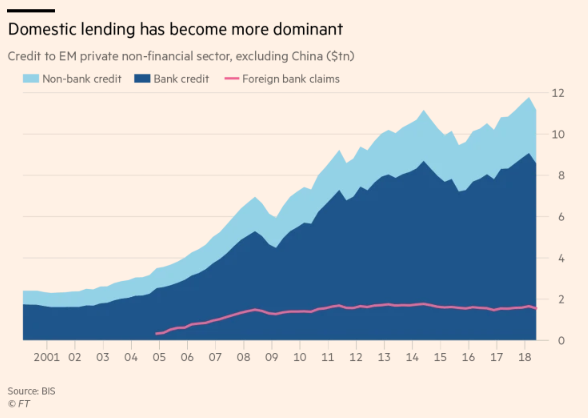
Foreign bank credit to the non-bank private sector in 17 major emerging economies rose sharply in the run-up to the global financial crisis from $310bn at the end of 2004 to $1.47tn in mid-2008, the analysis found.

It subsequently fell to a low of $1.26tn in early 2009 and has since risen modestly to $1.54tn as of last year. However, lending by both domestic banks and “non-banks”, such as bond investors, has risen far faster, as shown in the first chart.

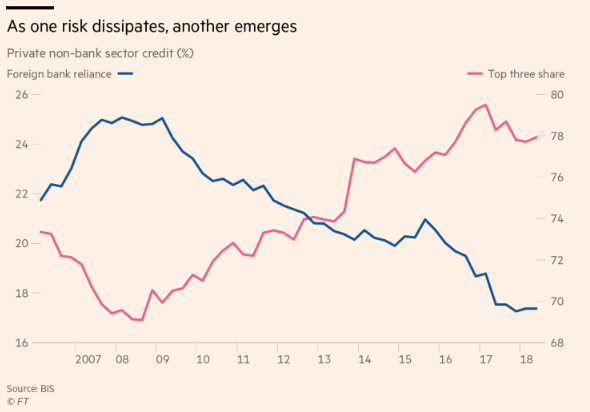
As a result, foreign bank reliance — the share of overall credit accounted for by foreign banks — has fallen from a peak of 28 per cent at the height of the financial crisis to 19 per cent, as depicted in the second chart.

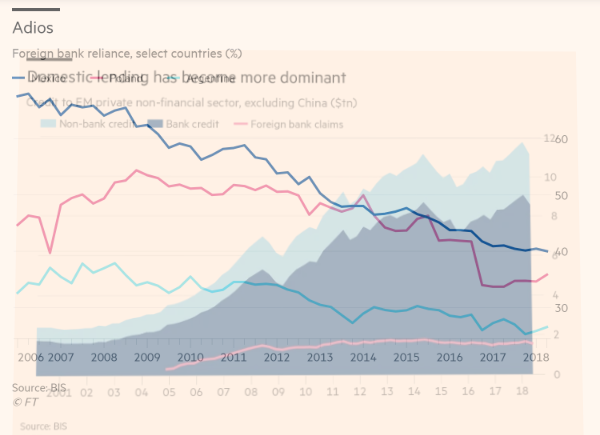
Reliance on foreign bank lending has fallen markedly in Mexico, Poland and Argentina, as illustrated in the third chart, as well as in Russia where, from a peak of 27 per cent in 2007, it has dwindled to just 10 per cent.

Moreover, the composition of the remaining foreign bank credit has also, arguably, improved for the better. The BIS found that “international claims” — a measure of cross-border lending as well as local lending in foreign currency by locally funded subsidiaries of foreign banks — has declined in importance more than “local claims in local currency”, ie lending by these subsidiaries in domestic currency.

The latter are “usually funded locally and so may be more insulated from foreign developments”, said Mr Hardy. Borrowing in domestic currency can also help avoid potentially ruinous currency mismatches.

The decline in reliance on foreign bank lending has come at its own cost, however, with the remaining credit flows sourced from a narrower range of countries. The BIS found that concentration among foreign bank lenders — the share of foreign credit from the top three national banking systems, typically the US, UK and Japan, Spain or France — was falling in the run-up to the financial crisis.

However it has risen sharply since, as the fourth chart shows, something Mr Hardy feared made emerging economies more vulnerable to a banking crisis in one of these developed countries.

The level of concentration is particularly elevated in several Latin American nations, such as Chile, Colombia and Argentina, the BIS found. Banks from Belgium, Germany, the Netherlands and Switzerland have become less important in EMs since the financial crisis, with those from Australia, Canada, Japan and Spain supplanting them to some extent.

Mr Hardy’s country-by-country analysis suggested there was a clear link between the degree of reliance on foreign banks and the level of concentration of those banks.

“This strong negative correlation in the time series reveals much about the landscape of credit provision by foreign banks in emerging markets,” he said.

“Leading up to the GFC, banks from many foreign countries lent to emerging markets, contributing to an increase in the foreign bank reliance measure and a fall in concentration. After the crisis, domestic banks and non-bank creditors expanded into emerging market lending.

“Aggregate credit from foreign banks remained about the same, but the composition of lenders became more concentrated, as some creditors retreated from emerging market lending and others expanded.”

Mr Hardy believed this was an issue authorities in EM countries needed to keep on top of.

“The diversity of funding sources may be important for emerging markets to monitor. Diversifying funding sources can reduce the risk of sudden reversals of credit from foreign developments in a single creditor country,” he said.


To: kidl who wrote (1897)3/9/2019 8:06:38 AM
From: elmatador  Respond to of 2508
 
Trump to host Brazil's Bolsonaro at White House this month


The White House said the March 19 meeting will focus on “how to build a more prosperous, secure, and democratic Western Hemisphere.”


https://thehill.com/homenews/administration/433303-trump-to-host-brazils-bolsonaro-at-white-house-this-month


To: kidl who wrote (1897)3/18/2019 1:33:22 AM
From: elmatador  Respond to of 2508
 
The IMF released
Brazil : Boom, Bust, and Road to Recovery Publication Date: March 14, 2019 Electronic Access:Free Full Text. Use the free Adobe Acrobat Reader to view this PDF file


Summary:


Brazil is at crossroads, emerging slowly from a historic recession that was preceded by a huge economic boom. Reasons for the historic bust following a boom are manifold. Policy mistakes were an important contributory factor, and included the pursuit of countercyclical policies, introduced to deal with the effects of the global financial crisis, beyond the point where they were helpful. More fundamentally, it reflects longstanding structural weaknesses plaguing the economy, that also help explain Brazil’s uninspiring growth performance over the past four decades.


https://www.imf.org/en/Publications/Books/Issues/2019/03/11/Brazil-Boom-Bust-and-Road-to-Recovery-44927


To: kidl who wrote (1897)5/16/2019 10:18:42 AM
From: elmatador1 Recommendation

Recommended By
Elroy Jetson

  Respond to of 2508
 
Lithium boom anticipated in Brazil as reserves are developed in Minas Gerais

Thursday, December 27th 2018 - 09:07 UTC

ANM reports that 117 survey applications for lithium were filed by December. That's three times the amount of last year and ten times 2016 applications

Lithium, sometimes called “oil of the future” given its potential in electric cars as a replacement of combustion engines, is a darling commodity in global markets
Favorable international demand and a recent discovery of lithium reserves in Brazil caused a rush for the metal, used in electrical batteries, reports the Folha de Sao Paulo. Two ongoing projects will elevate Brazil to the status of one of the world's largest lithium-producing countries in the next decade, according to data from the National Agency for Mining, ANM..

ANM reports that 117 survey applications for lithium were filed by December. That's over three times the amount of last year and almost ten times the number of applications in 2016.

The interest in bringing a lot of expectations at Vale do Jequitinhonha, in Northern Minas Gerais, one of the poorest parts of Brazil, but with a high potential given its lithium reserves.

Lithium, sometimes called “oil of the future” for its potential in electric fueled cars as a replacement of combustion engines, is a darling commodity in international markets.

Lithium prices skyrocketed recently because of a race to find new reserves, which in turn was caused by developed countries' plans to reduce carbon emissions. Carmakers like Volkswagen have already announced goals to end producing cars fueled by fossil fuels, and several Europeans countries have set time limits for combustion engins..

Currently, Brazil's lithium production is at a small-scale, concentrated in Araçuaí, Minas Gerais, geared towards the domestic market for lubricants and ceramics. But the new investments in surveying for new reserves are already making changes in the industry.

“Brazil's participation in the lithium market was shy. But now, with the demand for electric motors, the industry is awakening,” says Ivan Jorge Garcia, a specialist in mineral resources at ANM

Lithium supply in Brazil
lithium.today


To: kidl who wrote (1897)5/30/2019 1:03:08 PM
From: elmatador  Respond to of 2508
 
Brazil GDP dropped 0.2% in the first quarter.

Industry dropped 0.7% driven down by a fall of 6.3% in the mineral extraction industry 6.3%
  • Vale mining Brumadinho dam accident.
  • Petrobras production 5.% lower due to platforms' problems.


Production of Petrobras had an annual decrease of 5%; pre-salt produces 7% more

ECStats Content
posted 07/05/2019 20:50

Petrobras produced a total of 2.460 million barrels per day of oil and NGL in Brazil in the first quarter of this year, representing a decrease of about 5% over the same period of the previous year. Compared to the immediately preceding three months, this volume fell by 4%.

Despite the decrease in global production, the volume extracted exclusively in the pre-salt rose 7% year-on-year to 1.036 million barrels per day in this area of ??production. The volume showed a slight reduction of 1% compared to the end of 2018.

Natural gas production, in turn, reached 489 thousand barrels per day, slightly decreasing by 1% in the annual ratio and by 4% in comparison with the last three months of 2018.

According to the oil company, production declined year-on-year, especially "by the granting of rights of 25% of Campo de Roncador's stake and the reduction of Petrobras' participation in fields in the US, associated with the higher concentration of maintenance on platforms in the first quarter of 2019 and the natural decline in production and were partially offset by the start-up of seven new systems in the last 12 months, which are still in the process of commissioning and interconnecting new wells: P-74, P-75, P- 76 and P-77, in the field of Búzios, FPSO Campos dos Goytacazes, in the field of Green Turtle, P-69, in the Extreme South of Lula, and P-67, in the northern area of ??Lula.


To: kidl who wrote (1897)8/31/2019 1:14:19 PM
From: elmatador  Respond to of 2508
 
Update

Vale Clean up the Brumadinho dam tailings downstream

