SI
SI
discoversearch

We've detected that you're using an ad content blocking browser plug-in or feature. Ads provide a critical source of revenue to the continued operation of Silicon Investor.  We ask that you disable ad blocking while on Silicon Investor in the best interests of our community.  If you are not using an ad blocker but are still receiving this message, make sure your browser's tracking protection is set to the 'standard' level.
Strategies & Market Trends : 2026 TeoTwawKi ... 2032 Darkest Interregnum -- Ignore unavailable to you. Want to Upgrade?


To: Maurice Winn who wrote (148179)4/30/2019 12:51:38 AM
From: Snowshoe1 Recommendation

Recommended By
3bar

  Read Replies (2) | Respond to of 220075
 
re "Alaska's North slope doesn't get snow?"

It gets snow, but not enough for glaciers. They're mainly further south in high precipitation areas near the relatively warm Gulf of Alaska...


To: Maurice Winn who wrote (148179)4/30/2019 2:39:11 AM
From: Snowshoe1 Recommendation

Recommended By
3bar

  Read Replies (2) | Respond to of 220075
 
In contrast to the north slope, there's a large mountain icefield along the coast south of Anchorage that gets 400 inches of snow per year....

Harding Icefield
en.wikipedia.org

The Harding Icefield is over 300 square miles (777 km2) in its entirety (although, if one were to count its glaciers which descend from the icefield in all directions, the icefield measures in at over 1,100 square miles (2,849 km2) [1] The icefield spawns up to 40 glaciers of all types. Some of the more notable glaciers include the Tustumena Glacier, Exit Glacier, and McCarty Glacier. The Exit Glacier, however, is the most accessible of the glaciers being reached by a spur road off of the Seward Highway.

The icefield is also one of four remaining icefields in the United States and is the largest contained entirely within the United States.[2] The icefield itself receives over 400 inches of snow each year.[3]

Note: I took these photos at around the 3000 foot level where the the Exit Glacier descends from the Harding Icefield...


To: Maurice Winn who wrote (148179)4/30/2019 4:45:36 PM
From: TobagoJack  Respond to of 220075
 
the story teller is shifting the story, usually not a good sign

zerohedge.com

Boeing Changes Its Story, Admits 'Software Glitch' Disabled Critical Alerts On 737 MAXIn a clarification that only created more confusion, Boeing said Monday that an alert intended to notify pilots when the plane might be receiving erroneous data from one of the 737 MAX 8's 'angle of attack' sensors wasn't disabled intentionally, as WSJ reported on Sunday, but that the feature had been disabled because of a previously undisclosed software glitch.

What's confusing is that Boeing had confirmed WSJ's story that the aerospace company had neglected to tell the FAA and Southwest, the biggest customer for the 737 MAX 8, that the alert feature had been disabled because it had been made a new 'optional' safety feature. The alerts would have warned pilots that the plane's MCAS system might be about to misfire.


However, the airline appears to have changed its story, offering little clarification as to why. During Boeing's shareholder meeting in Chicago on Monday, CEO Dennis Muilenburg repeated the company's claim that the alerts were a 'non-essential' feature, however, given the fact that the misfire of Boeing's MCAS system (which Muilenburg also insisted wasn't an 'anti-stall' system, as it has been regularly described in media reports, but instead characterized it as a safety system) is widely suspected to have caused the crashes of Lion Air and an Ethiopian Airlines flights that together killed nearly 350 people makes this claim difficult to believe.

The company said that it didn't intentionally deactivate the alerts, and that they had only been disabled because of the software issue.

Boeing is now saying that its engineers, as well as safety regulators at the FAA, either missed or overlooked the software glitch that rendered these alerts inoperable, presumably even on planes where the extra safety features had been paid for. The alerts had been standard on earlier models.

The Monday statement suggests Boeing engineers and management, as well as U.S. air-safety regulators, either missed or overlooked one more software design problem when the model was certified two years ago.Before Monday, neither Boeing nor the Federal Aviation Administration had disclosed that an additional software glitch—rather than an intentional plan by the plane maker—rendered so-called angle of attack alerts inoperable on most MAX aircraft. The alerts warn pilots when there is a disagreement between two separate sensors measuring the angle of a plane’s nose.

Boeing’s disclosure comes as the plane maker scrambles to win FAA and international approval of a software fix for MCAS, making it less potent and less likely to misfire. In addition to the challenges already facing the MAX fleet, revelations of the additional software difficulties are likely to be scrutinized by airlines, passengers and regulators world-wide as Boeing strives to restore their trust and return the MAX fleet to service.

The alerts, intended to tell cockpit crews if sensors are transmitting errant data, had been standard on earlier 737 models. Officials at airlines around the globe, including Southwest Airlines Co., the largest 737 MAX customer, assumed the alerts remained standard until details emerged in the wake of the Lion Air crash. At that point, the industry and FAA inspectors monitoring Southwest realized the alerts hadn’t operated on most MAX aircraft, including Southwest jets.

Ultimately, Boeing's admission of this glitch could make winning FAA approval to allow the planes to return to the skies even more difficult, and it's also bound to make international regulators more wary of Boeing's updated flight software, which the company has said is being designed to make MCAS less powerful, and more quickly identify when a plane's sensors are feeding it erroneous data.

Despite the bad news, which could further weigh on new 737 orders by prolonging the grounding, Boeing shares traded slightly higher on Tuesday, and remained up on the year.


To: Maurice Winn who wrote (148179)4/30/2019 5:06:53 PM
From: TobagoJack  Respond to of 220075
 
czech goes all-in, and if enough around Poland do likewise, Poland would become a banana and soya bean exporter if it has any, per occupying the countryside to lay siege to the cities if we are to believe all is a game of strategy and tactics, as opposed to slogan and wishful thinking

let's see

euronews.com

New Czech minister sees no one ruled out of 5G, nuclear power expansion

• last updated: 30/04/2019 - 15:34

By Jason Hovet

PRAGUE (Reuters) - The Czech Republic should not initially rule out any Chinese or Russian companies from plans to build up new-generation 5G mobile networks or expand its fleet of nuclear power stations, new Industry Minister Karel Havlicek said in an interview.

After a cabinet shuffle, Havlicek is stepping into the industry post on Tuesday as the state pushes ahead with both projects that face security questions over the possible participation of China's Huawei in 5G, as well as Russian and Chinese involvement in the nuclear expansion.

Havlicek said security would play a key factor in both sectors and warnings would not be ignored. But first, conditions for the expansions have to be outlined and discussion with key players should take place, he said.

"We have to evaluate all of the factors," Havlicek told Reuters on Monday evening, before his official appointment to the government on Tuesday.

"But definitely it is not acceptable from the business point of view, and communication point of view, to in advance reduce the group of potential investors, potential suppliers," he said.

In December, the Czech cyber watchdog NUKIB warned about possible risks from using Huawei equipment. The United States has also urged allies not to use Huawei products, saying they could enable Chinese state espionage - which the company denies.

Similarly, in nuclear power, a Czech government advisory body recommended last year security settings that would indirectly exclude Chinese or Russian suppliers in the multi-billion dollar expansion project.

NEW PLAYER

The state is holding an auction for new 5G frequencies later this year, seeking to draw a fourth operator to the country to boost competition against O2 Czech Republic, T-Mobile and Vodafone and push down data prices, among the highest in Europe.

"I think the opportunity exists that a new multinational or Czech player is coming," Havlicek said, adding there had been talks with around 10 interested parties, including American, South Korean, French and Czech.

The nuclear expansion has six potential bidders: China's CGN, Atmea - a joint venture between Mitsubishi Heavy Industries and EDF Group - Westinghouse, South Korea's KEPCO, French state-owned Areva and Russia's Rosatom.

Czech utility CEZ, which runs two nuclear power plants accounting for about half of its traditional production, and the state, its 70 percent shareholder, have been stuck for years over financing the construction of new units.

In February, Prime Minister Andrej Babis outlined a plan under which the state would control construction after signing a contract with CEZ. The state would then have power to halt the project if power prices don't support it.

Havlicek said he hoped to have the contract with CEZ done in the autumn.

(Reporting by Jason Hovet; Editing by Mark Potter)


To: Maurice Winn who wrote (148179)4/30/2019 5:09:56 PM
From: TobagoJack  Respond to of 220075
 
deep-state rearguard action in progress, and now interfering in UK democracy

washingtonexaminer.com

Choosing China and bungling Brexit, May is losing confidence on all sides

Criticism of Prime Minister Theresa May’s handling of Brexit is being compounded by censure of her government’s decision to use a major Chinese communications company to help set up the nation’s 5G network.

News of this emerged from leaks after the National Security Council gave early stage approvals for a deal. Frantic efforts are now being made to trace the whistleblower and possibly prosecute them. But the real issue is why would the government risk upsetting Britain’s closest allies by choosing the Huawei Corporation?

Conservative MP Tom Tugendhat warns, "Allowing Huawei into the UK's 5G infrastructure would cause allies to doubt our ability to keep data secure and erode the trust essential to “Five Eyes” cooperation."

Britain has sought help from Chinese companies on other infrastructure projects. In 2016, May approved China General Nuclear Power group and China National Nuclear Corporation becoming major investors in Hinkley Point C, a low carbon and high-cost facility.

As for Brexit, there is little chance of May’s hapless withdrawal deal being accepted in time to prevent Britain having to take part in the upcoming European Union elections. This was a reckless gamble to buy time that will now result in her squandering £100 million of taxpayer’s money to pay for a pointless election. Of course, this is loose change compared to the £39 billion she intends to hand over to Brussels in her Brexit deal. What taxpayers will get for their money is the chance to humiliate the Conservatives for a second time at the ballot box after the local government elections, which are being held this week.

No wonder Conservative MPs are desperate to be rid of her, though their latest attempt to change party rules to allow that to happen has just been blocked. Rather than Britain facing the abyss over Brexit, this looks to be their party’s fate.

And they still don’t get it. “Remain” politicians will claim that Britain is a model democracy, even after conspiring for three years to thwart the result of the biggest ballot in its history.

People were initially told of an arcane rule that involved a two-year process called “triggering article 50” that would result in Britain leaving the EU, and even this took May nine months just to begin. Then voters were told to wait even longer, and they are still waiting. This would never be tolerated in a general election, so why do they think it is acceptable for a referendum?

For a democracy to function, people and governments have to accept the result and then allow for the peaceful transition of power. In the case of a referendum, the government doesn’t change, but it still has to accept the verdict of the people.

May’s justification for delaying Brexit is to protect Britain from financial uncertainty — catastrophe as she believes. But Conservatives could make that point every time a Labour government wins an election.

If Jeremy Corbyn ever gets voted in, will his appointment be delayed to protect Britain from the financial uncertainties of his policies? Of course not. Will he have to come up with a deal that is acceptable to the Conservatives first? No, the vote will be respected because that is what democracy demands.

The referendum has been treated differently because ever since the 1972 European Communities Act, Britain’s general elections have been less important than its relationship with the EU. That should offer some hint as to why Brexit was never going to be easy.

Andrew Davies is a U.K.-based video producer and scriptwriter.


To: Maurice Winn who wrote (148179)4/30/2019 6:20:42 PM
From: TobagoJack  Read Replies (1) | Respond to of 220075
 
following up to rare earth issues, team usa deep-state sycophant lackey advocating splitting up family and kidnapping child ...

latimes.com

Alas, there is no birthright citizenship for the San Diego Zoo’s giant pandas
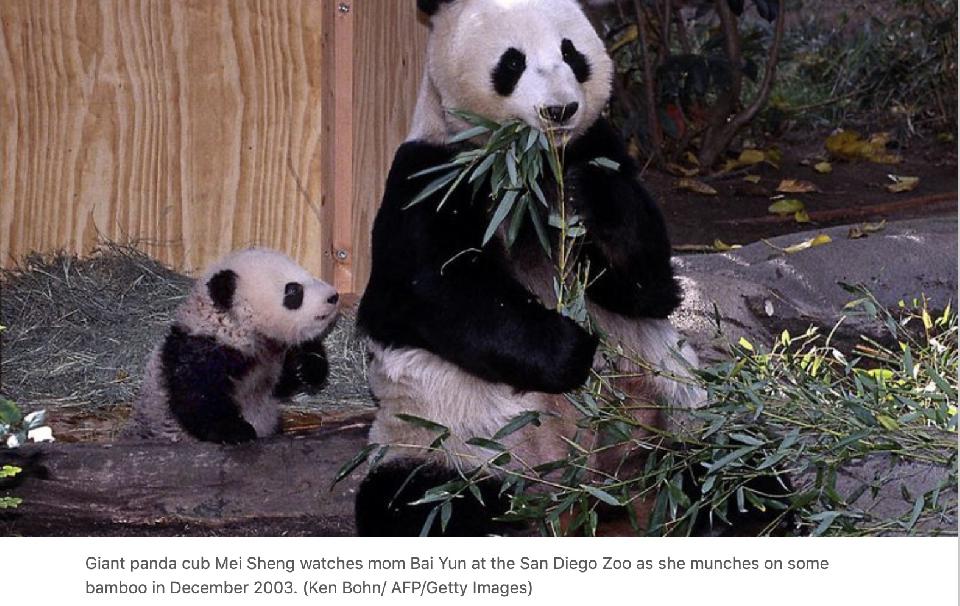


Giant panda cub Mei Sheng watches mom Bai Yun at the San Diego Zoo as she munches on some bamboo in December 2003. (Ken Bohn/ AFP/Getty Images)

It’s hard to imagine Southern California without giant pandas. Yet, sadly, the pandas that have become synonymous with the San Diego Zoo made their last public appearance on exhibit Monday and will leave for China sometime in the near future.

I’d say they were returning to their homeland — and it is for the panda Bai Yun, 27, who arrived in San Diego in 1996. But the other panda, her son, Xiao Liwu, 6, was born here in San Diego. Alas, there’s no birthright citizenship for pandas.

In fact, the contract under which the San Diego Zoo and the other three zoos in the U.S. that have pandas states that all the pandas here are on loan from China. Any offspring born here are sent to China around their third birthday. Xiao got to stay until he was 6. But they all go to China eventually. The 10-year contract with San Diego was extended to 23 years.

So they aren’t ours. Yet, they are.

We’ve been on panda baby watches, spent (or, some might say, wasted) hours watching the panda cam and become mesmerized by these bears that look like black and white stuffed toys come to life. The panda is the perfect antidote to life today — it’s not a lean, fast machine of any kind. It’s so deliciously Type … C. It just tumbles about, languid and unapologetically round, constantly eating. It deigns to mate but one or two days a year, saving its lust for solitary pursuits like more relaxing and eating.

In those past decades, two different adult males have come and gone. Bao Bao, meanwhile, has given birth to six cubs, the first by artificial insemination and the rest by her second mate, Gao Gao — who went back to China in October.

In the spring of 2000, I went to San Diego with my 2-and-a-half-year-old nephew and his mother, who was game for this adventure despite being eight months’ pregnant, to visit whichever little panda fur ball of hilarity was the cub of the moment. (A look through the archives indicates that it must have been Hua Mei.) We waited in line, talked in hushed voices (as the zoo staff instructed us all to do, lest we disturb the little one) and hoped the pandas wouldn’t wander off exhibit, as was their right, as we got to the front of the line. We were not disappointed. The baby gamboled with her mom and hung upside down from a low-hanging branch until she fell off and the crowd collectively let out a sotto voce “awww.” She scampered up and resumed playing.

We spent all these years in Southern California fostering them, and now China wants them?

I say: Don’t go! Resist! Do what frustrated tenants across California do when threatened with eviction: Lawyer up and fight to keep your home. (Do you really want to winter in China?) Don’t amble into the travel crate your keepers have, no doubt, spent months coaxing you to get accustomed to. Don’t walk in no matter how much bamboo they pack into it as a lure.

We forget how endangered pandas were two decades ago and how rare it was to have a cub born and survive. The San Diego Zoo’s giant panda conservation and research program did much to develop new techniques to decrease panda infant mortality. Negotiating a contract with China (the only supplier on Earth of the rare pandas) to get pandas is financially and politically challenging. Zoos reportedly hand over $1 million a year to China for conservation efforts for each year of a contract.

The San Diego Zoo says it has spent millions over the last 25 years furthering conservation efforts for pandas in China. Two decades ago, the wild population of pandas was estimated at under 1,000. In 2014, that number had gone up to more than 1,800. In 2016, the status of giant pandas was upgraded from endangered to vulnerable by the International Union for Conservation of Nature. The San Diego pandas will go to a conservation and research center in China.

Los Angeles tried for pandas once, to no avail. Then-Mayor Jim Hahn attempted a panda deal on a 2002 trade mission to China. Instead, the Chinese offered us golden monkeys. Then the deal for the monkeys fell through too. Once San Diego’s pandas depart, only three zoos in the U.S. will still have pandas: the National Zoo in Washington, D.C., Zoo Atlanta and the Memphis Zoo.

I checked the zoo’s panda cam one last time on Monday and there was a giant panda, gnawing on bamboo, lolling about, its rump covered in bits of grass. Again, I urge — just say no to China

Carla Hall is an editorial board member who writes about homelessness, reproductive rights, popular culture, animal welfare, and human rights in Asia and Africa, among other topics. Before joining the board, she was a general assignment reporter for the Los Angeles Times’ California section. She previously worked for the Washington Post’s Style section, where she juggled writing with acting roles in small theaters and even a couple of TV shows. She has a bachelor's degree in the history of science from Harvard University.

