here is a deep-state Neo-con / Neo-lib script
the so-called solutions (highlighted in blue) are thought provoking
https://www.zerohedge.com/news/2019-05-01/chinese-tortoise-american-hare
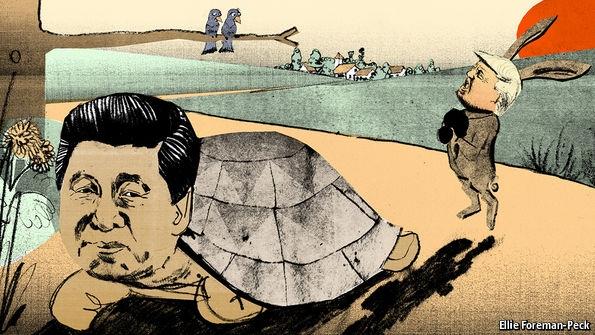
The Chinese Tortoise & The American Hare
Authored by David Goldman via PJMedia.com,
Here are my remarks at the New York conference of the Committee on the Present Danger in New York City. I spoke on a panel with Steve Bannon, Roger Robinson, Kyle Bass and Gordon Chang, chaired by Frank Gaffney of the Center for Security Policy.
Historian Andrew Roberts reports that Winston Churchill said just after Pearl Harbor that “in the event of war, the Japanese would ‘fold up like the Italians,’ because they were ‘the wops of the Far East.’” The West chronically underestimates Asians, as the Russians found out at Port Arthur, the Americans at Pearl Harbor and the Yalu River, the British at Singapore, and so forth.
A case in point is the present tariff war. The U.S. assumed that tariffs on Chinese imports would force China to make fundamental concessions to American trade demands. On January 6, President Donald Trump said, “China’s not doing very well now. It puts us in a very strong position. We are doing very well.” Since then China’s CSI 300 stock index has gained 37% during 2019 to date, double the gain in U.S. stock markets. China’s economic growth has accelerated while America’s has slowed. The tariff war may have hurt the U.S. economy more than China’s. With an internal market of 1.4 billion people, China can replace lost foreign business by increasing internal demand. Ten years ago exports made up 36% of China’s gross domestic product versus only 18% today. World trade is shrinking, but the impact on China is manageable.
I support President Trump. I applaud him for calling attention to China’s challenge to America’s strategic position. But I have warned from the outset that the tools he has employed won’t get the results he wants.
Early in 2018, the United States banned exports of U.S. components to the Chinese telecommunications equipment maker ZTE, which violated U.S. sanctions on Iran. Huawei, the dominant Chinese telecom equipment maker, undertook a crash program to devise substitutes for the U.S. chips that power Chinese-made handsets, and achieved self-sufficiency as of December 2018. Now a Japanese study reports that Huawei’s handset chips are equal to or better than Apple’s.
America’s campaign to persuade its allies to keep Huawei away from the rollout of 5G (fifth generation) mobile data networks has failed. Britain, Germany, Italy, Malaysia, Thailand, India, South Korea and the whole of Eastern Europe have rejected American demands. This was a sadly foreseeable diplomatic disaster. Huawei is the highest-quality as well as the lowest-cost provider of 5G systems. It spends US$20 billion a year on research and development, double the combined outlay of its two largest competitors, Nokia and Ericsson. Half of Huawei’s workforce is engaged in R&D, including thousands of European engineers.
Cisco used to dominate the market for mobile data systems. It currently has $72 billion of cash in the bank, roughly what Huawei spent on R&D during the past seven years. The question is: Why do Chinese companies invest while American companies hoard?
To paraphrase Leon Trotsky, you may not be interested in industrial policy, but industrial policy is interested in you. The Asian model treats capital-intensive industry as infrastructure. It supports chip foundries with public funds the way we Americans subsidize airports or sports arenas. The Asian model begins with Japan’s Meiji Restoration in 1868. China’s model is a variant of the Asian model, which Deng Xiaoping adopted with the advice of Lee Kuan Yew, in explicit emulation of Singapore.
China, Japan, South Korea, and Taiwan subsidize capital-intensive industry, with the result that virtually all of the high-tech products invented in America are now manufactured in Asia. Liquid-crystal displays, light-emitting diodes, semiconductor lasers, and solid-state sensors are produced almost exclusively in Asia. America’s share of semiconductor manufacturing fell from 25% in 2011, to less than 10% in 2018. Silicon is to the weapons of the 21st century what steel was to the 19th century. A country that cannot produce its own integrated circuits cannot defend itself.
China is outspending the U.S. in quantum computing, including $11 billion to build a single research facility in Hefei. By contrast, the U.S. allocated $1.2 billion for quantum computing over the next five years. Overall, federal development funding in the U.S. has fallen from 0.78% of GDP in 1988 to 0.39% in 2016.
China remains behind the U.S. in most key areas of technology, but it is catching up fast. In the last several years China has
Landed a probe on the dark side of the moon;
Developed successful quantum communication via satellite;
Built a 2,000-kilometer quantum communication network between Beijing and Shanghai;
Built missiles that can blind American satellites;
Developed surface-to-ship missiles that can destroy any vessel within hundreds of miles of its coast; and
Built some of the world’s fastest supercomputers.
China’s investment in education parallels its investment in the high-tech industry. Today China graduates four times as many STEM (science, technology, engineering and mathematics) bachelor’s degrees as the U.S. and twice as many doctoral degrees, and China continues to gain. A third of Chinese students major in engineering, vs 7% in the U.S. Eighty percent of U.S. doctoral candidates in computer science and electrical engineering are foreign students, of whom Chinese are the largest contingent. Most return to China. The best U.S. universities have trained top-level faculty for Chinese universities. American STEM graduate programs reported a sharp fall in foreign applications starting in 2017, partly because Chinese students no longer have to come to the U.S. for a world-class education.
China’s household consumption has risen 17-fold since 1986 and its GDP in U.S. dollars has risen 35-fold. China has moved 550 million people from countryside to city in only 40 years, the equivalent of Europe’s population from the Urals to the Atlantic. China has built the equivalent of all the cities in Europe to house the new urban dwellers, as well as 80,000 miles (nearly 130,000 kilometers) of superhighway and 18,000 miles (29,000km) of high-speed trains.
China’s debt-to-GDP ratio stands at 253% (47% government, households 50%, corporate 155%). That is about the same as America’s 248% (98% to government, households 77%, corporate 74%). The high corporate debt number is due to the fact that state-owned enterprises fund a great deal of infrastructure, building with debt that is counted as corporate rather than government. China’s debt problem is no worse than ours.
China’s Belt and Road Initiative intends to Sinify the economies of the Global South, from Malaysia and Indonesia to Mexico and Brazil. Huawei often is the spearhead of the BRI, building mobile broadband networks that prepare the ground for Chinese e-commerce and e-finance companies. China wants to integrate the labor of countries with a total population of 2 billion into its economic sphere.
It is fanciful to believe that any kind of American pressure can destabilize, let alone dislodge, the present regime within any calculable time horizon. But we can regain technological leadership and prove the superiority of our way of life, and degrade the credibility of the Chinese Communist Party over time.
Solutions include:
Forcing key high-tech industries onshore using defense subsidies/tax breaks
Placing export controls on high tech (no more Boeing satellites to help China surveil its citizens)
Change Defense Department budget priorities to emphasize war-winning advance technologies rather than legacy systems
A new National Defense Education Act
Create an alternative to the Belt and Road Initiative with Japan, South Korea, India and others
Engineer a brain drain of China’s most talented scientific cadre.
China can innovate, but we can innovate much better. We need to return with a vengeance to the strategies that won the Cold War.
 |



